
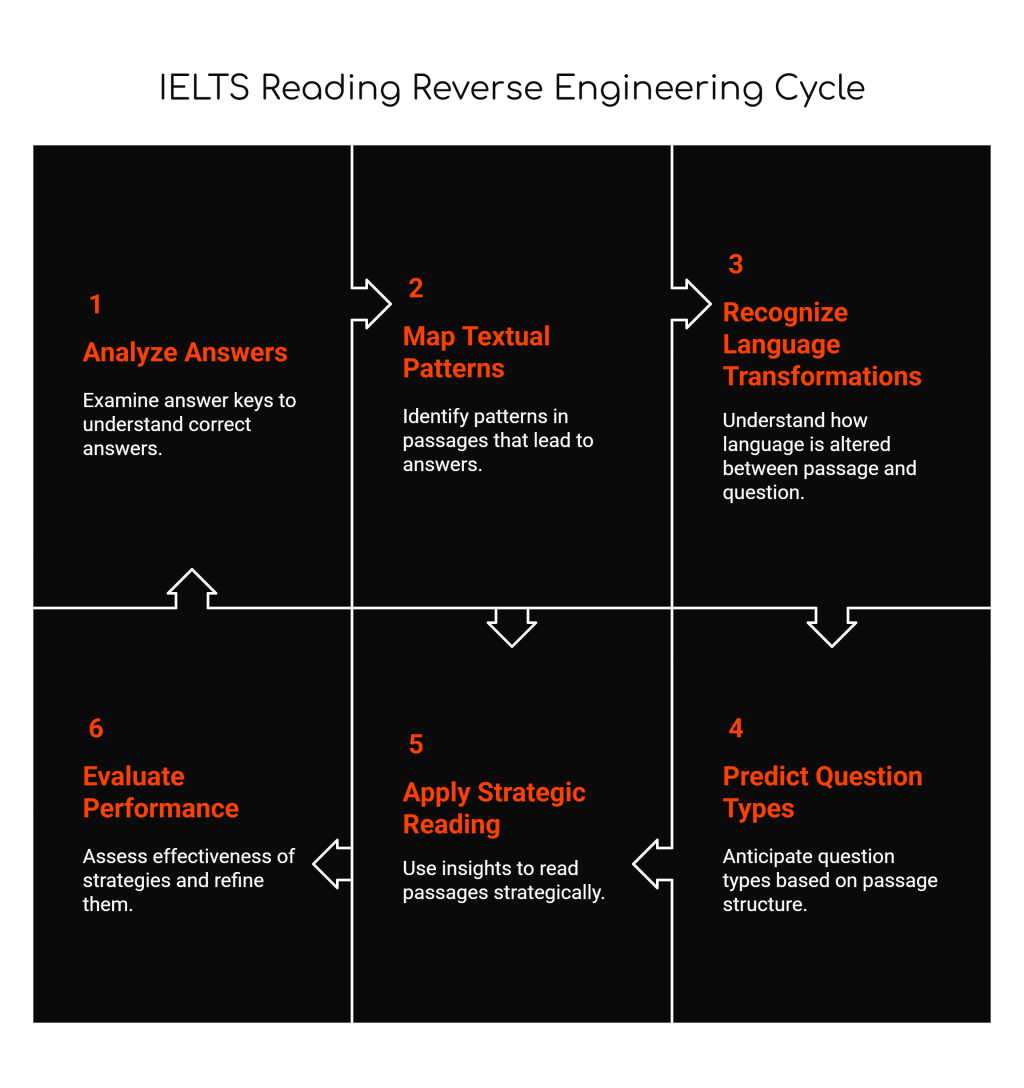
IELTS Reading isn’t just about comprehension—it’s about understanding how test designers embed answers within complex passages and transform them into questions. The most successful candidates don’t just read better; they think like IELTS examiners. Through systematic reverse engineering using answer keys and passages, you can crack the code of how correct answers are constructed and why distractors are designed to mislead.
Why Passage Analysis Transforms Your Performance
Traditional reading practice often reinforces inefficient habits. You might spend equal time on every paragraph, miss crucial signal words, or fall for carefully crafted distractors. Reverse engineering breaks these patterns by revealing the hidden architecture of IELTS passages and the systematic logic behind every correct answer.
When you analyze completed tests backwards—starting with answers and tracing them to their sources—you discover the specific textual patterns, linguistic transformations, and structural principles that IELTS uses consistently across all test versions.
The Complete Reading Reverse Engineering Method
Phase 1: The Answer Archaeology Excavation
Begin your investigation with surgical precision:
Exact Location Mapping:
- Identify the specific sentence containing each correct answer
- Note the paragraph number and sentence position within that paragraph
- Mark whether the answer appears in the topic sentence, supporting details, or conclusion
- Record any qualifying words that affect the answer’s meaning
Contextual Boundary Analysis:
- Examine the 2-3 sentences before and after each answer
- Identify setup language that introduces the key information
- Note any contrasting information that could create distractors
- Mark transitional phrases that signal important shifts in meaning
Phase 2: The Language Transformation Detective Work
IELTS never uses identical language between passages and questions. Map these transformations systematically:
Synonym Substitution Patterns:
- Passage: “detrimental effects” → Question: “harmful consequences”
- Passage: “accelerated rapidly” → Question: “increased quickly”
- Passage: “substantial evidence” → Question: “significant proof”
Grammatical Restructuring:
- Passage: “Scientists conducted the research” → Question: “The research was conducted by scientists”
- Passage: “The policy resulted in changes” → Question: “Changes occurred due to the policy”
Numerical and Statistical Transformations:
- Passage: “one quarter of participants” → Question: “25% of subjects”
- Passage: “doubled over five years” → Question: “100% increase during a five-year period”
Phase 3: The Question-Type Architecture Analysis
Different question types follow predictable structural patterns:
Multiple Choice Logic Chains:
- Correct answers often appear in sequential order through the passage
- Distractors typically come from the same paragraph as correct answers
- Extreme language in options (“always,” “never,” “all”) usually indicates incorrect choices
True/False/Not Given Construction Rules:
- TRUE: Information is explicitly stated and matches exactly
- FALSE: Information contradicts what’s stated in the passage
- NOT GIVEN: Information isn’t mentioned or cannot be inferred from the passage
Gap-Fill Systematic Patterns:
- Answers maintain the grammatical structure of the original passage
- Word limits are strictly enforced and usually require exact extraction
- Context clues immediately surrounding gaps provide answer hints
Passage-Type Specific Reverse Engineering
Academic Passage Deconstruction
Scientific Research Article Patterns:
IELTS academic passages follow predictable structural templates that create systematic answer opportunities:
Introduction Paragraphs:
- Background context that sets up comparison questions
- Problem statements that generate True/False questions about issues
- Thesis statements that create main idea and purpose questions
Methodology Sections:
- Procedural details that become gap-fill answers
- Participant information that generates numerical questions
- Timeline information that creates sequencing tasks
Results and Discussion:
- Statistical findings that transform into multiple choice options
- Comparative data that generates matching exercises
- Conclusions that create inference-based questions
The Scientific Language Pattern: Academic passages use specific language structures that consistently indicate answer locations:
- “Research indicates…” (high probability answer introduction)
- “Studies have shown…” (factual information likely to be tested)
- “Evidence suggests…” (tentative conclusions often questioned)
- “Data reveals…” (statistical information frequently tested)
Historical and Cultural Passage Analysis
Chronological Structure Exploitation: Historical passages organize information temporally, creating natural answer sequences:
Timeline Markers:
- “Initially,” “Subsequently,” “Eventually” (sequence indicators)
- “During the early period,” “By the mid-century” (time-specific information)
- “Prior to,” “Following,” “Simultaneously” (relationship indicators)
Cause and Effect Chains: Historical passages link events causally, providing logical answer progressions:
- “Due to,” “As a result,” “Consequently” (effect indicators)
- “Led to,” “Resulted in,” “Caused” (causation signals)
- “Because of,” “Owing to,” “Thanks to” (reason indicators)
Business and Social Issue Passage Patterns
Problem-Solution Architecture: Many IELTS passages follow problem-analysis-solution structures:
Problem Identification Sections:
- Statistical evidence of issues (numerical answers)
- Expert opinions about challenges (quote-based questions)
- Comparative data showing deterioration (before/after questions)
Analysis and Explanation Sections:
- Multiple causes or factors (list-completion tasks)
- Expert interpretations (opinion-matching exercises)
- Research findings (True/False/Not Given questions)
Solution and Recommendation Sections:
- Proposed interventions (gap-fill completion)
- Success case studies (example identification)
- Future predictions (inference questions)
Advanced Answer Pattern Recognition
The Paragraph Function Decoder
Through reverse engineering, you’ll discover that paragraphs serve specific functions that predict answer types:
Topic Sentence Patterns:
- Main idea questions typically source from paragraph opening sentences
- Author attitude questions often draw from topic sentence evaluative language
- Comparison questions frequently use topic sentences that introduce contrasts
Supporting Detail Patterns:
- Factual gap-fill answers usually come from supporting sentences
- Example-based questions draw from illustrative details
- Statistical questions source from numerical supporting evidence
Concluding Sentence Patterns:
- Inference questions often build from paragraph conclusions
- Summary completion tasks frequently use concluding sentence language
- Author’s final points generate opinion-based questions
The Signal Word Intelligence System
Certain words and phrases consistently precede testable information:
High-Probability Answer Signals:
- “Significantly,” “Notably,” “Remarkably” (emphasis indicators)
- “However,” “Nevertheless,” “On the contrary” (contrast signals)
- “Furthermore,” “Moreover,” “Additionally” (continuation markers)
- “For example,” “For instance,” “Such as” (illustration signals)
Distractor Warning Signals:
- “Some believe,” “It is often thought” (opinion, not fact)
- “Potentially,” “Possibly,” “Perhaps” (uncertainty indicators)
- “Generally,” “Usually,” “Typically” (qualified statements)
The Author’s Voice Analysis
Understanding how authors present information reveals answer construction logic:
Objective Presentation Patterns:
- Factual statements using present tense: “Research shows…”
- Statistical presentations: “Data indicates…”
- Definition structures: “X is defined as…”
Subjective Evaluation Patterns:
- Opinion markers: “Surprisingly,” “Unfortunately,” “Remarkably”
- Evaluative language: “Successful,” “Problematic,” “Effective”
- Comparative judgments: “More significant,” “Less effective”
Question-Type Mastery Through Reverse Engineering
Multiple Choice Strategic Deconstruction
Option Elimination Patterns: Through systematic analysis, you’ll identify consistent distractor types:
The Partial Truth Distractor:
- Contains information from the passage but doesn’t fully answer the question
- Often uses correct details in wrong contexts
- Example: Passage mentions “25% improvement in urban areas” but question asks about rural improvement
The Extreme Language Distractor:
- Uses absolute terms when passage language is more nuanced
- Example: Passage says “often effective” but option says “always successful”
The Topic Confusion Distractor:
- References correct topic but provides wrong specific information
- Example: Passage discusses temperature effects, distractor mentions correct study but wrong temperature range
True/False/Not Given Mastery System
TRUE Answer Construction:
- Information must be explicitly stated in passage
- Paraphrasing is allowed but meaning must remain identical
- Qualifying language in passage must match question implications
FALSE Answer Engineering:
- Direct contradiction of passage information
- Opposite relationships (cause becomes effect, positive becomes negative)
- Contradictory statistics or facts
NOT GIVEN Recognition Patterns:
- Information goes beyond what passage actually states
- Reasonable inferences that aren’t explicitly confirmed
- Details that seem logical but aren’t mentioned
Gap-Fill Systematic Approach
Word Limit Strategy:
- “NO MORE THAN TWO WORDS”: Extract exactly as written, don’t paraphrase
- “ONE WORD ONLY”: Usually single nouns, adjectives, or verbs
- “NO MORE THAN THREE WORDS AND/OR A NUMBER”: Allows numerical expressions
Grammatical Compatibility Analysis:
- Verb forms must match sentence tense and voice
- Articles (a/an/the) count toward word limits
- Plural/singular forms must agree with sentence context
Timing and Strategic Reading Through Reverse Engineering
The Answer Distribution Heat Map
Map where answers typically cluster in different passage types:
Academic Research Articles:
- Introduction: 1-2 answers (usually main idea or background)
- Methodology: 2-3 answers (procedures, participants, timeline)
- Results: 3-4 answers (findings, statistics, comparisons)
- Discussion: 2-3 answers (implications, conclusions)
Historical Narratives:
- Early paragraphs: Context and background answers
- Middle sections: Event sequences and cause-effect relationships
- Final paragraphs: Consequences and significance
The Strategic Reading Sequence
Based on answer distribution patterns:
Phase 1: Question Analysis (2 minutes)
- Read all questions to understand what information to seek
- Identify question types to predict answer locations
- Note any specific details (names, numbers, dates) to watch for
Phase 2: Strategic Skimming (3-4 minutes)
- Focus on paragraph topic sentences for main ideas
- Scan for signal words and transitional phrases
- Identify passage structure (problem-solution, chronological, comparative)
Phase 3: Targeted Reading (12-15 minutes)
- Read sections likely to contain answers more carefully
- Use question predictions to guide attention
- Apply reverse-engineering insights about answer construction
Building Your Reading Intelligence Database
Error Pattern Documentation
Track systematic mistakes to identify improvement areas:
Comprehension Errors:
- Vocabulary gaps that prevent understanding key concepts
- Complex sentence structures that confuse meaning
- Cultural or subject-specific knowledge that affects interpretation
Question-Type Errors:
- Consistent mistakes with specific question formats
- Time management issues with particular question types
- Strategic errors in approach or elimination techniques
Language Transformation Errors:
- Failure to recognize synonym substitutions
- Missing paraphrases or grammatical restructuring
- Inability to connect question language with passage content
Success Pattern Recognition
Document strategies that consistently improve performance:
High-Impact Techniques:
- Signal words that reliably predict answers
- Question types where reverse engineering provides biggest advantage
- Passage structures that you can now navigate efficiently
Moderate-Impact Insights:
- Helpful patterns that support but don’t guarantee success
- Context clues that aid comprehension but require confirmation
Passage-Specific Strategies:
- Approaches that work well for certain topics or formats
- Reading sequences that optimize your performance on different passage types
Advanced Integration Techniques
The Prediction Method Development
As reverse engineering skills mature, develop predictive abilities:
Question-Based Prediction:
- Use question language to predict what passage information will look like
- Anticipate likely synonym transformations before reading
- Forecast probable answer locations based on question sequence
Structure-Based Anticipation:
- Recognize passage organization patterns to predict information flow
- Use paragraph functions to anticipate question types
- Apply knowledge of author presentation styles to guide reading focus
The Cross-Reference Validation System
Develop skills to confirm answers through multiple passage elements:
Internal Consistency Checking:
- Ensure answers align with passage’s overall argument
- Verify that selected information doesn’t contradict other passage elements
- Confirm that answer choice fits logically with surrounding context
Language Pattern Verification:
- Check that transformations maintain original meaning
- Ensure grammatical compatibility in gap-fill questions
- Verify that inference questions don’t exceed passage scope
From Analysis to Application
Pre-Test Preparation Protocol
Reverse Engineering Review:
- Refresh understanding of signal word patterns
- Review common distractor types for your challenging question formats
- Remind yourself of timing strategies based on passage structure analysis
Mental Framework Activation:
- Prepare to identify passage organization quickly
- Ready yourself to spot language transformation patterns
- Set intention to apply prediction techniques throughout the test
During-Test Strategic Application
Active Pattern Recognition:
- Consciously identify signal words as you encounter them
- Apply structure recognition to predict answer locations
- Use distractor knowledge to eliminate wrong options efficiently
Adaptive Strategy Implementation:
- Adjust reading speed based on predicted answer density
- Apply question-type specific strategies automatically
- Monitor time allocation based on reverse-engineering insights
Post-Test Analysis Refinement
Performance Evaluation:
- Assess which reverse-engineering insights proved most valuable
- Identify any new patterns discovered during the test
- Note areas where analysis knowledge successfully prevented errors
Strategy Evolution:
- Refine techniques based on test performance
- Update pattern recognition database with new discoveries
- Adjust timing strategies based on actual implementation results
Common Reverse Engineering Pitfalls
Over-Analysis Paralysis
While patterns are valuable, don’t spend excessive time analyzing every detail. Focus on high-impact patterns that consistently improve performance, and develop the ability to apply insights quickly and intuitively.
Pattern Rigidity
IELTS deliberately varies its approaches to prevent complete predictability. Use reverse-engineering insights as strong guidelines while maintaining flexibility to adapt when patterns don’t perfectly match your expectations.
Answer Key Dependency
The ultimate goal is internalized pattern recognition that works during timed conditions. If you become too dependent on detailed post-test analysis, you might struggle to apply insights under pressure.
The Mastery Progression Path
Weeks 1-2: Foundation Building
- Master basic answer location mapping
- Identify common signal words and transitional phrases
- Begin recognizing basic language transformation patterns
Weeks 3-4: Advanced Pattern Recognition
- Develop question-type specific strategies
- Build understanding of passage structure patterns
- Create systematic approach to distractor elimination
Weeks 5-6: Prediction and Integration
- Apply prediction techniques to anticipate answers
- Integrate timing strategies with pattern recognition
- Develop rapid passage structure identification skills
Weeks 7-8: Mastery and Refinement
- Perfect real-time application of reverse-engineering insights
- Optimize personal strategies based on individual strengths
- Achieve consistent performance across all passage types and question formats
The Strategic Mindset Transformation
Reverse engineering transforms you from a passive reader hoping to stumble upon correct answers to an analytical strategist who understands the systematic logic underlying every IELTS Reading question. You begin to think like a test designer, predicting how passages will be structured and how questions will relate to textual information.
This analytical approach typically produces significant score improvements because you’re developing sophisticated reading strategies based on deep understanding of the test’s construction principles. You move from simply trying to comprehend passages to strategically navigating them with purpose and precision.
When you can consistently reverse engineer why specific passage segments become answers and others become distractors, you’ve developed the strategic reading skills that distinguish high-scoring candidates from average performers. Reading becomes less about hoping you’ll find the right information and more about knowing exactly where and how that information will be presented.
The test transforms from an unpredictable challenge into a systematic puzzle with discoverable patterns. Each passage becomes an opportunity to apply your sophisticated understanding of how IELTS constructs questions and embeds answers within complex academic and general texts.
Remember: every IELTS Reading passage is carefully crafted with specific organizational principles, linguistic patterns, and answer construction logic. When you reverse engineer these elements through systematic analysis, you’re not just preparing for a test—you’re developing advanced analytical reading skills that will enhance your academic and professional capabilities far beyond the IELTS examination room.
#IELTSGuidePhil #IELTSReading #IELTSPreparation #IELTSStrategy #ReverseEngineering #IELTSTips #ReadingComprehension #IELTSStudyTips #TestPreparation #IELTSMastery #EnglishProficiency #IELTSSuccess #StudyStrategy #IELTSHacks #ReadingSkills #IELTSExam
 IELTS Guide Phil
Leave a comment