
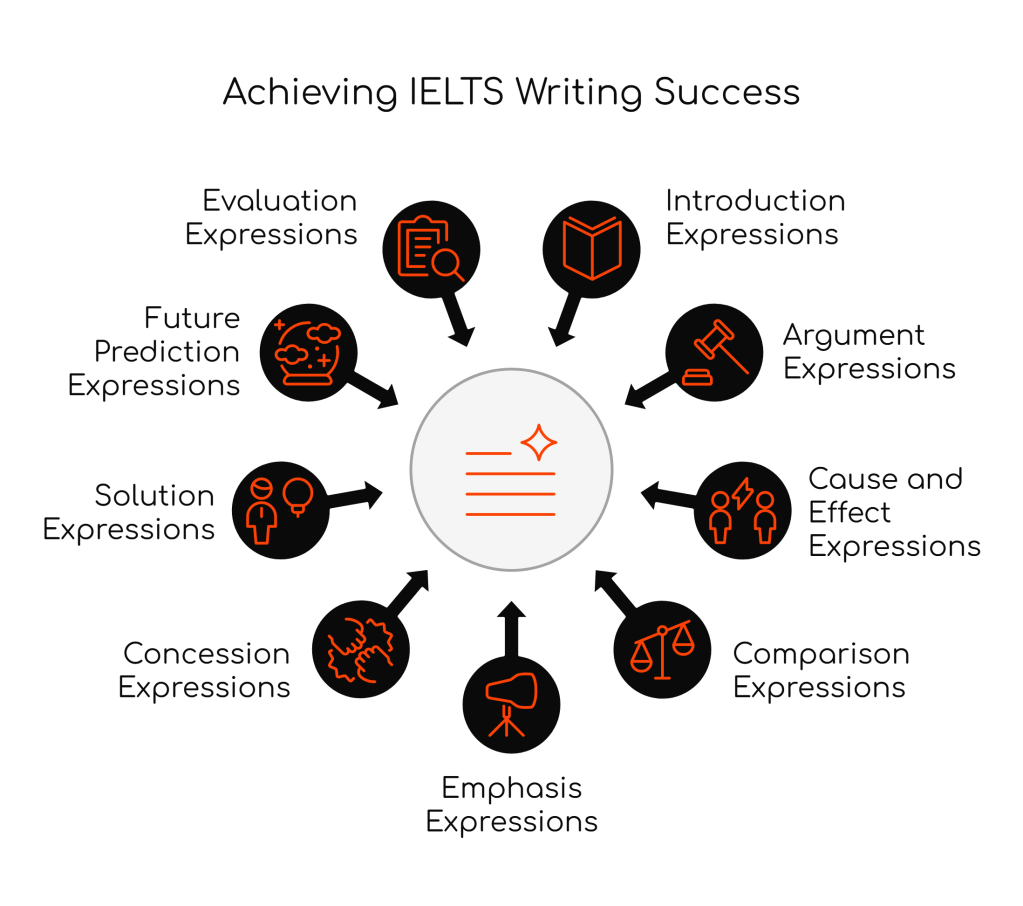
Mastering sophisticated academic expressions is crucial for achieving high band scores in IELTS Writing Task 2. These 100 carefully selected phrases will help you structure arguments, express ideas clearly, and demonstrate advanced language proficiency in your essays.
Part 1: Introduction and Thesis Statement Expressions
1. “In recent years, there has been a growing concern about…”
Meaning: To introduce a contemporary issue
Example: “In recent years, there has been a growing concern about the environmental impact of fast fashion.”
2. “This essay will examine…”
Meaning: To state what your essay will discuss
Example: “This essay will examine the advantages and disadvantages of remote working.”
3. “The purpose of this essay is to…”
Meaning: To clearly state your essay’s objective
Example: “The purpose of this essay is to analyze the causes of urban air pollution.”
4. “It is widely acknowledged that…”
Meaning: To present a commonly accepted fact
Example: “It is widely acknowledged that education plays a crucial role in social mobility.”
5. “There is considerable debate surrounding…”
Meaning: To introduce a controversial topic
Example: “There is considerable debate surrounding the effectiveness of standardized testing.”
6. “This issue has sparked intense discussion…”
Meaning: To show that a topic is hotly debated
Example: “This issue has sparked intense discussion among educators and policymakers.”
7. “From my perspective…”
Meaning: To introduce your viewpoint
Example: “From my perspective, renewable energy is essential for sustainable development.”
8. “This essay argues that…”
Meaning: To present your main argument
Example: “This essay argues that technology has fundamentally transformed modern education.”
9. “The central premise of this argument is…”
Meaning: To state your main point
Example: “The central premise of this argument is that economic growth must be balanced with environmental protection.”
10. “It is my contention that…”
Meaning: To formally state your position
Example: “It is my contention that globalization has created both opportunities and challenges.”
Part 2: Presenting Arguments and Evidence
11. “A compelling argument for this position is…”
Meaning: To introduce strong supporting evidence
Example: “A compelling argument for renewable energy is its potential to reduce carbon emissions.”
12. “Research indicates that…”
Meaning: To cite research findings
Example: “Research indicates that bilingual education enhances cognitive development.”
13. “Statistical evidence suggests…”
Meaning: To present numerical data
Example: “Statistical evidence suggests that crime rates decrease with improved education.”
14. “Empirical data demonstrates…”
Meaning: To reference factual evidence
Example: “Empirical data demonstrates the correlation between exercise and mental health.”
15. “Studies have consistently shown…”
Meaning: To reference repeated research findings
Example: “Studies have consistently shown that early childhood education improves academic outcomes.”
16. “There is substantial evidence to support…”
Meaning: To indicate strong proof
Example: “There is substantial evidence to support the benefits of Mediterranean diets.”
17. “The evidence overwhelmingly suggests…”
Meaning: To present very strong proof
Example: “The evidence overwhelmingly suggests that climate change is human-caused.”
18. “This is substantiated by…”
Meaning: To support a claim with evidence
Example: “This is substantiated by numerous peer-reviewed studies on the topic.”
19. “A case in point is…”
Meaning: To provide a specific example
Example: “A case in point is Singapore’s successful urban planning model.”
20. “To illustrate this point…”
Meaning: To provide an example
Example: “To illustrate this point, consider the impact of social media on political discourse.”
Part 3: Cause and Effect Relationships
21. “This phenomenon can be attributed to…”
Meaning: To explain the cause of something
Example: “This phenomenon can be attributed to rapid technological advancement.”
22. “The underlying cause of this issue is…”
Meaning: To identify the root cause
Example: “The underlying cause of this issue is inadequate infrastructure investment.”
23. “This stems from…”
Meaning: To show origin or cause
Example: “This stems from fundamental changes in consumer behavior.”
24. “The ramifications of this are…”
Meaning: To discuss consequences
Example: “The ramifications of this are far-reaching and affect multiple sectors.”
25. “This gives rise to…”
Meaning: To show what something causes
Example: “This gives rise to significant social and economic challenges.”
26. “The knock-on effect is…”
Meaning: To describe indirect consequences
Example: “The knock-on effect is increased pressure on public services.”
27. “This invariably leads to…”
Meaning: To show inevitable consequences
Example: “This invariably leads to greater social inequality.”
28. “The net result is…”
Meaning: To describe the final outcome
Example: “The net result is improved quality of life for citizens.”
29. “This precipitates…”
Meaning: To cause something to happen suddenly
Example: “This precipitates a decline in traditional manufacturing jobs.”
30. “The repercussions include…”
Meaning: To list consequences
Example: “The repercussions include environmental degradation and health problems.”
Part 4: Comparison and Contrast
31. “In stark contrast to…”
Meaning: To show strong difference
Example: “In stark contrast to previous generations, today’s students have access to vast digital resources.”
32. “Conversely…”
Meaning: To present an opposite view
Example: “Urban areas offer career opportunities. Conversely, rural regions provide tranquility.”
33. “By comparison…”
Meaning: To compare two things
Example: “By comparison, European cities have more efficient public transportation systems.”
34. “In juxtaposition to…”
Meaning: To place things side by side for comparison
Example: “In juxtaposition to traditional education, online learning offers greater flexibility.”
35. “On the contrary…”
Meaning: To present an opposing point
Example: “On the contrary, some argue that technology isolates rather than connects people.”
36. “Whereas…”
Meaning: To show difference between two things
Example: “Whereas developed nations have advanced healthcare, developing countries lack basic facilities.”
37. “In contradistinction to…”
Meaning: To show clear difference
Example: “In contradistinction to public schools, private institutions often have smaller class sizes.”
38. “Similarly…”
Meaning: To show likeness
Example: “Similarly, both approaches require substantial financial investment.”
39. “Likewise…”
Meaning: To indicate similarity
Example: “Likewise, both policies aim to reduce income inequality.”
40. “Analogously…”
Meaning: To draw a parallel
Example: “Analogously, economic systems require balance between growth and stability.”
Part 5: Adding Information and Emphasis
41. “Furthermore…”
Meaning: To add additional information
Example: “Furthermore, technological advancement has revolutionized communication methods.”
42. “Moreover…”
Meaning: To add more important information
Example: “Moreover, this approach has proven successful in multiple countries.”
43. “Additionally…”
Meaning: To include extra points
Example: “Additionally, environmental benefits make this policy particularly attractive.”
44. “What is more…”
Meaning: To add emphasis to additional information
Example: “What is more, the long-term benefits far outweigh initial costs.”
45. “Not only… but also…”
Meaning: To emphasize two related points
Example: “Not only does exercise improve physical health, but it also enhances mental well-being.”
46. “It is particularly noteworthy that…”
Meaning: To highlight important information
Example: “It is particularly noteworthy that younger generations are more environmentally conscious.”
47. “Of particular significance is…”
Meaning: To emphasize importance
Example: “Of particular significance is the role of education in social development.”
48. “It should be emphasized that…”
Meaning: To stress an important point
Example: “It should be emphasized that sustainable development requires global cooperation.”
49. “Equally important is…”
Meaning: To show something is just as significant
Example: “Equally important is the need for cultural sensitivity in international business.”
50. “Above all…”
Meaning: To indicate the most important point
Example: “Above all, public safety must remain the primary concern.”
Part 6: Concession and Counter-Arguments
51. “While it is true that…”
Meaning: To acknowledge a point before presenting counter-argument
Example: “While it is true that technology has benefits, it also creates new challenges.”
52. “Although this may be the case…”
Meaning: To concede a point while maintaining your position
Example: “Although this may be the case, alternative solutions deserve consideration.”
53. “Despite the validity of this argument…”
Meaning: To acknowledge opposing views
Example: “Despite the validity of this argument, environmental concerns cannot be ignored.”
54. “Notwithstanding these concerns…”
Meaning: To acknowledge problems while proceeding
Example: “Notwithstanding these concerns, the benefits of globalization are substantial.”
55. “Admittedly…”
Meaning: To acknowledge a point
Example: “Admittedly, implementing these changes will require significant resources.”
56. “It must be acknowledged that…”
Meaning: To recognize an important point
Example: “It must be acknowledged that cultural differences can create communication barriers.”
57. “Critics argue that…”
Meaning: To present opposing viewpoints
Example: “Critics argue that standardized testing fails to measure true intelligence.”
58. “Skeptics contend that…”
Meaning: To present doubts about your argument
Example: “Skeptics contend that renewable energy cannot meet current demand.”
59. “However, this perspective fails to consider…”
Meaning: To counter opposing arguments
Example: “However, this perspective fails to consider long-term environmental benefits.”
60. “Nevertheless…”
Meaning: To present contrasting information
Example: “Nevertheless, the advantages of urban living continue to attract millions.”
Part 7: Solutions and Recommendations
61. “A viable solution to this problem is…”
Meaning: To propose a practical answer
Example: “A viable solution to this problem is implementing comprehensive recycling programs.”
62. “This issue could be addressed by…”
Meaning: To suggest how to solve a problem
Example: “This issue could be addressed by investing in renewable energy infrastructure.”
63. “It is recommended that…”
Meaning: To make a formal suggestion
Example: “It is recommended that governments prioritize education funding.”
64. “The most effective approach would be…”
Meaning: To suggest the best solution
Example: “The most effective approach would be to combine traditional and modern teaching methods.”
65. “Policy makers should consider…”
Meaning: To make suggestions to authorities
Example: “Policy makers should consider the long-term implications of urban expansion.”
66. “Urgent action is required to…”
Meaning: To emphasize need for immediate solutions
Example: “Urgent action is required to address climate change.”
67. “A multifaceted approach involving…”
Meaning: To suggest complex solutions
Example: “A multifaceted approach involving government, business, and citizens is necessary.”
68. “The implementation of…”
Meaning: To suggest putting something into practice
Example: “The implementation of stricter regulations would improve air quality.”
69. “Practical measures could include…”
Meaning: To suggest specific actions
Example: “Practical measures could include carbon taxes and renewable energy subsidies.”
70. “A comprehensive strategy encompassing…”
Meaning: To suggest a complete approach
Example: “A comprehensive strategy encompassing education and legislation is needed.”
Part 8: Future Predictions and Trends
71. “Current trends suggest that…”
Meaning: To predict based on present patterns
Example: “Current trends suggest that remote work will become increasingly common.”
72. “It is anticipated that…”
Meaning: To make predictions
Example: “It is anticipated that artificial intelligence will transform healthcare.”
73. “Projections indicate that…”
Meaning: To reference future forecasts
Example: “Projections indicate that global temperatures will continue rising.”
74. “In the foreseeable future…”
Meaning: To discuss near-term predictions
Example: “In the foreseeable future, electric vehicles will dominate transportation.”
75. “The trajectory suggests…”
Meaning: To predict based on current direction
Example: “The trajectory suggests continued growth in renewable energy adoption.”
76. “Emerging patterns indicate…”
Meaning: To predict based on new developments
Example: “Emerging patterns indicate a shift toward sustainable consumption.”
77. “It is likely that…”
Meaning: To express probability
Example: “It is likely that automation will reshape the job market.”
78. “The outlook for…”
Meaning: To discuss future prospects
Example: “The outlook for renewable energy is increasingly positive.”
79. “Future developments may include…”
Meaning: To speculate about coming changes
Example: “Future developments may include personalized medical treatments.”
80. “Long-term implications suggest…”
Meaning: To discuss extended consequences
Example: “Long-term implications suggest fundamental changes in work patterns.”
Part 9: Evaluation and Assessment
81. “Upon closer examination…”
Meaning: To analyze more thoroughly
Example: “Upon closer examination, the benefits of this policy become apparent.”
82. “A critical analysis reveals…”
Meaning: To show results of detailed study
Example: “A critical analysis reveals significant flaws in current education systems.”
83. “When evaluated objectively…”
Meaning: To assess without bias
Example: “When evaluated objectively, both approaches have merit.”
84. “The evidence suggests that…”
Meaning: To draw conclusions from data
Example: “The evidence suggests that early intervention is most effective.”
85. “A balanced assessment indicates…”
Meaning: To provide fair evaluation
Example: “A balanced assessment indicates both benefits and drawbacks.”
86. “From an analytical perspective…”
Meaning: To provide systematic evaluation
Example: “From an analytical perspective, the policy shows mixed results.”
87. “Objective evaluation demonstrates…”
Meaning: To show unbiased assessment
Example: “Objective evaluation demonstrates the effectiveness of this approach.”
88. “The merits of this approach include…”
Meaning: To discuss advantages
Example: “The merits of this approach include cost-effectiveness and sustainability.”
89. “A comprehensive evaluation reveals…”
Meaning: To show thorough assessment results
Example: “A comprehensive evaluation reveals the complexity of this issue.”
90. “Assessment criteria should include…”
Meaning: To suggest evaluation standards
Example: “Assessment criteria should include environmental impact and social benefits.”
Part 10: Conclusion and Summary
91. “In conclusion…”
Meaning: To begin your final thoughts
Example: “In conclusion, sustainable development requires global cooperation.”
92. “To summarize…”
Meaning: To provide a brief overview
Example: “To summarize, technology has both positive and negative impacts on society.”
93. “In light of the evidence presented…”
Meaning: To conclude based on your arguments
Example: “In light of the evidence presented, investment in education is crucial.”
94. “The analysis demonstrates that…”
Meaning: To state what your essay has shown
Example: “The analysis demonstrates that renewable energy is economically viable.”
95. “Taking all factors into consideration…”
Meaning: To show you’ve considered everything
Example: “Taking all factors into consideration, remote work offers significant benefits.”
96. “On balance…”
Meaning: To provide overall assessment
Example: “On balance, the advantages of globalization outweigh the disadvantages.”
97. “The weight of evidence suggests…”
Meaning: To conclude based on strong proof
Example: “The weight of evidence suggests that climate action is urgently needed.”
98. “Ultimately…”
Meaning: To state final conclusion
Example: “Ultimately, success depends on balancing economic growth with environmental protection.”
99. “It can be concluded that…”
Meaning: To state final judgment
Example: “It can be concluded that education is the key to social progress.”
100. “In final analysis…”
Meaning: To provide ultimate assessment
Example: “In final analysis, sustainable practices are essential for future generations.”
Essay Structure Guide
Introduction (75-100 words)
- Use expressions 1-10 to introduce topic and thesis
- Background information + Your position
- Brief outline of main points
Body Paragraph 1 (120-150 words)
- Use expressions 11-30 for arguments and evidence
- Topic sentence + Supporting evidence + Examples
- Link to next paragraph
Body Paragraph 2 (120-150 words)
- Use expressions 31-50 for comparison and additional points
- Contrasting viewpoint or additional argument
- Strong supporting evidence
Body Paragraph 3 (Optional – 100-120 words)
- Use expressions 51-70 for counter-arguments and solutions
- Address opposing views
- Provide balanced perspective
Conclusion (50-75 words)
- Use expressions 91-100 for summary and final thoughts
- Restate thesis in different words
- Final compelling statement
Tips for Effective Usage
1. Vary Your Vocabulary
Don’t repeat the same expressions. Use different phrases to show language range.
2. Context Appropriateness
Ensure expressions fit the essay type (argumentative, discussion, problem-solution).
3. Academic Tone
Maintain formal, objective language throughout your essay.
4. Logical Flow
Use transitional expressions to create smooth connections between ideas.
5. Accuracy Matters
Practice using expressions correctly to avoid grammatical errors.
6. Support with Examples
Always back up sophisticated expressions with concrete examples.
7. Practice Integration
Incorporate expressions naturally into your writing practice.
8. Time Management
Learn to use these expressions quickly during the 40-minute writing window.
Common Mistakes to Avoid
- Overusing complex expressions: Balance sophistication with clarity
- Incorrect usage: Ensure you understand each expression’s meaning
- Repetition: Vary your language to demonstrate range
- Inappropriate formality: Match expressions to academic writing style
- Weak support: Always provide evidence after using claim expressions
Band Score Benefits
Using these expressions effectively can help you achieve:
- Band 7+: Demonstrates language range and flexibility
- Band 8+: Shows sophisticated vocabulary and natural usage
- Band 9: Indicates complete command of academic English
Remember: High-scoring essays combine sophisticated language with clear argumentation, relevant examples, and logical structure. These expressions are tools to enhance your writing, not replace critical thinking and content development.
#IELTSGuidePhil #IELTS #IELTSWriting #IELTSEssay #EnglishWriting #AcademicWriting #IELTSPreparation #WritingTask2 #EnglishTest #IELTSSuccess #StudyAbroad #EnglishLanguage #IELTSTips #WritingSkills #IELTSVocabulary #TestPreparation #EnglishLearning #IELTSExam #WritingExpressions #IELTSBandScore #AcademicEnglish
 IELTS Guide Phil
Leave a comment