
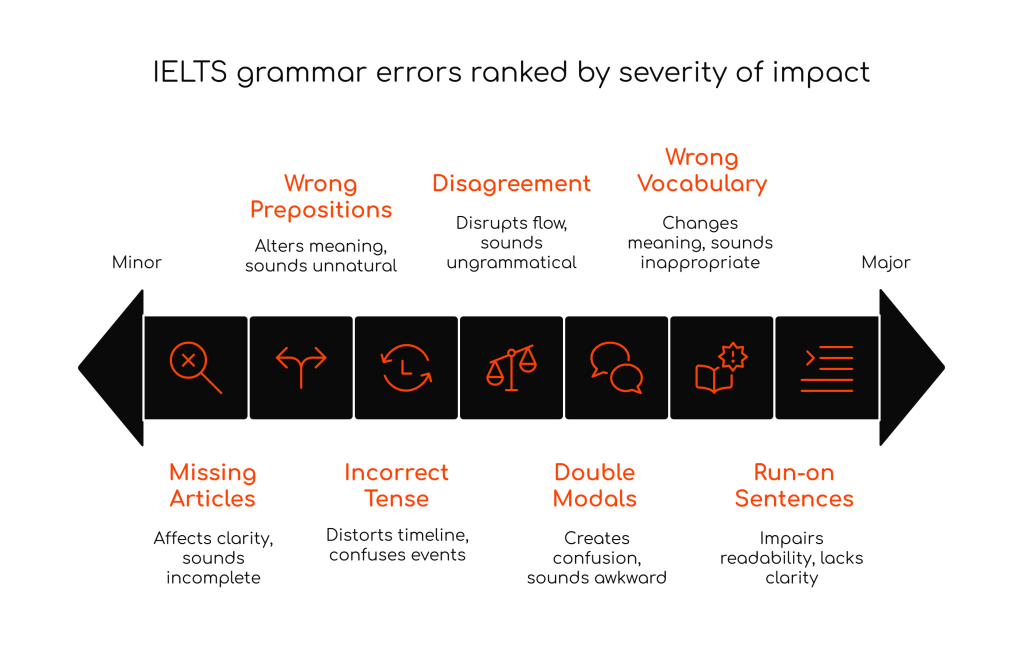
Achieving a high score in IELTS requires mastering not just complex grammar structures, but also avoiding common pitfalls that can significantly impact your band score. This comprehensive guide covers 100 of the most frequent grammar and vocabulary mistakes IELTS test-takers make, along with their corrections and detailed explanations.
Article Errors
1. Missing Articles with Countable Nouns
Wrong: “Education is important factor in society.”
Correct: “Education is an important factor in society.”
Explanation: Singular countable nouns require an article (a/an/the). Use “an” before vowel sounds.
2. Incorrect Use of “The” with General Concepts
Wrong: “The technology has changed the world.”
Correct: “Technology has changed the world.”
Explanation: Don’t use “the” when referring to general concepts or uncountable nouns in their general sense.
3. Missing “The” with Superlatives
Wrong: “This is most important issue.”
Correct: “This is the most important issue.”
Explanation: Superlatives always require “the” before them.
4. Incorrect Article with Plural Nouns
Wrong: “The students need a good education.”
Correct: “Students need good education.” OR “The students need good education.”
Explanation: Use “the” only when referring to specific students; omit articles for general statements about plural nouns.
5. Wrong Article with Unique Nouns
Wrong: “A internet has revolutionized communication.”
Correct: “The internet has revolutionized communication.”
Explanation: Use “the” with unique entities like “the internet,” “the sun,” “the government.”
6. Omitting Articles in Fixed Phrases
Wrong: “In conclusion of this essay…”
Correct: “In the conclusion of this essay…”
Explanation: Some phrases require specific articles as part of their structure.
7. Incorrect Use of “A/An” with Uncountable Nouns
Wrong: “We need a good information about this topic.”
Correct: “We need good information about this topic.”
Explanation: Uncountable nouns (information, advice, research) don’t take a/an.
8. Missing Article in Comparisons
Wrong: “Rich countries should help poor countries.”
Correct: “Rich countries should help the poor countries.” OR “Wealthy countries should help poorer nations.”
Explanation: Use “the” before adjectives used as nouns, or rephrase with proper nouns.
9. Wrong Article with Institutions
Wrong: “Students go to the university to learn.”
Correct: “Students go to university to learn.”
Explanation: Don’t use “the” with institutions when referring to their primary purpose.
10. Incorrect Article with Means of Transport
Wrong: “I prefer traveling by the car.”
Correct: “I prefer traveling by car.”
Explanation: Omit “the” after “by” when referring to means of transport.
Subject-Verb Agreement
11. Singular/Plural Confusion with Collective Nouns
Wrong: “The government are planning new policies.”
Correct: “The government is planning new policies.”
Explanation: In formal writing, treat collective nouns as singular unless emphasizing individual members.
12. Agreement Errors with “Each/Every”
Wrong: “Each of the students have their own opinion.”
Correct: “Each of the students has his or her own opinion.”
Explanation: “Each” and “every” take singular verbs and pronouns.
13. Confusion with “There is/There are”
Wrong: “There is many reasons for this problem.”
Correct: “There are many reasons for this problem.”
Explanation: Use “there are” with plural nouns, “there is” with singular nouns.
14. Wrong Verb with Percentage/Fraction
Wrong: “Fifty percent of students is absent.”
Correct: “Fifty percent of students are absent.”
Explanation: The verb agrees with the noun after “of” in percentage/fraction phrases.
15. Subject-Verb Disagreement with Inverted Sentences
Wrong: “Among the causes of pollution is cars and factories.”
Correct: “Among the causes of pollution are cars and factories.”
Explanation: Find the real subject after the prepositional phrase.
16. Error with Compound Subjects
Wrong: “Both the teacher and the student was present.”
Correct: “Both the teacher and the student were present.”
Explanation: Compound subjects joined by “and” take plural verbs.
17. Confusion with “Neither…nor”
Wrong: “Neither the students nor the teacher are happy.”
Correct: “Neither the students nor the teacher is happy.”
Explanation: With “neither…nor,” the verb agrees with the subject closest to it.
18. Wrong Verb with “One of”
Wrong: “One of the problems are lack of funding.”
Correct: “One of the problems is lack of funding.”
Explanation: “One” is the subject, so use singular verb form.
19. Gerund Subject Agreement Error
Wrong: “Reading books help improve vocabulary.”
Correct: “Reading books helps improve vocabulary.”
Explanation: Gerunds (verb + -ing as subject) take singular verbs.
20. Confusion with Indefinite Pronouns
Wrong: “Everyone have their own opinion.”
Correct: “Everyone has his or her own opinion.”
Explanation: Indefinite pronouns like “everyone,” “someone,” “anyone” are singular.
Tense Errors
21. Present Perfect vs. Simple Past Confusion
Wrong: “I have visited London last year.”
Correct: “I visited London last year.” Explanation: Use simple past with specific past time markers like “last year,” “yesterday.”
22. Incorrect Use of Present Perfect Continuous
Wrong: “I am studying English since 2020.”
Correct: “I have been studying English since 2020.”
Explanation: Use present perfect continuous for actions that started in the past and continue to the present.
23. Future Tense in Time Clauses
Wrong: “When I will graduate, I will find a job.”
Correct: “When I graduate, I will find a job.”
Explanation: Don’t use future tense in time clauses starting with when, after, before, until.
24. Past Perfect Misuse
Wrong: “After I had eaten dinner, I had watched TV.”
Correct: “After I had eaten dinner, I watched TV.”
Explanation: Use past perfect for the earlier action, simple past for the later one.
25. Conditional Tense Errors
Wrong: “If I would have money, I would travel.”
Correct: “If I had money, I would travel.”
Explanation: Don’t use “would” in the if-clause of conditional sentences.
26. Present Continuous for Habitual Actions
Wrong: “I am usually going to work by bus.”
Correct: “I usually go to work by bus.”
Explanation: Use simple present for habitual actions, not present continuous.
27. Simple Past vs. Past Continuous
Wrong: “I was studying when my friend was calling.”
Correct: “I was studying when my friend called.”
Explanation: Use simple past for the interrupting action, past continuous for the ongoing action.
28. Future Perfect Confusion
Wrong: “By 2030, climate change will affect many countries.”
Correct: “By 2030, climate change will have affected many countries.”
Explanation: Use future perfect for actions completed before a specific future time.
29. Stative Verbs in Continuous Form
Wrong: “I am knowing the answer.”
Correct: “I know the answer.”
Explanation: Stative verbs (know, understand, believe, like) don’t usually take continuous forms.
30. Mixed Tenses in Reported Speech
Wrong: “He said that he will come tomorrow.”
Correct: “He said that he would come the next day.”
Explanation: Backshift tenses in reported speech and change time references.
31. Incorrect Zero Conditional
Wrong: “If you will heat water, it will boil.”
Correct: “If you heat water, it boils.”
Explanation: Use simple present in both clauses for zero conditional (general truths).
32. Wrong Tense with “Since”
Wrong: “Since I came here, I learn a lot.”
Correct: “Since I came here, I have learned a lot.”
Explanation: Use present perfect with “since” to show connection between past and present.
33. Future in the Past Errors
Wrong: “He said he will help us.”
Correct: “He said he would help us.”
Explanation: Use “would” instead of “will” when reporting future statements made in the past.
34. Habitual Past Confusion
Wrong: “When I was young, I was playing football every day.”
Correct: “When I was young, I used to play football every day.”
Explanation: Use “used to” or “would” for past habits, not past continuous.
35. Present Perfect with Finished Time
Wrong: “I have finished my homework yesterday.”
Correct: “I finished my homework yesterday.”
Explanation: Don’t use present perfect with finished time periods.
Preposition Errors
36. Wrong Preposition with Time
Wrong: “I was born in 1995 at January.”
Correct: “I was born in 1995 in January.”
Explanation: Use “in” with months, years, seasons; “on” with specific dates; “at” with specific times.
37. Incorrect Preposition of Place
Wrong: “The book is in the table.”
Correct: “The book is on the table.”
Explanation: Use “on” for surfaces, “in” for enclosed spaces.
38. Wrong Preposition with Transportation
Wrong: “I go to work with bus.”
Correct: “I go to work by bus.”
Explanation: Use “by” for means of transport, “in/on” when referring to the vehicle itself.
39. Preposition Error with “Discuss”
Wrong: “Let’s discuss about this problem.”
Correct: “Let’s discuss this problem.”
Explanation: “Discuss” is a transitive verb that doesn’t need a preposition.
40. Wrong Preposition with “Different”
Wrong: “This is different than that.”
Correct: “This is different from that.”
Explanation: Use “different from” in formal writing, though “different than” is acceptable in some contexts.
41. Incorrect Use of “In” vs. “At” with Locations
Wrong: “I study at university in London.”
Correct: “I study at a university in London.”
Explanation: Use “at” for specific institutions, “in” for cities/countries.
42. Preposition Error with “Married”
Wrong: “She is married with a doctor.”
Correct: “She is married to a doctor.”
Explanation: Use “married to” someone, not “married with.”
43. Wrong Preposition with “Arrive”
Wrong: “I arrived to the airport early.”
Correct: “I arrived at the airport early.”
Explanation: Use “arrive at” for specific places, “arrive in” for cities/countries.
44. Preposition Confusion with “Depend”
Wrong: “It depends from your decision.”
Correct: “It depends on your decision.”
Explanation: Use “depend on,” not “depend from.”
45. Incorrect Preposition with “Consist”
Wrong: “The team consists from five members.”
Correct: “The team consists of five members.”
Explanation: Use “consist of” to show composition.
46. Wrong Preposition with “Participate”
Wrong: “Students participate to the program.”
Correct: “Students participate in the program.”
Explanation: Use “participate in” activities or events.
47. Preposition Error with “Prevent”
Wrong: “This medicine prevents to get sick.”
Correct: “This medicine prevents you from getting sick.”
Explanation: Use “prevent someone from doing something.”
48. Incorrect Preposition with “Responsible”
Wrong: “He is responsible to this project.”
Correct: “He is responsible for this project.”
Explanation: Use “responsible for” duties or obligations.
49. Wrong Preposition with “Suffer”
Wrong: “Many people suffer with poverty.”
Correct: “Many people suffer from poverty.”
Explanation: Use “suffer from” illnesses or problems.
50. Preposition Error with “Agree”
Wrong: “I agree to your opinion.”
Correct: “I agree with your opinion.”
Explanation: Use “agree with” opinions/people, “agree to” proposals/plans.
Modal Verb Mistakes
51. Double Modals
Wrong: “You should must study harder.”
Correct: “You should study harder.” OR “You must study harder.”
Explanation: Don’t use two modal verbs together.
52. Modal + Infinitive with “To”
Wrong: “You should to study more.”
Correct: “You should study more.”
Explanation: Modal verbs are followed by bare infinitives (without “to”).
53. Past Modal Form Errors
Wrong: “I should went to the meeting.”
Correct: “I should have gone to the meeting.”
Explanation: Use “modal + have + past participle” for past modal meanings.
54. Confusion with “Must” and “Have to”
Wrong: “I must to finish this by tomorrow.”
Correct: “I must finish this by tomorrow.” OR “I have to finish this by tomorrow.”
Explanation: “Must” doesn’t take “to”; it’s followed by the bare infinitive.
55. Wrong Modal for Ability
Wrong: “When I was young, I could to swim very well.”
Correct: “When I was young, I could swim very well.”
Explanation: Modal verbs don’t take “to” after them.
56. Incorrect Use of “Would” in Conditionals
Wrong: “If I would be rich, I would help others.”
Correct: “If I were rich, I would help others.”
Explanation: Don’t use “would” in the if-clause of second conditional.
57. Modal Verb Agreement Error
Wrong: “He cans speak three languages.”
Correct: “He can speak three languages.”
Explanation: Modal verbs don’t change form for different subjects.
58. Confusion with “May” and “Might”
Wrong: “It may happened yesterday.”
Correct: “It may have happened yesterday.”
Explanation: Use “may/might + have + past participle” for past possibilities.
59. Wrong Form After “Ought”
Wrong: “You ought study harder.”
Correct: “You ought to study harder.”
Explanation: “Ought” is followed by “to + infinitive.”
60. Incorrect Negative Modal
Wrong: “You don’t must smoke here.”
Correct: “You must not smoke here.” OR “You don’t have to smoke here.”
Explanation: Use “must not” for prohibition, “don’t have to” for lack of necessity.
Vocabulary Mistakes
61. Confusing “Economic” vs. “Economical”
Wrong: “This car is very economic.”
Correct: “This car is very economical.”
Explanation: “Economic” relates to economics; “economical” means cost-effective.
62. Misusing “Affect” vs. “Effect”
Wrong: “The new policy will have a positive affect.”
Correct: “The new policy will have a positive effect.”
Explanation: “Affect” is a verb; “effect” is a noun.
63. Confusing “Beside” vs. “Besides”
Wrong: “Beside studying, I also work part-time.”
Correct: “Besides studying, I also work part-time.”
Explanation: “Besides” means “in addition to”; “beside” means “next to.”
64. Wrong Use of “Amount” vs. “Number”
Wrong: “A large amount of people attended.”
Correct: “A large number of people attended.”
Explanation: Use “number” with countable nouns, “amount” with uncountable nouns.
65. Confusing “Advice” vs. “Advise”
Wrong: “Can you advice me on this matter?”
Correct: “Can you advise me on this matter?”
Explanation: “Advice” is a noun; “advise” is a verb.
66. Misusing “Fewer” vs. “Less”
Wrong: “There are less students this year.”
Correct: “There are fewer students this year.”
Explanation: Use “fewer” with countable nouns, “less” with uncountable nouns.
67. Confusing “Lose” vs. “Loose”
Wrong: “Don’t loose your keys.”
Correct: “Don’t lose your keys.”
Explanation: “Lose” is a verb; “loose” is an adjective meaning not tight.
68. Wrong Use of “Principal” vs. “Principle”
Wrong: “The main principle of the school is very strict.”
Correct: “The principal of the school is very strict.”
Explanation: “Principal” is a person or main thing; “principle” is a rule or belief.
69. Confusing “Accept” vs. “Except”
Wrong: “Everyone was invited accept John.”
Correct: “Everyone was invited except John.”
Explanation: “Accept” means to receive; “except” means excluding.
70. Misusing “Complement” vs. “Compliment”
Wrong: “She gave me a nice complement on my dress.”
Correct: “She gave me a nice compliment on my dress.”
Explanation: “Compliment” is praise; “complement” means to complete or make perfect.
71. Wrong Collocation with “Make/Do”
Wrong: “I need to make my homework.”
Correct: “I need to do my homework.”
Explanation: Learn common collocations: “do homework,” “make a decision.”
72. Incorrect Use of “Say” vs. “Tell”
Wrong: “He said me the truth.”
Correct: “He told me the truth.”
Explanation: “Tell” takes an object person; “say” doesn’t require an object person.
73. Confusing “Borrow” vs. “Lend”
Wrong: “Can you borrow me your pen?”
Correct: “Can you lend me your pen?”
Explanation: “Borrow” means to take; “lend” means to give temporarily.
74. Wrong Preposition with Phrasal Verbs
Wrong: “I’m looking forward for your reply.”
Correct: “I’m looking forward to your reply.”
Explanation: Learn phrasal verbs with their correct prepositions.
75. Misusing “Bring” vs. “Take”
Wrong: “I will take this book to you tomorrow.”
Correct: “I will bring this book to you tomorrow.”
Explanation: “Bring” implies movement toward the speaker; “take” implies movement away.
76. Confusing “Lay” vs. “Lie”
Wrong: “I need to lay down for a while.”
Correct: “I need to lie down for a while.”
Explanation: “Lay” requires an object; “lie” doesn’t take an object.
77. Wrong Use of “Rise” vs. “Raise”
Wrong: “The government will rise taxes.”
Correct: “The government will raise taxes.”
Explanation: “Raise” takes an object; “rise” doesn’t take an object.
78. Confusing “Site” vs. “Sight”
Wrong: “The old castle is a beautiful site.”
Correct: “The old castle is a beautiful sight.”
Explanation: “Sight” is something you see; “site” is a location.
79. Misusing “Stationary” vs. “Stationery”
Wrong: “I need to buy some stationary for school.”
Correct: “I need to buy some stationery for school.”
Explanation: “Stationery” is writing materials; “stationary” means not moving.
80. Wrong Use of “Than” vs. “Then”
Wrong: “First study, and then take the test.”
Correct: “First study, and then take the test.” (This is actually correct)
Better example: “This book is more interesting then that one.”
Correct: “This book is more interesting than that one.”
Explanation: “Than” is for comparisons; “then” indicates time sequence.
Sentence Structure Errors
81. Run-on Sentences
Wrong: “The weather was nice we decided to go for a walk.”
Correct: “The weather was nice, so we decided to go for a walk.”
Explanation: Join independent clauses with conjunctions or separate them with periods.
82. Sentence Fragments
Wrong: “Because it was raining heavily.”
Correct: “Because it was raining heavily, we stayed inside.”
Explanation: Dependent clauses need independent clauses to form complete sentences.
83. Dangling Modifiers
Wrong: “Walking to school, the rain started falling.”
Correct: “Walking to school, I noticed the rain started falling.”
Explanation: Modifying phrases should clearly relate to the subject of the sentence.
84. Misplaced Modifiers
Wrong: “She served drinks to the guests in plastic cups.”
Correct: “She served drinks in plastic cups to the guests.”
Explanation: Place modifiers as close as possible to what they modify.
85. Parallel Structure Errors
Wrong: “I like reading, writing, and to paint.”
Correct: “I like reading, writing, and painting.”
Explanation: Use parallel grammatical structures in lists or series.
86. Comma Splices
Wrong: “The exam was difficult, many students failed.”
Correct: “The exam was difficult, and many students failed.”
Explanation: Don’t join independent clauses with just a comma; use a conjunction or semicolon.
87. Incorrect Relative Pronoun Usage
Wrong: “The book who I read was interesting.”
Correct: “The book that I read was interesting.”
Explanation: Use “who” for people, “that/which” for things.
88. Faulty Comparison
Wrong: “The climate in Japan is different from Korea.”
Correct: “The climate in Japan is different from that in Korea.”
Explanation: Compare similar elements; add “that” or “the climate” to make the comparison clear.
89. Incorrect Word Order in Questions
Wrong: “What you are doing?”
Correct: “What are you doing?”
Explanation: Invert subject and auxiliary verb in questions.
90. Mixed Constructions
Wrong: “The reason I was late was because of traffic.”
Correct: “The reason I was late was traffic.” OR “I was late because of traffic.”
Explanation: Don’t mix “the reason…was” with “because.”
Advanced Grammar Errors
91. Incorrect Subjunctive Mood
Wrong: “I suggest that he comes to the meeting.”
Correct: “I suggest that he come to the meeting.”
Explanation: Use base form of verb after verbs like suggest, recommend, insist.
92. Wrong Use of “Wish” Constructions
Wrong: “I wish I will pass the exam.”
Correct: “I wish I would pass the exam.”
Explanation: Use past tense or “would” after “wish” for unreal situations.
93. Incorrect Passive Voice Formation
Wrong: “The problem was solved by quickly.”
Correct: “The problem was solved quickly.”
Explanation: Don’t use “by” with adverbs in passive voice; use “by” only with agents.
94. Misuse of Causative Verbs
Wrong: “I had my car to repair yesterday.”
Correct: “I had my car repaired yesterday.”
Explanation: Use “have + object + past participle” for causative constructions.
95. Incorrect Inversion with Negative Adverbs
Wrong: “Never I have seen such a beautiful sunset.”
Correct: “Never have I seen such a beautiful sunset.”
Explanation: Invert subject and auxiliary verb after negative adverbs at sentence beginning.
96. Wrong Use of Emphatic “Do”
Wrong: “I do am interested in this topic.”
Correct: “I am indeed interested in this topic.” OR “I do find this topic interesting.”
Explanation: Use “do” for emphasis with main verbs, not with “be” or auxiliary verbs.
97. Incorrect Cleft Sentence Structure
Wrong: “It was yesterday when I met her.”
Correct: “It was yesterday that I met her.”
Explanation: Use “that” in cleft sentences, not “when” or “where.”
98. Misuse of “So/Such” Constructions
Wrong: “It was so a difficult exam that many failed.”
Correct: “It was such a difficult exam that many failed.”
Explanation: Use “such + (adjective) + noun” and “so + adjective/adverb.”
99. Incorrect Tag Questions
Wrong: “You can speak English, can you?”
Correct: “You can speak English, can’t you?”
Explanation: Use opposite polarity in tag questions (positive statement → negative tag).
100. Wrong Conditional Perfect
Wrong: “If I would have studied harder, I would pass the exam.”
Correct: “If I had studied harder, I would have passed the exam.”
Explanation: Use past perfect in if-clause and conditional perfect in main clause for third conditional.
Tips for Avoiding These Mistakes
Practice Regularly: Regular practice with these common errors will help you internalize correct usage patterns.
Read Extensively: Reading high-quality texts exposes you to correct grammar and vocabulary usage in context.
Use Grammar Resources: Invest in good grammar books and online resources specifically designed for IELTS preparation.
Get Feedback: Have teachers or native speakers review your writing to identify patterns in your mistakes.
Focus on Your Weak Areas: Identify which types of errors you make most frequently and focus extra attention on those areas.
Proofread Systematically: Develop a systematic approach to proofreading that checks for different types of errors.
Learn Collocations: Many vocabulary errors stem from incorrect word combinations. Study common collocations.
Understand Context: Learn when to use formal vs. informal language, and adjust your vocabulary accordingly.
By mastering these 100 common mistakes, you’ll significantly improve your IELTS performance and demonstrate the language accuracy that examiners are looking for in higher band scores.
#IELTS #IELTSPreparation #IELTSWriting #IELTSSpeaking #EnglishGrammar #EnglishVocabulary #IELTSTips #EnglishLearning #IELTSStudy #TestPreparation #EnglishMistakes #GrammarTips #IELTSSuccess #EnglishExam #BandScore
 IELTS Guide Phil
Leave a comment