
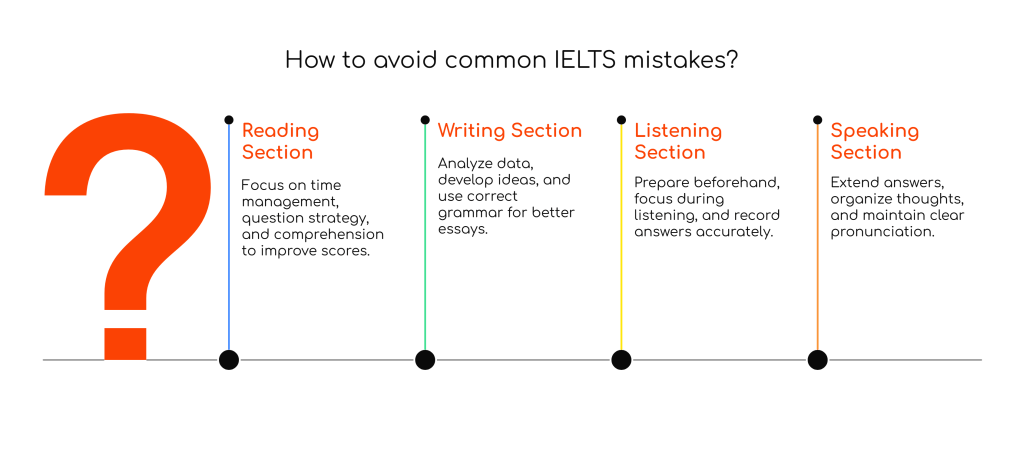
Preparing for the IELTS exam can be overwhelming, and even the most dedicated students often make predictable mistakes that can significantly impact their scores. Whether you’re aiming for band 6.5 or targeting that elusive band 9, understanding and avoiding these common pitfalls is crucial for your success. This comprehensive guide covers 100 frequent IELTS mistakes across all four skills, complete with explanations and practical fixes to help you achieve your target score. You can watch this YouTube video explainer by IELTS Guide Phil.
Reading Section Mistakes
Time Management Errors
1. Spending too much time on difficult passages Fix: Allocate 20 minutes per passage strictly. If you’re stuck, move on and return if time permits.
2. Reading every word carefully Fix: Practice skimming and scanning techniques. Focus on keywords and topic sentences rather than every detail.
3. Not managing time for transferring answers Fix: Reserve 2-3 minutes at the end to transfer answers from question booklet to answer sheet.
4. Getting stuck on unknown vocabulary Fix: Use context clues to understand meaning. Don’t panic over unfamiliar words if you can still grasp the main idea.
5. Not reading instructions carefully Fix: Always check word limits and specific requirements. “NO MORE THAN THREE WORDS” means exactly that.
Question Strategy Mistakes
6. Answering in the wrong order Fix: Questions usually follow the passage order. Use this to your advantage for efficient searching.
7. Overthinking True/False/Not Given questions Fix: Stick to what’s explicitly stated. If information isn’t in the passage, it’s “Not Given.”
8. Changing answers too frequently Fix: Trust your first instinct unless you find clear evidence contradicting it.
9. Not using elimination strategies Fix: For multiple choice questions, eliminate obviously wrong answers first.
10. Ignoring synonyms and paraphrasing Fix: IELTS uses extensive paraphrasing. Look for similar meanings, not identical words.
Comprehension Errors
11. Misunderstanding the main idea Fix: Focus on topic sentences and concluding statements. Practice identifying main ideas in various texts.
12. Confusing specific details with general concepts Fix: Pay attention to whether questions ask for specific information or general themes.
13. Missing transitional signals Fix: Words like “however,” “moreover,” and “consequently” often signal important information.
14. Not understanding question types Fix: Familiarize yourself with all question formats: gap-filling, matching, multiple choice, etc.
15. Misreading numerical information Fix: Pay careful attention to dates, percentages, and statistics. They’re often key to correct answers.
Technical Mistakes
16. Spelling errors in answers Fix: Copy spelling exactly from the passage. Check your transferred answers carefully.
17. Exceeding word limits Fix: Hyphenated words count as one word. Contractions count as one word. Practice counting accurately.
18. Using incorrect grammatical forms Fix: Ensure your answer fits grammatically with the question stem.
19. Not capitalizing proper nouns Fix: Copy capitalization exactly as it appears in the passage.
20. Leaving answers blank Fix: Always guess if you’re unsure. There’s no penalty for wrong answers.
Passage Analysis Errors
21. Not identifying text type Fix: Recognize whether you’re reading an academic article, report, or opinion piece to adjust your approach.
22. Missing implicit information Fix: Sometimes answers require inference. Practice reading between the lines.
23. Confusing cause and effect Fix: Pay attention to causal relationships indicated by words like “because,” “due to,” “results in.”
24. Not recognizing writer’s attitude Fix: Look for adjectives and adverbs that indicate the author’s opinion or stance.
25. Misunderstanding comparisons Fix: Comparative and superlative forms often contain key information for answers.
Writing Section Mistakes
Task 1 (Academic) Mistakes
26. Not analyzing the visual data properly Fix: Spend 2-3 minutes understanding trends, highest/lowest points, and overall patterns before writing.
27. Including personal opinions in Task 1 Fix: Task 1 requires objective description only. Avoid phrases like “I think” or “In my opinion.”
28. Not using appropriate data description language Fix: Learn specific vocabulary for trends: “peaked,” “plummeted,” “fluctuated,” “remained stable.”
29. Failing to highlight key features Fix: Identify and describe the most significant trends or comparisons, not every detail.
30. Poor paragraph organization Fix: Use clear paragraph structure: introduction, overview, and 2-3 body paragraphs with logical grouping.
31. Not writing an overview Fix: Always include an overview paragraph summarizing the main trends or key features.
32. Misreading scales and units Fix: Pay careful attention to axes labels, percentages vs. numbers, and time periods.
Task 2 Mistakes
33. Not fully addressing the question Fix: Analyze the question carefully. Identify if it asks for discussion, opinion, causes/solutions, etc.
34. Weak thesis statements Fix: Your thesis should clearly state your position and preview your main arguments.
35. Insufficient development of ideas Fix: Each body paragraph needs a clear topic sentence, explanation, examples, and conclusion.
36. Using irrelevant examples Fix: Ensure all examples directly support your argument and are culturally appropriate.
37. Poor logical flow between paragraphs Fix: Use transitional phrases to connect ideas and maintain coherent argument progression.
Language and Grammar Mistakes
38. Limited vocabulary range Fix: Practice using synonyms and varied expressions. Avoid repeating the same words throughout.
39. Incorrect word formation Fix: Study common suffixes and prefixes. Practice forming nouns, adjectives, and adverbs correctly.
40. Inconsistent verb tenses Fix: Maintain consistent tense throughout your essay unless the context requires a change.
41. Run-on sentences Fix: Use proper punctuation to separate clauses. Vary sentence length for better readability.
42. Incorrect article usage Fix: Study when to use “a,” “an,” “the,” or no article. This is crucial for grammatical accuracy.
43. Preposition errors Fix: Learn common preposition combinations (e.g., “dependent on,” “interested in”).
44. Subject-verb disagreement Fix: Ensure subjects and verbs agree in number, especially with collective nouns and compound subjects.
Structure and Content Issues
45. Inadequate introduction or conclusion Fix: Write engaging introductions that paraphrase the question and strong conclusions that summarize key points.
46. Not meeting word count requirements Fix: Practice writing within the required range (150+ for Task 1, 250+ for Task 2).
47. Repetitive sentence structures Fix: Vary your sentence beginnings and use different grammatical structures throughout.
48. Weak supporting arguments Fix: Develop each point thoroughly with explanations, examples, and analysis.
49. Cultural bias in examples Fix: Use universal examples that examiners from any background can understand.
50. Illegible handwriting Fix: Practice writing clearly under time pressure. Consider printing if your cursive is unclear.
Listening Section Mistakes
Pre-listening Preparation
51. Not reading questions beforehand Fix: Use the preparation time to read questions and predict possible answers.
52. Ignoring question types Fix: Identify whether you need to listen for specific information, main ideas, or speaker attitudes.
53. Not predicting answers Fix: Use context clues from questions to anticipate what kind of information you’ll hear.
54. Failing to identify keywords Fix: Underline key terms in questions that will help you locate answers in the audio.
55. Not understanding the context Fix: Pay attention to the introduction that sets the scene for each section.
During Listening Errors
56. Writing while listening to instructions Fix: Listen to instructions carefully first, then prepare to write when the recording begins.
57. Missing the first answer Fix: Be ready to write immediately when the conversation or monologue starts.
58. Not following the speaker’s pace Fix: Don’t get stuck on one question. Keep moving with the audio flow.
59. Mishearing similar-sounding words Fix: Practice distinguishing between commonly confused words (e.g., “thirteen” vs. “thirty”).
60. Writing too much information Fix: Write only what’s needed to answer the question. Avoid unnecessary details.
Answer Recording Mistakes
61. Poor spelling from audio Fix: If unsure about spelling, write what you hear phonetically and check during transfer time.
62. Not using correct capitalization Fix: Capitalize proper nouns (names, places) and sentence beginnings appropriately.
63. Exceeding word limits Fix: Follow word count restrictions strictly. Practice condensing information when necessary.
64. Incorrect number format Fix: Pay attention to how numbers should be written (digits vs. words, dates, times).
65. Missing plural forms Fix: Listen carefully for singular vs. plural markers, especially with nouns.
Concentration and Focus Issues
66. Losing focus during long sections Fix: Practice active listening with similar-length recordings. Take brief mental breaks between sections.
67. Getting distracted by accents Fix: Expose yourself to various English accents through podcasts, news, and practice materials.
68. Panicking when missing answers Fix: Stay calm and refocus on upcoming questions. Don’t let one missed answer affect others.
69. Not using elimination strategies Fix: For multiple choice, eliminate obviously wrong options even if you’re not completely sure.
70. Changing answers unnecessarily Fix: Only change answers if you’re certain you misheard initially.
Transfer and Final Check Errors
71. Running out of transfer time Fix: Practice transferring answers quickly and accurately within the 10-minute limit.
72. Making careless transfer errors Fix: Double-check that you’re copying answers to the correct question numbers.
73. Not checking grammar in transferred answers Fix: Ensure answers make grammatical sense in context during transfer time.
74. Leaving questions blank Fix: Always write something. Educated guesses are better than blank answers.
75. Not reviewing obvious errors Fix: Use remaining transfer time to check for clear mistakes in spelling or grammar.
Speaking Section Mistakes
Part 1 (Introduction) Mistakes
76. Giving overly short answers Fix: Extend responses with explanations, examples, or additional details while staying relevant.
77. Memorizing rehearsed responses Fix: Prepare ideas and vocabulary, but speak naturally. Examiners can detect memorized answers.
78. Not listening to questions carefully Fix: If you don’t understand, politely ask for clarification rather than guessing.
79. Using inappropriate register Fix: Maintain a semi-formal tone. Avoid being too casual or overly formal.
80. Rushing through answers Fix: Speak at a natural pace. It’s better to say less clearly than more unclearly.
Part 2 (Long Turn) Mistakes
81. Not using preparation time effectively Fix: Make quick notes covering all prompt points. Organize your thoughts logically.
82. Not addressing all parts of the prompt Fix: Ensure you cover every bullet point in the task card during your 2-minute talk.
83. Running out of things to say Fix: Prepare extension strategies: provide examples, compare experiences, or add personal reflections.
84. Speaking for too short a time Fix: Practice speaking for the full 2 minutes. Use fillers appropriately to maintain fluency.
85. Not organizing ideas coherently Fix: Use clear sequencing (first, then, finally) and logical connections between ideas.
Part 3 (Discussion) Mistakes
86. Giving superficial answers to complex questions Fix: Develop analytical thinking. Consider multiple perspectives and provide detailed explanations.
87. Not understanding abstract concepts Fix: Practice discussing theoretical topics. Ask for clarification if needed.
88. Avoiding difficult questions Fix: Engage with challenging topics. It’s okay to acknowledge complexity while attempting to answer.
89. Not providing examples to support points Fix: Illustrate abstract ideas with concrete examples from your experience or knowledge.
90. Failing to develop arguments fully Fix: State your opinion, explain your reasoning, provide examples, and consider counterarguments.
General Speaking Errors
91. Poor pronunciation affecting comprehension Fix: Focus on clear articulation of individual sounds and word stress patterns.
92. Limited vocabulary causing communication breakdown Fix: Learn to paraphrase when you don’t know specific words. Describe concepts in simpler terms.
93. Grammatical errors impeding understanding Fix: Practice common structures until they become automatic. Don’t sacrifice accuracy for complexity.
94. Inappropriate use of fillers Fix: Use natural fillers (well, actually, I mean) sparingly and appropriately.
95. Not maintaining eye contact Fix: Look at the examiner naturally. This shows confidence and engagement.
96. Speaking too quietly or loudly Fix: Practice projecting your voice clearly without shouting. Ensure the examiner can hear you easily.
97. Showing nervousness through body language Fix: Practice relaxation techniques. Sit up straight and use natural gestures.
98. Not asking for clarification when needed Fix: It’s acceptable to ask “Could you repeat that?” or “What do you mean by…?”
99. Using inappropriate humor or references Fix: Keep responses professional and culturally neutral. Avoid jokes that might not translate.
100. Giving up when struggling Fix: Keep trying to communicate your ideas. Examiners appreciate effort and persistence.
Final Tips for IELTS Success
Understanding these common mistakes is just the beginning of your IELTS journey. The key to success lies in consistent practice, targeted preparation, and developing test-taking strategies that work for your learning style. Remember that IELTS is not just testing your English proficiency but also your ability to perform under pressure and manage time effectively.
Focus on your weakest areas first, but don’t neglect your strengths. Regular practice with authentic materials, feedback from qualified instructors, and honest self-assessment will help you avoid these pitfalls and achieve your target score. Most importantly, remember that improvement takes time, so be patient with yourself and celebrate small victories along the way.
Good luck with your IELTS preparation, and remember that avoiding these common mistakes will put you well on your way to success!
#IELTS #IELTSPreparation #IELTSTips #IELTSMistakes #IELTSWriting #IELTSReading #IELTSListening #IELTSSpeaking #EnglishTest #IELTSStudy #IELTSSuccess #EnglishLearning #TestPreparation #IELTSBand #StudyTips
 IELTS Guide Phil
Leave a comment