
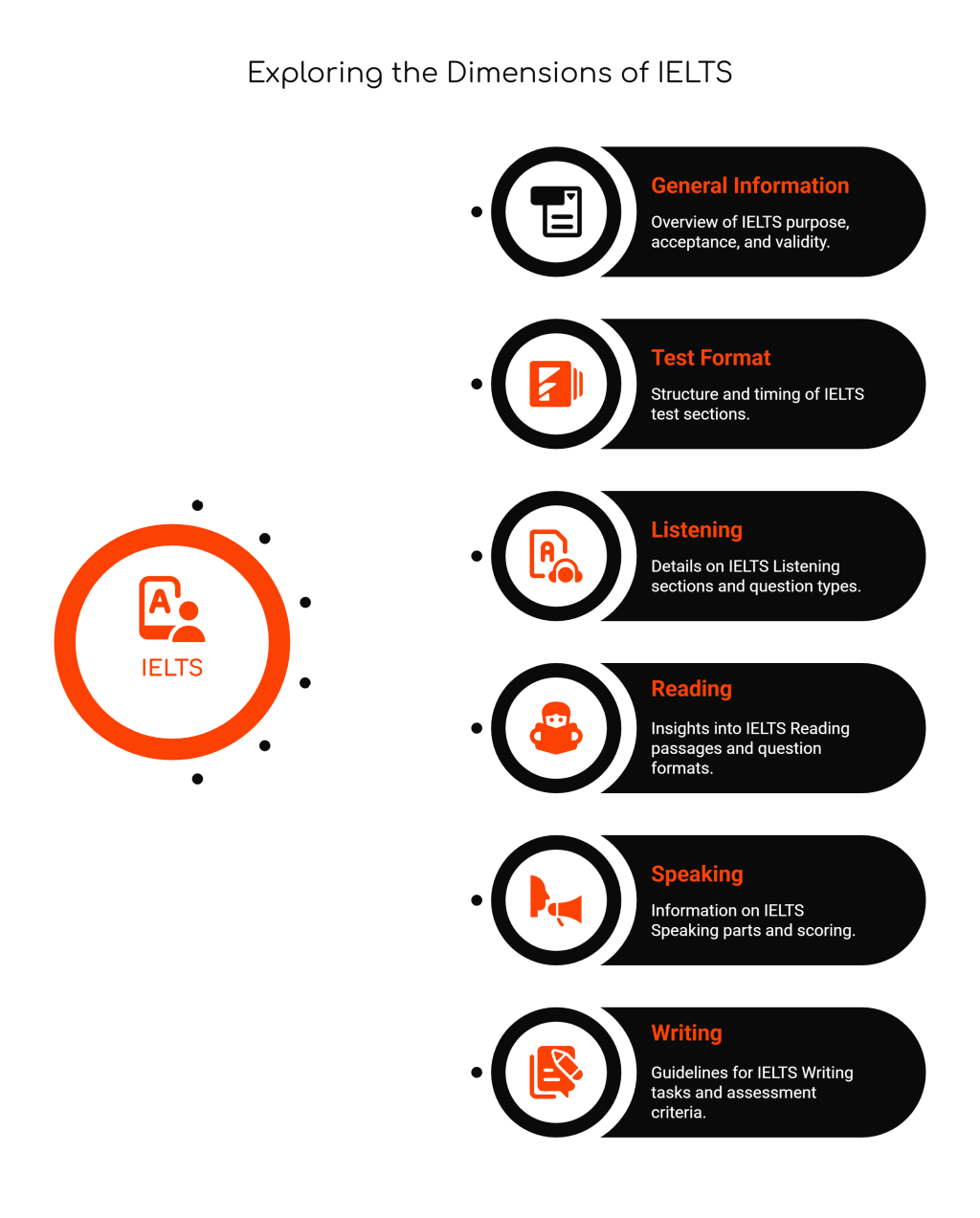
General IELTS Information
1. What does IELTS stand for?
Answer: IELTS stands for International English Language Testing System. It’s a standardized test designed to assess the English language proficiency of non-native English speakers who want to study, work, or migrate to English-speaking countries.
2. Who accepts IELTS scores?
Answer: IELTS scores are accepted by over 11,000 organizations worldwide, including universities, employers, immigration authorities, and professional bodies in countries like the UK, Australia, Canada, New Zealand, and the USA.
3. What’s the difference between Academic and General Training IELTS?
Answer: Academic IELTS is for those applying to higher education or professional registration, featuring academic texts and formal writing tasks. General Training is for migration, work experience, or secondary education, with everyday English contexts and practical writing tasks.
4. How long is the IELTS test valid?
Answer: IELTS test results are valid for two years from the test date. After this period, you’ll need to retake the test if you require a current English proficiency certificate.
5. Can I take IELTS multiple times?
Answer: Yes, there’s no limit to how many times you can take IELTS. However, you must wait for your results before booking another test, and some test centers may have waiting periods between attempts.
6. What’s the minimum age to take IELTS?
Answer: There’s no official minimum age, but IELTS is designed for adults. Test takers under 16 may find the content challenging as it assumes adult-level knowledge and experience.
7. Is IELTS available online?
Answer: Yes, IELTS Online is available in select locations. It maintains the same format, content, and scoring as the paper-based test but is taken on a computer at home under remote supervision.
8. What identification do I need for IELTS?
Answer: You need the same passport you used during registration. The name on your passport must exactly match your registration details. Other forms of national identification may be accepted.
9. Can I use a pen or pencil in IELTS?
Answer: For paper-based tests, a black pen provided by the test center is now used for Listening, Reading (to enable changes), and Writing. For computer-based tests, you type responses but may use paper for notes.
10. What happens if I arrive late to the test?
Answer: Late arrivals are not permitted to enter the test room. You’ll forfeit your test fee and need to register for another test date.
IELTS Test Format
11. How long is the entire IELTS test?
Answer: The total test time is approximately 2 hours and 45 minutes. Listening (30 minutes + 10 minutes transfer time for the paper test), Reading (60 minutes), Writing (60 minutes), and Speaking (11-14 minutes, scheduled separately).
12. In what order are the IELTS sections taken?
Answer: Listening, Reading, and Writing are taken consecutively on the same day with no breaks between sections. Speaking may be scheduled up to 7 days before or after the other sections.
13. Can I take breaks during the test?
Answer: No scheduled breaks are provided between Listening, Reading, and Writing sections. You should use the bathroom before the test begins, though some breaks may be allowed within the Reading and Writing sections. The Speaking test is separate and relatively short.
14. Are calculators allowed in IELTS?
Answer: No, calculators, electronic devices, watches, or any external materials are not permitted in the test room. All necessary materials are provided by the test center.
15. Can I make notes during the test?
Answer: Yes, you can make notes on the question paper during Listening and Reading sections. In computer-based tests, you’re provided with paper for notes, but these aren’t collected or assessed.
16. What’s the difference between paper-based and computer-based IELTS?
Answer: The content and scoring are identical. Paper-based uses physical papers and pens, while computer-based uses computers for Listening, Reading, and Writing. Speaking remains either a video call or face-to-face in both formats.
17. Can I choose between paper-based and computer-based IELTS?
Answer: Availability depends on your test center. Most locations offer both options, but some may only provide one format. Check with your local test center for available options.
18. Is the Speaking test always face-to-face?
Answer: The Speaking test may be conducted face-to-face or via a video call with a certified IELTS examiner, whether you take the paper-based or computer-based version of the other sections.
19. How are the four skills weighted in the overall score?
Answer: All four skills (Listening, Reading, Writing, Speaking) are weighted equally. Your overall band score is the average of your four individual band scores, rounded to the nearest half or whole band.
20. Can I request specific accommodations for disabilities?
Answer: Yes, IELTS provides accommodations for test takers with disabilities, including extra time, modified materials, or alternative formats. Apply well in advance with supporting documentation.
IELTS Listening
21. How many parts are in IELTS Listening?
Answer: There are four parts with increasing difficulty: Part 1 (social conversation), Part 2 (monologue on general topic), Part 3 (academic discussion), and Part 4 (academic lecture).
22. How many questions are in IELTS Listening?
Answer: There are 40 questions total, with 10 questions in each part. Each correct answer receives one mark, contributing to your final Listening band score.
23. Do I hear the audio once or twice?
Answer: Each audio recording is played only once. You must listen carefully and answer questions as you hear the information. There’s no opportunity to replay any part of the recording.
24. What types of questions appear in Listening?
Answer: Question types include multiple choice, matching, plan/map/diagram labeling, form/note/table/flow-chart completion, and sentence completion. Each requires different listening strategies.
25. How much time do I have to transfer answers?
Answer: In paper-based tests, you get 10 minutes at the end to transfer answers from the question booklet to the answer sheet. Computer-based tests require immediate input.
26. What happens if I spell an answer incorrectly?
Answer: Spelling must be correct to receive marks. However, both UK and US spelling conventions are accepted (e.g., “colour” or “color”). Minor errors may be overlooked if meaning is clear.
27. Should I write answers in capital or lowercase letters?
Answer: Both are acceptable. The important thing is clarity and correct spelling. However, proper nouns (names, places) should follow standard capitalization rules.
28. What if I miss an answer during Listening?
Answer: Move on immediately to the next question. Don’t dwell on missed answers as you’ll miss subsequent questions. Use the time between parts to review and predict upcoming answers.
29. Can I write more than the word limit?
Answer: No, exceeding the word limit results in zero marks for that answer. If the instruction says “NO MORE THAN THREE WORDS,” writing four words receives no credit, even if the content is correct.
30. Are there different accents in IELTS Listening?
Answer: Yes, you’ll hear various English accents including British, Australian, New Zealand, American, and Canadian. This reflects real-world English usage and tests your ability to understand global English.
IELTS Reading
31. How many passages are in IELTS Reading?
Answer: There are three passages of increasing difficulty. Academic passages are from books, journals, magazines, and newspapers. General Training includes everyday texts, work-related materials, and general interest articles.
32. How many questions are in IELTS Reading?
Answer: There are 40 questions total across the three passages. The number of questions per passage varies, but typically ranges from 12-14 questions per passage.
33. How long are the Reading passages?
Answer: Each passage is typically 750-900 words long. The total reading material is approximately 2,000-2,750 words, which you must read and answer questions about in 60 minutes.
34. What question types appear in Reading?
Answer: Question types include multiple choice, identifying information (True/False/Not Given), identifying writer’s views (Yes/No/Not Given), matching headings, matching features, matching sentence endings, sentence completion, summary completion, note completion, table completion, flow-chart completion, diagram label completion, and short-answer questions.
35. What’s the difference between True/False/Not Given and Yes/No/Not Given?
Answer: True/False/Not Given deals with factual information in the text. Yes/No/Not Given concerns the writer’s opinions or claims. “Not Given” means the information isn’t provided in either case.
36. How should I manage time in Reading?
Answer: Spend approximately 20 minutes per passage, including reading time and answering questions. Don’t spend too long on difficult questions; mark them and return if time permits.
37. Should I read the passages completely before answering questions?
Answer: It’s more efficient to skim the passage first, then read questions to understand what to look for, then scan for specific information. Complete reading of dense academic texts can consume too much time.
38. Can I write on the question paper in Reading?
Answer: Yes, you can underline, circle, and make notes on the question paper. This helps you locate information quickly and organize your thoughts.
39. What if I can’t find an answer in the Reading passage?
Answer: The answer might be “Not Given” for True/False/Not Given questions, or you might need to look more carefully. All other question types have answers somewhere in the text.
40. Are Reading answers always in order?
Answer: Most question types follow the order of information in the passage, but some (like matching headings or multiple choice with options listed A-Z) may not. Check each question type’s characteristics.
IELTS Writing
41. What are the two Writing tasks?
Answer: Task 1 differs by test type. Academic Task 1 requires describing visual information (graphs, charts, diagrams). General Training Task 1 is letter writing. Task 2 is an essay for both versions.
42. How much should I write for each task?
Answer: Task 1 requires at least 150 words, and Task 2 requires at least 250 words. Writing significantly less will result in penalty, but writing more is acceptable if it improves quality.
43. How much time should I spend on each Writing task?
Answer: Spend approximately 20 minutes on Task 1 and 40 minutes on Task 2. Task 2 carries twice the weight in scoring, so allocate time accordingly.
44. What’s assessed in IELTS Writing?
Answer: Four criteria are assessed equally (25% each): Task Achievement/Response (addressing the task requirements), Coherence and Cohesion (organization and linking), Lexical Resource (vocabulary range and accuracy), and Grammatical Range and Accuracy (grammar variety and correctness).
45. Can I write in bullet points?
Answer: No, IELTS Writing requires continuous prose in paragraph form. Bullet points, notes, or telegraphic language will significantly reduce your score.
46. Should I write an introduction and conclusion?
Answer: Task 2 essays should have clear introductions and conclusions. Task 1 reports typically have an overview rather than a conclusion. Proper structure is essential for Coherence and Cohesion scores.
47. Can I give my personal opinion in Academic Task 1?
Answer: No, Academic Task 1 requires objective description of visual information. Personal opinions, speculation, or explanations beyond what’s shown will lower your Task Achievement score.
48. What types of essays appear in Task 2?
Answer: Common types include opinion essays (agree/disagree), discussion essays (discuss both views), problem/solution essays, two-part questions, and advantage/disadvantage essays.
49. How important is handwriting in IELTS Writing?
Answer: Handwriting must be legible for paper-based tests. Illegible handwriting can result in lower scores if examiners cannot read your response. Computer-based tests eliminate this concern.
50. Can I use abbreviations in IELTS Writing?
Answer: Avoid abbreviations in formal writing. Write out full forms (e.g., “do not” instead of “don’t”). Some standard abbreviations like “etc.” or “e.g.” may be acceptable but use sparingly.
IELTS Writing Assessment Criteria – Detailed Questions
51. What exactly is Task Achievement in IELTS Writing Task 1?
Answer: Task Achievement for Task 1 measures how well you address all parts of the task. For Academic Task 1, this means providing a clear overview of main trends, selecting and reporting key features, and making relevant comparisons. For General Training Task 1, you must fulfill the three bullet points in the task, use appropriate tone and format for the letter type, and meet the purpose of the communication.
52. What is Task Response in IELTS Writing Task 2?
Answer: Task Response evaluates how well you answer the essay question. You must address all parts of the task, present a clear position (where required), develop your ideas with relevant examples and explanations, and stay focused on the topic throughout. Band 7+ requires addressing all parts of the task with clear development and relevant examples.
53. How can I achieve high marks for Coherence and Cohesion in Writing?
Answer: For high Coherence and Cohesion scores, organize your ideas logically with clear progression throughout your response. Use paragraphing effectively (each paragraph should have one main idea), employ a range of cohesive devices (linking words, pronouns, repetition) naturally and accurately, and ensure your writing flows smoothly from one idea to the next.
54. What does Lexical Resource assess in IELTS Writing?
Answer: Lexical Resource evaluates your vocabulary range, accuracy, and appropriateness. Higher bands require wide vocabulary range used naturally and flexibly, precise word choice, awareness of style and collocation, and rare minor errors that don’t impede communication. Avoid repetition and demonstrate less common vocabulary relevant to the topic.
55. How is Grammatical Range and Accuracy assessed in Writing?
Answer: This criterion examines the variety and accuracy of your grammar structures. Higher bands require a wide range of structures used flexibly and accurately, with majority of sentences error-free. Demonstrates complex grammatical forms, good control of grammar and punctuation, and errors are rare and don’t impede communication.
56. What are common mistakes that lower Task Achievement scores?
Answer: Common mistakes include not addressing all parts of the task, providing irrelevant information, not giving an overview in Task 1, not supporting arguments with examples in Task 2, going off-topic, not meeting word count requirements, and misunderstanding the task requirements.
57. How can I improve my Coherence and Cohesion score?
Answer: Use clear paragraph structure with topic sentences, employ a variety of linking words appropriately (however, avoid overusing them), ensure logical flow between ideas, use referencing effectively (this, these, such), maintain consistent throughout your writing, and practice organizing ideas before writing.
58. What vocabulary mistakes should I avoid in IELTS Writing?
Answer: Avoid repetitive vocabulary, inappropriate word choice for the context, overuse of simple vocabulary, incorrect word forms (noun instead of adjective), imprecise vocabulary that creates confusion, memorized phrases used inappropriately, and spelling errors that impede understanding.
59. What grammar errors most commonly affect Writing scores?
Answer: Common errors include incorrect verb tenses, subject-verb disagreement, article errors (a/an/the), sentence fragments, run-on sentences, incorrect prepositions, confusion between countable/uncountable nouns, and inconsistent punctuation that affects meaning.
60. How detailed should my Task 1 overview be?
Answer: Your overview should be 1-2 sentences summarizing the most significant trends or features without including specific data. For graphs, mention overall trends (increase/decrease/stability). For diagrams, describe the main stages or components. This overview is crucial for Task Achievement and should be clearly identifiable.
IELTS Speaking Assessment Criteria – Detailed Questions
61. What exactly does Fluency and Coherence measure in Speaking?
Answer: Fluency and Coherence assesses your ability to speak at length without noticeable effort, with appropriate pausing and self-correction. Higher bands demonstrate natural, effortless speech with few hesitations, logical sequencing of ideas, appropriate discourse markers, and coherent development of topics. It’s not about speaking fast, but speaking smoothly and logically.
62. How can I improve my Fluency and Coherence score in Speaking?
Answer: Practice speaking at length on various topics, use natural pausing rather than awkward silence, employ discourse markers appropriately (well, actually, on the other hand), develop ideas logically, practice self-correction techniques, and work on reducing hesitations and repetitions. Record yourself to identify areas for improvement.
63. What does Lexical Resource evaluate in IELTS Speaking?
Answer: Lexical Resource measures your vocabulary range, accuracy, and natural usage. Higher bands require wide vocabulary used naturally and precisely, effective paraphrasing when lacking specific words, appropriate vocabulary for different topics and situations, and awareness of style and collocation. It includes both breadth and depth of vocabulary knowledge.
64. How can I demonstrate good Lexical Resource in Speaking?
Answer: Use varied vocabulary appropriate to the topic, employ less common words accurately, practice paraphrasing when you don’t know specific words, use idiomatic language naturally (not memorized phrases), demonstrate topic-specific vocabulary, and show awareness of formal/informal register as appropriate.
65. What aspects of grammar are assessed in Speaking?
Answer: Grammatical Range and Accuracy evaluates your use of various grammatical structures accurately and appropriately. Higher bands require flexible use of complex structures, majority of sentences error-free, effective use of different tenses, and errors that don’t impede communication. It’s about variety and accuracy, not perfection.
66. How can I improve my Grammatical Range and Accuracy in Speaking?
Answer: Practice using complex sentence structures naturally, work on accurate tense usage, use conditional sentences appropriately, employ relative clauses effectively, practice different grammatical forms in context, and focus on accuracy while maintaining fluency. Don’t sacrifice communication for complex grammar.
67. What does Pronunciation assessment include in IELTS Speaking?
Answer: Pronunciation assesses individual sounds, word stress, sentence stress, rhythm, and intonation patterns. Higher bands require clear pronunciation with effective use of phonological features, minimal L1 influence, and sustained use of prosodic features. It’s about clarity and natural English rhythm, not having a perfect accent.
68. How can I improve my Pronunciation score?
Answer: Focus on clear articulation of sounds, practice word stress patterns, work on sentence stress and rhythm, develop natural intonation patterns, reduce L1 accent interference, practice connected speech features, and ensure your speech is easily understood by English speakers from different backgrounds.
69. What are the biggest mistakes that affect Speaking scores?
Answer: Common mistakes include memorized answers (heavily penalized), very short responses that don’t develop ideas, poor pronunciation that impedes understanding, limited vocabulary with excessive repetition, frequent grammatical errors that cause confusion, and lack of coherent organization in longer responses.
70. How do examiners differentiate between band scores in Speaking?
Answer: Band 6 shows adequate performance with some flexibility but noticeable limitations. Band 7 demonstrates good performance with flexibility and some natural language. Band 8 shows wide range and flexibility with natural, effortless delivery. Band 9 exhibits complete flexibility and precise usage equivalent to an educated native speaker.
71. Can I get different band scores for different parts of the Speaking test?
Answer: No, you receive one overall Speaking band score based on your performance across all three parts. However, examiners assess your performance throughout the entire test, and different parts may demonstrate different aspects of your speaking ability. Consistency across all parts is important for higher bands.
72. How important is accent in IELTS Speaking assessment?
Answer: Accent is not directly assessed in IELTS Speaking. You can have any accent (American, British, Australian, or your regional accent) as long as your pronunciation is clear and easily understood. The focus is on intelligibility and effective communication, not on sounding like a native speaker from a particular region.
IELTS Speaking
51. How long is the IELTS Speaking test?
Answer: The Speaking test lasts 11-14 minutes and consists of three parts: Part 1 (introduction and interview, 4-5 minutes), Part 2 (long turn, 3-4 minutes including preparation), and Part 3 (discussion, 4-5 minutes).
52. What happens in Speaking Part 1?
Answer: The examiner asks questions about familiar topics like your home, family, work, studies, and interests. This part assesses your ability to communicate opinions and information on everyday topics.
53. What is the Speaking Part 2 task card?
Answer: You receive a task card with a topic and bullet points to guide your response. You have one minute to prepare notes, then speak for 1-2 minutes. Topics often involve describing experiences, people, places, or objects.
54. What types of questions appear in Speaking Part 3?
Answer: Part 3 features more abstract questions related to your Part 2 topic. Questions often explore broader themes, require analysis, speculation, or comparison, and test your ability to discuss complex ideas.
55. Can I ask the examiner to repeat a question?
Answer: Yes, you can politely ask for clarification or repetition if you don’t understand a question. This won’t negatively impact your score and shows good communication strategies.
56. What if I don’t know about the topic?
Answer: It’s acceptable to say you don’t have personal experience with a topic, but try to relate it to something you do know or give a hypothetical response. Avoid giving very short answers.
57. How is IELTS Speaking scored?
Answer: Four criteria are assessed equally (25% each): Fluency and Coherence (flow, pace, and logical organization), Lexical Resource (vocabulary range, accuracy, and appropriateness), Grammatical Range and Accuracy (grammar variety and correctness), and Pronunciation (clarity, stress, rhythm, and intonation).
58. Should I memorize answers for IELTS Speaking?
Answer: No, memorized answers are easily detected and will significantly lower your score. Examiners are trained to identify rehearsed responses, which don’t demonstrate your actual speaking ability.
73. What if I make grammar mistakes while speaking?
Answer: Minor mistakes are normal and won’t severely impact your score if you generally demonstrate good grammatical control. Self-correction shows awareness and can actually be positive.
74. Can I use informal language in IELTS Speaking?
Answer: Yes, Speaking allows for more informal language than Writing, especially in Parts 1 and 2. However, Part 3 may require more formal language when discussing abstract topics.
IELTS Scoring and Results
75. What is the IELTS band score system?
Answer: IELTS uses a 9-band scale where 9 is expert user and 1 is non-user. Scores are reported in whole and half bands (e.g., 6.5, 7.0) for each skill and overall.
76. How is the overall band score calculated?
Answer: The overall band score is the average of your four skill scores, rounded to the nearest half band. For example, if your scores are 6.5, 6.0, 6.5, 7.0, your overall score would be 6.5.
77. When will I receive my IELTS results?
Answer: Results are available 13 days after your test date for paper-based tests and 3-5 days for computer-based tests. You’ll receive an email notification when results are ready.
78. How do I access my IELTS results?
Answer: Results are accessed online through your IELTS account on the test center’s website. You’ll also receive a Test Report Form (TRF) by mail or can collect it from the test center.
79. Can I get my IELTS results remarked?
Answer: Yes, you can request Enquiry on Results (EOR) within 6 weeks of your paper-based test date. If your score increases, the fee is refunded. If it stays the same or decreases, you keep your original score but lose the fee.
80. Which sections can be remarked, or can I retake one section?
Answer: You can request remarking for one or more sections. Writing and Speaking are more commonly remarked as they involve subjective assessment, while Listening and Reading have objective answers. The One Skill Retake is only available for IELTS on Computer candidates.
81. What band score do I need for university admission?
Answer: Requirements vary by institution and program. Generally, undergraduate programs require 6.0-6.5 overall, while postgraduate programs typically require 6.5-7.5. Check specific requirements with your chosen institution.
82. What IELTS score is needed for immigration?
Answer: Immigration requirements vary by country and visa type. For example, Canada’s Express Entry typically requires CLB 7 (equivalent to IELTS 6.0), while Australia’s requirements depend on the occupation and visa subclass.
83. Can I send my IELTS scores to multiple institutions?
Answer: Yes, you can send additional Test Report Forms to multiple institutions for a fee. Some test centers offer a certain number of free score reports if requested at the time of registration.
84. What if I lose my IELTS Test Report Form?
Answer: You can request replacement copies from the test center where you took the test, usually for a fee. The replacement will have the same validity as the original.
Test Preparation
85. How long should I prepare for IELTS?
Answer: Preparation time varies based on your current English level and target score. Generally, allow 6-12 weeks of focused study. Complete beginners may need 6-12 months, while advanced speakers might need just a few weeks of familiarization.
86. What’s the best way to prepare for IELTS?
Answer: Combine various approaches: take practice tests, improve general English skills, learn test strategies, work on weak areas, and consider taking a preparation course or getting tutoring for personalized guidance.
87. Are there official IELTS preparation materials?
Answer: Yes, Cambridge Assessment English publishes official IELTS materials including practice tests, preparation books, and online resources. These are the most accurate representations of the actual test.
88. Should I take an IELTS preparation course?
Answer: Preparation courses can be helpful, especially if you need structured learning, expert guidance, or motivation. However, self-study with quality materials can also be effective for disciplined learners.
89. How can I improve my IELTS Listening score?
Answer: Practice with various English accents, improve your note-taking skills, learn to predict answers, practice different question types, and build vocabulary for common IELTS topics.
90. What’s the best way to prepare for IELTS Reading?
Answer: Develop skimming and scanning techniques, practice different question types, build academic vocabulary, improve reading speed, and learn to identify paraphrased information.
91. How can I improve my IELTS Writing?
Answer: Learn the structure for different task types, practice writing within time limits, expand your vocabulary, improve grammar accuracy, and get feedback from qualified teachers.
92. What’s the most effective way to prepare for IELTS Speaking?
Answer: Practice speaking regularly, record yourself, work with conversation partners, expand topic-specific vocabulary, and practice thinking in English rather than translating.
93. Should I focus on my weakest skill?
Answer: While it’s important to improve weak areas, don’t neglect your stronger skills. A balanced approach often works best, with extra time allocated to areas needing most improvement.
94. How many practice tests should I take?
Answer: Take at least 4-6 complete practice tests under timed conditions. This helps build stamina, familiarize you with the format, and identify areas needing work. Don’t over-practice as quality is more important than quantity.
Registration and Logistics
95. How do I register for IELTS?
Answer: Register online through authorized IELTS test centers or visit them in person. You’ll need to provide personal information, choose test dates, and pay the test fee. Registration usually closes 2-5 weeks before the test date.
96. How much does IELTS cost?
Answer: Fees vary by country and test center, typically ranging from $200-$300 USD. Check with your local test center for exact pricing. Additional fees apply for services like result remarking or extra score reports.
97. When should I register for IELTS?
Answer: Register as early as possible, especially in busy periods (before university application deadlines). Popular test dates fill up quickly, and you want to allow time for results to reach your intended institutions.
98. Can I change my test date after registration?
Answer: Yes, but changes must be made at least 5 weeks before your test date, and you’ll pay a modification fee. Changes made less than 5 weeks in advance may not be possible or may require full re-registration.
99. Can I get a refund if I can’t take the test?
Answer: Refund policies vary by test center. Generally, you can get a partial refund if you cancel more than 5 weeks in advance. Medical emergencies or other exceptional circumstances may allow refunds with appropriate documentation.
100. What should I bring on test day?
Answer: Bring the same passport used during registration, arrive early, and don’t bring prohibited items like mobile phones, watches, or food. Test centers provide all necessary materials including pencils and erasers.
Special Circumstances
101. What accommodations are available for test takers with disabilities?
Answer: IELTS provides various accommodations including extra time, separate testing rooms, modified test materials, assistive technology, and alternative formats. Apply well in advance with supporting medical documentation.
102. Can I take IELTS if I’m under 16?
Answer: There’s no official minimum age, but IELTS is designed for adult-level knowledge and experience. Test centers may have their own age policies, and young test takers should consider whether IELTS is appropriate for their needs.
103. What if English isn’t my first language but I’ve lived in an English-speaking country?
Answer: You may still need to take IELTS depending on your educational background and the requirements of your intended institution or immigration program. Living in an English-speaking country doesn’t automatically exempt you from testing requirements.
104. Can I take IELTS if I’m a native English speaker?
Answer: Yes, native speakers can take IELTS, though it’s unusual. Some institutions or programs may require standardized test scores regardless of native language status, particularly for international students or specific visa categories.
105. What happens if there’s a technical problem during computer-based IELTS?
Answer: Test centers have protocols for technical issues. You may be moved to another computer, given additional time, or offered a retest depending on the severity and timing of the problem.
106. Can I appeal my IELTS results?
Answer: Beyond the Enquiry on Results (remarking) process, there’s no formal appeals process for IELTS scores. The remarking process is the official way to challenge your results if you believe there was an error.
107. What if I have dietary restrictions or need to pray during the test?
Answer: Contact the test center in advance to discuss your needs. Most centers try to accommodate religious or medical requirements, but policies vary and advance notice is essential.
108. Can I take IELTS if I’m pregnant?
Answer: Yes, pregnancy doesn’t prevent you from taking IELTS. However, inform the test center if you need special accommodations like frequent bathroom breaks or modified seating arrangements.
109. What if I need to retake only one section of IELTS?
Answer: IELTS doesn’t allow retaking individual sections. You must retake the entire test if you want to improve any section score. This maintains the integrity and comparability of test scores.
110. How can I verify the authenticity of IELTS test centers?
Answer: Only take IELTS at official test centers authorized by the British Council, IDP Education, or Cambridge Assessment English. Check the official IELTS website for a list of authorized centers in your area. Beware of fraudulent centers offering unofficial tests.
Conclusion
This comprehensive guide covers the most frequently asked questions about IELTS, providing detailed answers and explanations to help you understand every aspect of the test. Remember that IELTS is not just a test of English language proficiency, but also a measure of your ability to use English effectively in academic or general contexts.
Success in IELTS requires not only good English skills but also familiarity with the test format, effective time management, and appropriate test strategies. Use this guide as a reference throughout your preparation journey, and don’t hesitate to seek additional help from qualified teachers or official IELTS resources when needed.
Good luck with your IELTS preparation and test!
This guide is based on official IELTS information and common test-taker experiences. Always verify current requirements and policies with official IELTS sources and your chosen test center, as details may change over time.
IELTS #IELTSGuidePhil #IELTSPreparation #IELTSTest #EnglishProficiency #IELTSStudy #IELTSTips #EnglishLanguageTest #IELTSExam #StudyAbroad #IELTSGuide #EnglishLearning #IELTSSuccess #TestPreparation #EnglishSkills #IELTSHelp
 IELTS Guide Phil
Leave a comment