
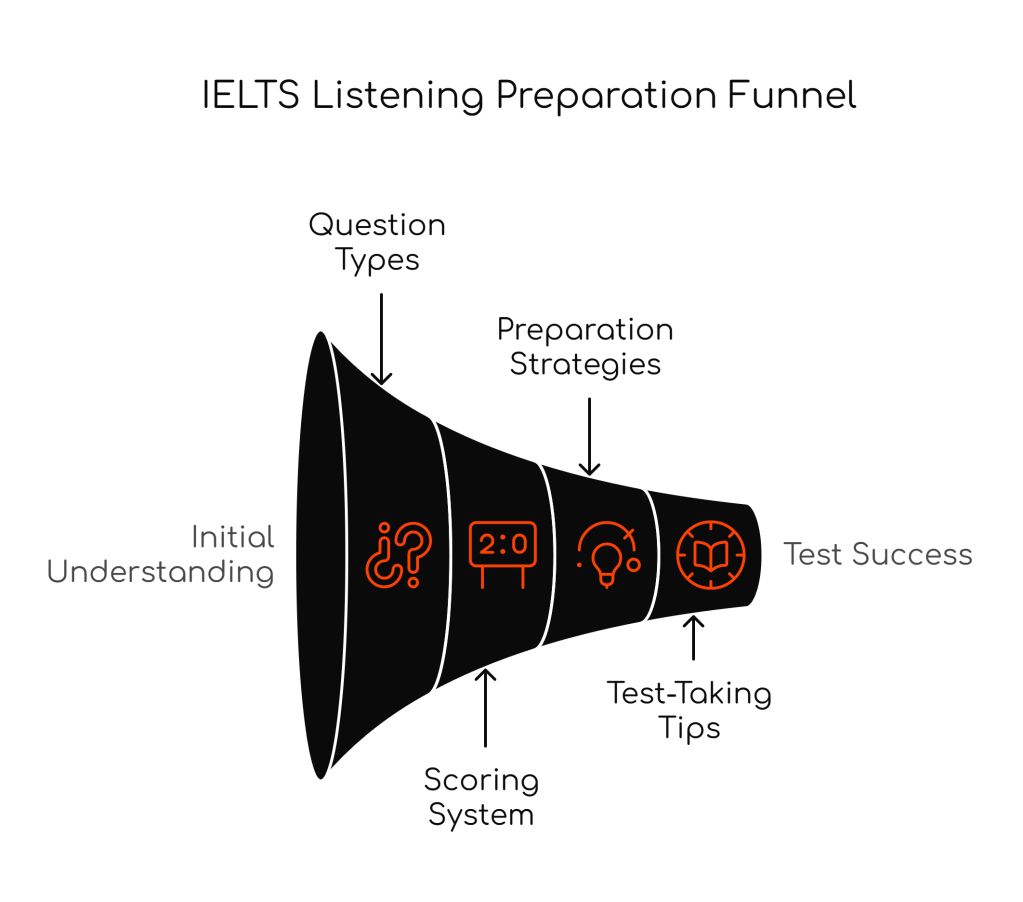
The IELTS Listening test can be challenging, but understanding what to expect and how to approach it makes all the difference. This comprehensive guide answers the 100 most frequently asked questions about IELTS Listening, providing you with the knowledge and strategies needed to excel.
Test Format and Structure
1. How long is the IELTS Listening test? The test lasts approximately 40 minutes: 30 minutes for listening to recordings and answering questions, plus 10 minutes to transfer answers to the answer sheet.
2. How many parts are there in IELTS Listening? There are 4 parts, each with 10 questions, totaling 40 questions.
3. What is the format of each part?
- Part 1: Conversation between two people in an everyday social context
- Part 2: Monologue in an everyday social context
- Part 3: Conversation between up to four people in an educational context
- Part 4: Academic lecture or talk
4. Do I hear each recording once or twice? Each recording is played only once, so you must listen carefully and take notes.
5. What accents will I hear in the test? You’ll hear a variety of native English accents including British, American, Australian, Canadian, and New Zealand accents.
6. Are the sections in order of difficulty? Yes, the difficulty gradually increases from Part 1 (easiest) to Part 4 (most challenging).
7. Can I write on the question paper? Yes, you can and should write notes, underline keywords, and mark important information on the question paper.
8. How much time do I get between parts? You get approximately 30-40 seconds between parts to review the next set of questions.
9. Is there a break during the listening test? No, the test runs continuously for 30 minutes without breaks.
10. What equipment is used for the listening test? In paper-based tests, audio is played through speakers. In computer-based tests, you’ll use headphones.
Question Types
11. What types of questions appear in IELTS Listening? Multiple choice, matching, plan/map/diagram labeling, form/note/table/flow-chart completion, sentence completion, and short-answer questions.
12. What is the most common question type? Form completion and note completion are among the most frequent, especially in Parts 1 and 2.
13. How many words can I write for completion questions? Follow the instruction carefully – it will specify “NO MORE THAN ONE WORD,” “NO MORE THAN TWO WORDS,” or “NO MORE THAN THREE WORDS AND/OR A NUMBER.”
14. What happens if I write more words than allowed? Your answer will be marked incorrect even if the content is right.
15. Are there always multiple choice questions? No, not every test includes multiple choice questions, but they appear frequently.
16. What are matching questions? You match items from one list to items in another, such as matching speakers to opinions or locations to features.
17. How do map and diagram questions work? You’ll label parts of a map, floor plan, or diagram based on descriptions you hear in the recording.
18. What are flow-chart completion questions? You complete a flow-chart showing a process or sequence of events described in the recording.
19. Do I need to spell words correctly? Yes, spelling must be correct. However, both British and American spellings are accepted.
20. What about capitalization? Proper nouns (names, places) should be capitalized, but minor capitalization errors usually don’t affect your score.
Scoring and Band System
21. How is IELTS Listening scored? You receive one point for each correct answer. Your raw score out of 40 is converted to a band score from 1-9.
22. What raw score do I need for Band 7? Typically, you need 30-31 correct answers out of 40 for Band 7, though this can vary slightly.
23. How many questions can I get wrong and still get Band 6? Usually around 23-26 correct answers will give you Band 6.
24. Is there negative marking? No, there’s no penalty for wrong answers, so always guess if you’re unsure.
25. Are all questions worth the same points? Yes, each question is worth one point regardless of difficulty.
26. How precise does my spelling need to be? Very precise. Minor spelling errors will result in incorrect answers.
27. What if I write an answer that’s grammatically incorrect? If the grammar doesn’t fit the sentence structure, your answer may be marked wrong.
28. Can I get half points? No, scoring is either correct (1 point) or incorrect (0 points).
29. How quickly are results available? Results are typically available 13 days after the test date for the paper-delivered test, and 1 to 5 days after the computer-based test.
30. Can I request a re-mark? Yes, you can apply for Enquiry on Results (EOR) if you believe there’s been an error.
Preparation Strategies
31. How long should I prepare for IELTS Listening? Most students need 2-3 months of regular practice, but this varies based on your current English level.
32. What’s the best way to improve my listening skills? Regular exposure to English audio content, active listening practice, and vocabulary building.
33. Should I practice with British or American accents? Practice with various English accents since the test includes multiple accent types.
34. How can I improve my concentration during listening? Practice listening to 30-40 minute audio sessions without breaks to build stamina.
35. What vocabulary should I focus on? Academic vocabulary, everyday conversation terms, and topic-specific words for education, travel, accommodation, and work.
36. Should I take notes while listening? Yes, note-taking is crucial. Practice developing your own shorthand system.
37. How can I predict answers before listening? Read questions carefully and identify keywords, question types, and possible answer formats.
38. What’s the best way to use practice tests? Simulate real test conditions, analyze your mistakes, and identify weak areas.
39. Should I practice with subtitles? Start with subtitles for comprehension, then gradually remove them to build listening skills.
40. How important is grammar for listening? Very important – you need to understand sentence structure to identify where answers fit.
During the Test
41. What should I do while the instructions are being read? Use this time to read the questions for Section 1 and identify keywords.
42. How should I manage my time during the test? Don’t spend too long on one question. Move forward and come back if time permits.
43. What if I miss an answer? Don’t panic. Keep listening and focus on the next question.
44. Should I change my answers? Only if you’re confident. Your first instinct is often correct.
45. How can I stay focused throughout the test? Take deep breaths, stay calm, and maintain active listening posture.
46. What if I can’t understand the speaker’s accent? Focus on context clues and keywords rather than every word.
47. Should I write answers immediately or wait? Write answers as you hear them, but be prepared to modify them if needed.
48. What if two answers seem correct? Choose the one that most directly answers the question based on what you heard.
49. How do I handle distractor information? Listen for signal words like “but,” “however,” “actually” that often introduce the correct answer.
50. What should I do in the transfer time? Check your answers, ensure proper spelling and grammar, and fill any blanks with educated guesses.
Common Challenges
51. Why do I struggle with Part 4? Section 4 uses academic vocabulary and complex sentence structures. Increase exposure to academic content.
52. How do I deal with fast speakers? Practice with various speaking speeds and focus on identifying stressed words and key information.
53. What if I can’t distinguish between similar sounds? Work on minimal pairs practice and phonetic awareness exercises.
54. Why do I miss answers even when I understand the content? You might be listening for meaning rather than specific answer formats. Practice identifying question types.
55. How do I handle multiple speakers in Part 3? Learn to identify different voices quickly and follow conversation flow.
56. What if I panic during the test? Take slow, deep breaths and remember that missing one answer doesn’t ruin your score.
57. Why do I perform worse in actual tests than practice? Test anxiety is common. Practice under timed conditions and develop relaxation techniques.
58. How do I avoid getting distracted by background noise? In practice, occasionally listen with mild distractions to build focus skills.
59. What if I can’t keep up with note-taking? Develop shorthand symbols and focus on keywords rather than complete sentences.
60. Why do I second-guess my answers? Trust your initial response unless you clearly hear contradictory information.
Specific Section Strategies
61. What topics appear in Part 1? Hotel bookings, course enrollment, social arrangements, travel planning, and general inquiries.
62. How should I approach Part 1? Focus on specific details like names, numbers, dates, and addresses.
63. What makes Part 2 challenging? It’s a monologue, so there’s no conversation flow to help predict information.
64. What topics appear in Part 2? Tours, facilities descriptions, events, procedures, and public announcements.
65. How is Section 3 different from Part 1? Section 3 involves academic discussions with more complex vocabulary and concepts.
66. What topics appear in Part 3? Student discussions, tutorial conversations, academic project planning, and course-related conversations.
67. Why is Part 4 the most difficult? It’s an academic lecture with complex vocabulary, abstract concepts, and longer, more detailed explanations.
68. What subjects appear in Part 4? Science, history, business, psychology, environmental studies, and other academic disciplines.
69. How should I prepare for academic vocabulary? Read academic articles, listen to university lectures online, and build subject-specific vocabulary.
70. What signal words should I listen for? “First,” “finally,” “however,” “on the other hand,” “in contrast,” “for example,” and “most importantly.”
Answer Writing Techniques
71. Should I use contractions in my answers? Avoid contractions unless specifically heard in the recording.
72. How do I handle plural vs. singular answers? Listen carefully to the recording and match the form exactly as heard.
73. What about articles (a, an, the)? Include articles only if they’re part of the specific answer required.
74. How do I write numbers in answers? Write numbers as you hear them – if you hear “fifteen,” write “15” unless the format suggests otherwise.
75. What if I’m unsure about hyphenation? Follow standard English conventions, but minor hyphenation errors rarely affect scoring.
76. Should I use capital letters for all proper nouns? Yes, capitalize names of people, places, organizations, and specific titles.
77. How do I handle compound words? Write them as you would in standard English dictionaries.
78. What if I hear two possible spellings? Choose the spelling that makes sense in context.
79. How do I write times and dates? Follow the format suggested by the question or use standard formats (e.g., 2:30 PM, January 15th).
80. What about abbreviations? Use abbreviations only if specifically mentioned in the recording.
Technology and Test Variations
81. Is computer-based IELTS Listening different? The content is identical, but you type answers and use headphones instead of speakers.
82. Can I adjust volume in computer-based tests? Yes, you can adjust headphone volume before the test begins.
83. Are there practice opportunities before the actual test? Yes, both paper-based and computer-based tests include brief practice sessions.
84. What if there are technical problems? Inform the test supervisor immediately. Tests can be paused or restarted if necessary.
85. Do I get the same 10 minutes transfer time in computer-based tests? No, you enter answers directly, so there’s no separate transfer time (unless given additional 2 minutes to check answers).
86. Can I review and change answers in computer-based tests? You can review and change answers within each section, but not once you’ve moved to the next part.
87. Is the scoring identical for both test formats? Yes, scoring criteria and band calculations are identical.
88. Which format is easier? This depends on personal preference. Some find typing faster, others prefer writing.
89. Can I choose my test format? Yes, you can select paper-based or computer-based when booking, subject to availability.
90. Are there any format-specific preparation tips? For computer-based tests, practice typing quickly and accurately under time pressure.
Final Preparation Tips
91. What should I do the day before the test? Review key strategies, relax, get adequate sleep, and avoid intensive studying.
92. What should I bring to the test center? Valid ID, pens for paper-based tests, and any permitted items specified in your confirmation.
93. Should I guess answers I’m unsure about? Yes, always provide an answer since there’s no negative marking.
94. How can I build confidence before the test? Take several full practice tests under timed conditions and track your improvement.
95. What if English isn’t my first language? Focus extra attention on pronunciation patterns and intonation, which help predict meaning.
96. Should I study alone or with others? Both approaches help. Group practice can simulate Part 3 conversations, while solo study builds concentration.
97. What online resources are most helpful? Official IELTS practice materials, BBC Learning English, TED Talks, and the IELTS Guide Phil blog and Spotify podcast.
98. How do I maintain motivation during preparation? Set weekly goals, track progress, and celebrate small improvements.
99. What’s the most important advice for test day? Stay calm, read instructions carefully, and trust your preparation.
100. How do I know if I’m ready for the test? When you consistently score at or above your target band in practice tests under timed conditions.
Conclusion
Success in IELTS Listening comes from understanding the test format, developing effective strategies, and practicing regularly with authentic materials. Remember that improvement takes time, so be patient with yourself and maintain consistent effort. The key is not just to practice, but to practice smartly by analyzing your mistakes and focusing on your weak areas.
Focus on building your overall English listening skills while mastering test-specific techniques. With dedicated preparation and the right approach, you can achieve your target score in IELTS Listening. Good luck with your preparation and test day!
#IELTSListening #IELTSPrep #IELTSTest #EnglishListening #IELTSStudy #IELTSTips #EnglishExam #IELTSStrategies #ListeningSkills #IELTSPractice #EnglishProficiency #TestPreparation #IELTSSuccess #StudyEnglish #IELTSGuidePhil #IELTS
 IELTS Guide Phil
Leave a comment