
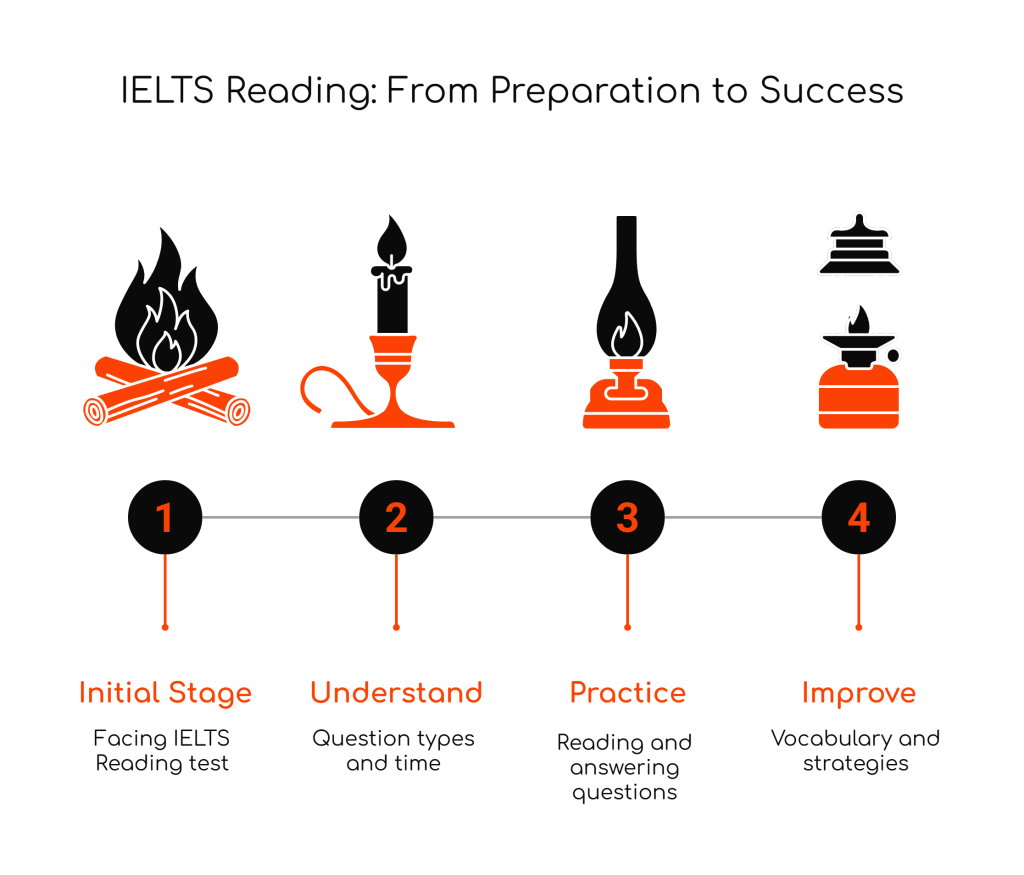
The IELTS Reading test can be challenging, but understanding what to expect and how to approach different question types will significantly improve your performance. This comprehensive guide addresses the 100 most frequently asked questions about IELTS Reading, providing detailed answers and explanations to help you succeed.
General IELTS Reading Information
1. How long is the IELTS Reading test?
The IELTS Reading test is exactly 60 minutes long. You must complete all three passages and answer 40 questions within this time limit. No extra time is given for transferring answers to the answer sheet.
2. How many passages are there in IELTS Reading?
There are three passages in the IELTS Reading test. Each passage becomes progressively more difficult, with Passage 1 being the easiest and Passage 3 being the most challenging.
3. How many questions are there in total?
There are 40 questions in total across all three passages. The distribution is typically 13-14 questions per passage, though this can vary slightly.
4. What’s the difference between Academic and General Training Reading?
Academic Reading features three long passages from books, journals, magazines, and newspapers, designed for academic contexts. General Training Reading has three sections: Section 1 contains short factual texts (advertisements, notices), Section 2 has work-related texts, and Section 3 contains one long, complex text on a general topic.
5. How is IELTS Reading scored?
IELTS Reading is scored on a band scale from 0-9. Your raw score (number of correct answers out of 40) is converted to a band score. Generally, you need about 30+ correct answers for Band 7, and 35+ for Band 8.
Question Types and Strategies
6. What are the main question types in IELTS Reading?
The main question types include: Multiple Choice, True/False/Not Given, Yes/No/Not Given, Matching Headings, Matching Information, Matching Features, Sentence Completion, Summary Completion, Note Completion, Table Completion, Flow Chart Completion, Diagram Labeling, and Short Answer Questions.
7. What’s the difference between True/False/Not Given and Yes/No/Not Given?
True/False/Not Given questions ask about factual information in the text. Yes/No/Not Given questions ask about the writer’s opinions, views, or claims. The logic is the same, but the focus differs.
8. How should I approach True/False/Not Given questions?
Read each statement carefully and find the relevant part of the text. “True/Yes” means the statement matches the text exactly. “False/No” means the statement contradicts the text. “Not Given” means the information isn’t mentioned or there’s insufficient information to determine the answer.
9. What’s the most difficult question type?
Many students find Matching Headings and True/False/Not Given questions most challenging because they require careful analysis and understanding of main ideas versus specific details.
10. Should I read the questions first or the passage first?
It’s generally recommended to skim the passage first to get an overview, then read the questions, and finally read the passage more carefully while answering questions. However, develop a strategy that works best for you through practice.
Time Management
11. How should I divide my time between the three passages?
A common approach is 18-20 minutes per passage, but you might spend slightly less time on Passage 1 (easier) and more on Passage 3 (harder). Always leave time to transfer answers if writing on the question paper.
12. Should I spend equal time on each passage?
Not necessarily. Passage 1 is typically easier and may require less time, while Passage 3 is more complex and may need more time. Adjust based on difficulty and your comfort level.
13. What if I’m running out of time?
If time is running short, focus on question types you’re most confident with. Make educated guesses rather than leaving answers blank, as there’s no penalty for wrong answers.
14. Is it better to guess or leave answers blank?
Always guess if you’re unsure. There’s no negative marking in IELTS, so a guess gives you a chance of getting points, while a blank answer gives you zero points.
15. How much time should I spend on difficult questions?
Don’t spend more than 2-3 minutes on any single question. If you’re stuck, make your best guess and move on. You can return if time permits.
Reading Strategies and Techniques
16. Should I read the entire passage before answering questions?
A quick skim of the entire passage first is helpful for understanding the general topic and structure. Then read more carefully as you answer questions.
17. What is skimming and how do I use it effectively?
Skimming means reading quickly to get the general idea. Focus on the first and last sentences of paragraphs, headings, and key words. Use this to understand the passage structure and main topics.
18. What is scanning and when should I use it?
Scanning means looking quickly for specific information like names, dates, numbers, or keywords. Use this when you know exactly what information you’re looking for based on the questions.
19. How can I improve my reading speed?
Practice reading regularly without stopping to look up every unknown word. Focus on understanding the general meaning. Use finger or pen to guide your eyes and maintain steady pace.
20. Should I try to understand every word?
No, focus on understanding the main ideas and information needed to answer questions. You can often understand the meaning from context without knowing every single word.
Vocabulary and Context
21. What should I do when I encounter unknown words?
Try to understand the meaning from context. Look at surrounding words, the sentence structure, and the general topic. Don’t panic if you don’t know some words.
22. How important is vocabulary for IELTS Reading?
Vocabulary is very important, but you don’t need to know every word. Focus on understanding academic vocabulary, synonyms, and being able to guess meaning from context.
23. Should I use a dictionary during the test?
No, dictionaries are not allowed during the IELTS test. You must rely on your vocabulary knowledge and context clues.
24. How can I improve my vocabulary for IELTS Reading?
Read widely from academic sources, newspapers, and magazines. Keep a vocabulary journal, learn word families and collocations, and practice using new words in context.
25. What are the most common vocabulary topics in IELTS Reading?
Common topics include science and technology, environment, education, health and medicine, business and economics, history and archaeology, social issues, and culture.
Specific Question Types – Multiple Choice
26. How many options are there in multiple choice questions?
Usually 4 options (A, B, C, D), but sometimes 3 options. Read all options carefully before choosing.
27. What’s the best strategy for multiple choice questions?
Eliminate obviously wrong answers first. Look for synonyms and paraphrasing in the correct option. The correct answer often uses different words but the same meaning as the text.
28. Why are multiple choice questions tricky?
The incorrect options (distractors) are designed to seem plausible. They might contain words from the text but in wrong contexts, or be partially correct but not completely accurate.
29. Should I choose the option with words directly from the text?
Not necessarily. The correct answer often paraphrases the text using synonyms. Be cautious of options that contain exact words from the passage, as these might be distractors.
30. How can I avoid multiple choice traps?
Read the question stem carefully, identify key words, find the relevant section in the text, and compare each option with what the text actually says, not what you think it means.
Matching Questions
31. What’s the strategy for Matching Headings questions?
Read all headings first, then read each paragraph to identify its main idea. Cross out headings as you use them. Be aware that there are usually more headings than paragraphs.
32. How do I identify the main idea of a paragraph?
Focus on the topic sentence (usually the first sentence) and the concluding sentence. Ignore examples and details. Ask yourself: “What is this paragraph mainly about?”
33. What should I do if two headings seem to fit a paragraph?
Choose the heading that best captures the main idea, not just a detail mentioned in the paragraph. The correct heading should encompass the overall theme of the paragraph.
34. Are there always extra headings in Matching Headings questions?
Yes, there are always more headings than paragraphs. This means some headings will not be used, making the task more challenging.
35. How do I approach Matching Information questions?
These ask you to find which paragraph contains specific information. Use scanning to locate key words or synonyms from the questions in the text.
Completion Questions
36. What are the rules for completion questions?
Follow the word limit strictly (e.g., “NO MORE THAN TWO WORDS”). Use exact words from the text. Ensure your answer is grammatically correct in the context.
37. Should I change the form of words in completion questions?
Generally no, use words exactly as they appear in the text. However, sometimes minor grammatical changes (like singular to plural) may be necessary for the sentence to make sense.
38. What if the word limit is “ONE WORD ONLY”?
You must write exactly one word. If the answer in the text is two words, you typically need to choose the most important word, or look for a single word that conveys the same meaning nearby.
39. Can I use numbers and symbols in completion questions?
Yes, numbers (including dates) count as one word each. Symbols like % or $ usually count as words, but hyphenated words typically count as one word.
40. How do I maintain grammatical accuracy in completion questions?
Read the incomplete sentence carefully to understand what type of word is needed (noun, verb, adjective). Ensure your answer fits grammatically and makes logical sense.
Academic vs General Training Differences
41. Which is harder, Academic or General Training Reading?
Academic Reading is generally considered more challenging due to complex academic texts and abstract concepts. General Training has more practical, everyday texts but can still be challenging.
42. Can I prepare for both Academic and General Training together?
While some strategies overlap, the text types and contexts are different. Focus your preparation on the specific version you need to take.
43. Are question types the same in both versions?
Yes, both versions use the same question types, but the context and complexity of the texts differ significantly.
44. How do scoring standards compare between the two versions?
The band descriptors are the same, but some research suggests General Training might have slightly stricter marking for higher bands due to more straightforward texts.
45. Which version should I take?
Take Academic if you’re applying for undergraduate or postgraduate study. Take General Training if you’re migrating, applying for work experience, or secondary education.
Test Day Strategies
46. Should I write answers directly on the answer sheet?
If you have time, it’s safer to write answers on the question paper first, then transfer them. However, if you’re short on time, write directly on the answer sheet.
47. What type of pencil should I use?
Use an HB pencil for clear, dark marks. Avoid pens as corrections are difficult, and very light pencils may not scan properly.
48. How should I mark my answers clearly?
For multiple choice, fill in the circle completely. For written answers, write clearly in capital letters to avoid ambiguity.
49. What if I make a mistake on the answer sheet?
Erase completely and mark your new answer clearly. Ensure no traces of the old answer remain, as this might confuse the scanner.
50. Can I ask questions during the test?
You can only ask questions about test procedures, not about the content of the passages or questions. Clarify any doubts about instructions before the test begins.
Common Mistakes
51. What’s the most common mistake in IELTS Reading?
Not reading questions carefully enough and missing key words like “NOT,” “EXCEPT,” or specific time frames that change the meaning completely.
52. Why do students often get True/False/Not Given wrong?
Students often confuse “False” with “Not Given.” Remember: False means the statement contradicts the text; Not Given means the information isn’t mentioned at all.
53. What’s a common error in completion questions?
Exceeding the word limit or using grammatically incorrect forms. Always check that your answer fits grammatically and stays within the specified word count.
54. Why do students struggle with Matching Headings?
Students often choose headings based on keywords rather than main ideas, or they don’t distinguish between main ideas and supporting details.
55. What timing mistake do students often make?
Spending too much time on difficult questions early in the test, leaving insufficient time for easier questions later.
Preparation and Practice
56. How long should I prepare for IELTS Reading?
This depends on your current English level. Generally, 6-12 weeks of focused preparation is recommended, with daily reading practice.
57. What materials should I use for preparation?
Use official IELTS practice tests, Cambridge IELTS books, authentic academic articles, quality newspapers, and reputable online IELTS resources.
58. How often should I take practice tests?
Take one complete practice test weekly, with additional focused practice on specific question types 3-4 times per week.
59. Should I time myself during practice?
Yes, always practice under timed conditions to build speed and stamina. Start with relaxed timing, then gradually work toward the 60-minute limit.
60. How can I analyze my practice test results?
Review every answer, understand why wrong answers are incorrect, identify patterns in your mistakes, and focus additional practice on weak areas.
Text Types and Topics
61. What types of texts appear in Academic Reading?
Academic Reading features excerpts from textbooks, academic journals, research papers, professional articles, and high-quality newspapers and magazines.
62. What topics commonly appear in IELTS Reading?
Common topics include climate change, technology and AI, education systems, health and medicine, archaeology and history, psychology, business and economics, and social issues.
63. Do I need background knowledge of the topics?
No, all information needed to answer questions is in the text. However, general knowledge can help you understand context and work more efficiently.
64. Are IELTS Reading topics culturally biased?
IELTS aims to be culturally neutral, drawing topics from international contexts. However, some familiarity with Western academic writing styles can be helpful.
65. How can I prepare for unfamiliar topics?
Read widely across different subjects, focus on understanding argument structure and main ideas rather than technical details, and practice extracting information regardless of topic familiarity.
Advanced Strategies
66. What is the paragraph method for reading?
Read the first paragraph completely, then read only the first and last sentences of subsequent paragraphs to understand structure, then read in detail as needed for questions.
67. How can I identify writer’s attitude and opinion?
Look for evaluative language, adjectives with positive/negative connotations, modal verbs expressing certainty/uncertainty, and phrases like “surprisingly,” “unfortunately,” or “clearly.”
68. What are transition words and why are they important?
Transition words (however, therefore, moreover, in contrast) show relationships between ideas and help you follow the argument structure and predict what comes next.
69. How do I handle questions that ask about the whole passage?
These usually come last and ask about overall themes, writer’s main purpose, or general conclusions. Consider the passage as a whole rather than focusing on specific details.
70. What’s the difference between main ideas and supporting details?
Main ideas are the central points of paragraphs or the whole passage. Supporting details are examples, statistics, or explanations that support these main ideas.
Specific Challenges
71. How do I deal with very long sentences?
Break them down into smaller parts, identify the main subject and verb first, then understand how additional clauses modify the main idea.
72. What should I do when the text contradicts my knowledge?
Always go with what the text says, not your personal knowledge or opinions. IELTS tests your ability to understand written English, not your general knowledge.
73. How do I handle technical or scientific texts?
Focus on understanding the general argument and relationships between ideas rather than technical details. Use context clues to understand specialized vocabulary.
74. What if I find a passage very boring or difficult?
Stay focused and remember that interest level doesn’t affect your ability to find information. Use active reading strategies to maintain concentration.
75. How do I deal with anxiety during the reading test?
Practice relaxation techniques, maintain steady breathing, focus on one question at a time, and remember that some level of challenge is normal.
Scoring and Results
76. What’s considered a good IELTS Reading score?
This depends on your goals. Band 6.5-7 is good for most university programs, while Band 8+ is excellent and demonstrates near-native reading ability.
77. How accurate are online IELTS score calculators?
They provide rough estimates but aren’t perfectly accurate. Official IELTS uses complex statistical methods that simple calculators can’t replicate exactly.
78. Can I improve my Reading score quickly?
Reading improvement takes time, but focused practice on specific weaknesses can yield relatively quick improvements in test technique and strategy.
79. What if I get different scores on practice tests?
Score variation is normal due to different passage difficulty, your familiarity with topics, and daily performance fluctuations. Focus on trends over time.
80. How do universities view IELTS Reading subscores?
Most universities look at overall IELTS scores, but some programs may have minimum requirements for specific skills including Reading.
Technology and Changes
81. Is IELTS Reading available on computer?
Yes, IELTS on computer is available in many locations. The content and timing are the same, but you read on screen and type answers directly.
82. Which is easier, paper-based or computer-based?
This varies by individual preference. Computer-based allows easier text searching and editing answers, but some prefer reading on paper.
83. Has IELTS Reading changed recently?
The basic format remains stable, but there are occasional minor updates to question types and text topics to reflect current academic and general contexts.
84. Are there any new question types being introduced?
IELTS occasionally pilots new question formats, but changes are introduced gradually and with advance notice to test-takers.
85. How does AI affect IELTS preparation?
AI tools can help with practice and feedback, but be cautious about over-relying on them. Human judgment and authentic materials remain crucial for effective preparation.
Special Considerations
86. What accommodations are available for disabilities?
IELTS provides various accommodations including extra time, large print materials, separate rooms, and computer-based tests for candidates with documented disabilities.
87. Can I retake just the Reading component?
No, you must retake the entire IELTS test. However, some institutions accept IELTS One Skill Retake where available.
88. How long are IELTS scores valid?
IELTS scores are valid for two years from the test date for most purposes, though some institutions may have different requirements.
89. What if English isn’t my first language?
IELTS is designed for non-native English speakers. Focus on developing reading strategies and academic English vocabulary relevant to the test format.
90. How does age affect IELTS Reading performance?
There’s no age limit for IELTS. Older test-takers might need more time to adjust to test formats, while younger ones might struggle with academic text complexity.
Final Preparation Tips
91. What should I do the week before my test?
Take one final practice test, review common question types and strategies, ensure you know test day procedures, and avoid intensive studying the day before.
92. How can I build confidence for test day?
Take multiple full-length practice tests under timed conditions, review your improvement over time, and familiarize yourself with test center procedures.
93. Should I study other IELTS skills while preparing Reading?
Yes, integrated practice is beneficial. Reading skills support Writing Task 1 descriptions and provide vocabulary for Speaking, but maintain focused Reading practice.
94. What’s the best way to review mistakes?
Understand why each wrong answer is incorrect, identify the correct information in the text, analyze what led to the mistake, and practice similar question types.
95. How important is general English improvement vs. test strategy?
Both are important. Strong general reading ability provides the foundation, while specific test strategies help you apply that ability effectively within IELTS constraints.
Test Day Logistics
96. What should I bring to the test center?
Bring the same identification used for registration, additional acceptable ID as backup, and any approved materials. Leave everything else at home or in a locker.
97. What happens if I arrive late?
Arrive at least 30 minutes early. Late arrivals may not be admitted, and you won’t receive a refund or be able to reschedule without paying additional fees.
98. Can I leave early if I finish the Reading test?
No, you must remain in the test room for the full 60 minutes. Use extra time to review your answers and ensure they’re marked clearly.
99. What if I feel unwell during the test?
Inform the test supervisor immediately. You may be able to reschedule without penalty if you have medical documentation, depending on the circumstances.
100. How soon will I receive my results?
Results are typically available 3-5 days after computer-based tests and 13 days after paper-based tests. You’ll receive notification when results are ready online.
Conclusion
Success in IELTS Reading comes from combining strong English reading skills with effective test strategies and regular practice. Focus on understanding question types, managing your time efficiently, and developing confidence through consistent preparation. Remember that improvement takes time, so be patient with yourself and maintain regular practice habits.
The key to achieving your target score lies in understanding not just what to do, but why certain strategies work and how to adapt them to different text types and question formats. Use this guide as a reference throughout your preparation, and don’t hesitate to revisit specific sections as you identify areas for improvement.
Good luck with your IELTS Reading preparation and test day!
#IELTSReading #IELTSPreparation #IELTSTest #IELTSTips #IELTSStudy #EnglishTest #IELTSAcademic #IELTSGeneralTraining #ReadingSkills #IELTSStrategy #TestPreparation #EnglishLearning #IELTSHelp #StudyAbroad #IELTSSuccess #IELTSGuidePhil
 IELTS Guide Phil
Leave a comment