
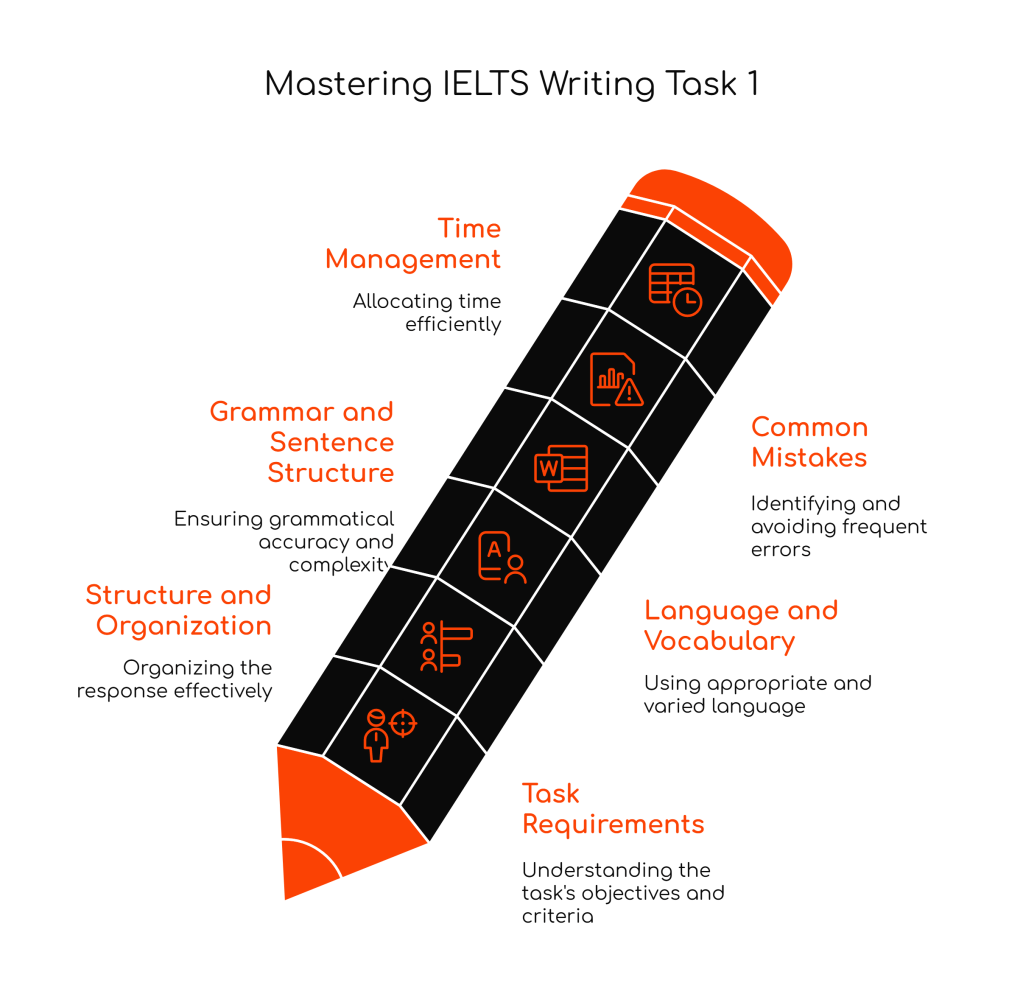
Complete Guide with Answers and Explanations
The IELTS Writing Task 1 Academic can be challenging for many test-takers. This comprehensive guide addresses the 100 most frequently asked questions to help you master this crucial component of the IELTS exam.
General Questions About IELTS Writing Task 1
1. What is IELTS Writing Task 1 Academic? IELTS Writing Task 1 Academic requires you to describe, summarize, or explain visual information such as graphs, charts, tables, diagrams, or maps in at least 150 words within 20 minutes.
2. How much time should I spend on Task 1? Allocate exactly 20 minutes to Task 1. This leaves 40 minutes for Task 2, which carries more weight in your overall Writing band score.
3. What types of visuals appear in Task 1? Common types include line graphs, bar charts, pie charts, tables, process diagrams, maps, and mixed charts combining multiple visual elements.
4. How many words should I write? Write at least 150 words. However, aim for 160-180 words to ensure you meet the requirement while staying focused and concise.
5. Will I be penalized for writing more than 150 words? No direct penalty exists for exceeding 150 words, but writing too much may waste time needed for Task 2 and could lead to irrelevant information.
Understanding Task Requirements
6. What are the assessment criteria for Task 1? You’re assessed on four criteria: Task Achievement (25%), Coherence and Cohesion (25%), Lexical Resource (25%), and Grammatical Range and Accuracy (25%).
7. What does Task Achievement mean? Task Achievement measures how well you address the task requirements, including covering key features, making appropriate comparisons, and presenting accurate information.
8. How important is the overview paragraph? The overview is crucial for achieving a high Task Achievement score. It should summarize the main trends or most significant features without specific data.
9. Should I include my opinion in Task 1? No, Task 1 is purely descriptive. Avoid giving opinions, explanations for trends, or speculating about causes and effects.
10. Do I need to describe every single detail? No, focus on the most significant features, main trends, and notable comparisons. Describing every minor detail will exceed the word limit unnecessarily.
Structure and Organization
11. What’s the recommended structure for Task 1? Use four paragraphs: Introduction (paraphrase the question), Overview (main trends/features), Body 1 (specific details), and Body 2 (more specific details with comparisons).
12. How do I write an effective introduction? Paraphrase the question using synonyms and different sentence structures. For example, change “shows” to “illustrates” or “depicts.”
13. What should I include in the overview? Highlight the most significant trends, patterns, or features without including specific numbers or data points.
14. How do I organize body paragraphs? Group related information logically. For line graphs, you might organize by time periods or by different categories shown.
15. Should I write a conclusion? No, a conclusion is not necessary in Task 1. The overview serves as your summary of main points.
Language and Vocabulary
16. What vocabulary is essential for describing trends? Learn verbs (increase, decrease, fluctuate), nouns (growth, decline, stability), adjectives (significant, gradual, steady), and adverbs (dramatically, slightly, consistently).
17. How can I vary my language for describing increases? Use synonyms like: rise, grow, climb, surge, soar, escalate, or jump. Combine with adverbs for precision: rose sharply, increased gradually.
18. What words describe decreases effectively? Try: fall, drop, decline, plummet, dip, slide, or tumble. Add adverbs: decreased significantly, fell slightly.
19. How do I describe stability or no change? Use: remain stable, stay constant, maintain the same level, plateau, level off, or show little variation.
20. What prepositions are important for Task 1? Master: from X to Y (time/range), at X (specific point), by X (amount of change), of X (possession/proportion), in X (time period/location).
Describing Different Chart Types
21. How do I approach line graphs? Focus on trends over time, identify highest and lowest points, note significant changes, and compare different lines if multiple are present.
22. What’s the best strategy for bar charts? Compare values between categories, identify highest and lowest bars, group similar values, and note any patterns or significant differences.
23. How should I describe pie charts? Focus on proportions, identify the largest and smallest segments, group similar-sized segments, and make relevant comparisons between parts.
24. What’s important when describing tables? Organize data logically (by rows, columns, or categories), identify highest and lowest values, and make meaningful comparisons across different dimensions.
25. How do I handle mixed charts? Treat each chart type according to its specific requirements while making connections between the different visual elements when relevant.
Grammar and Sentence Structure
26. What tenses should I use in Task 1? Use past tense for historical data, present tense for current/general information, and future tense for projections. Match the tense to the time frame shown.
27. How can I create complex sentences? Use subordinating conjunctions (while, whereas, although), relative clauses (which, that), and participial phrases to combine ideas effectively.
28. What’s the passive voice’s role in Task 1? Use passive voice to vary sentence structure and focus on data rather than agents: “Sales were recorded at…” instead of “The company recorded sales at…”
29. How do I make effective comparisons? Use comparative structures: “higher than,” “twice as much as,” “significantly more than,” or “the highest among all categories.”
30. What about superlative forms? Use superlatives to highlight extremes: “the most popular,” “the least common,” “the highest peak,” or “the most significant change.”
Common Mistakes and How to Avoid Them
31. What’s the biggest mistake in Task 1? Failing to write an overview paragraph is the most common error that significantly impacts your Task Achievement score.
32. Should I copy words from the question? Minimize copying by paraphrasing the question in your introduction. Use synonyms and different sentence structures.
33. Is it wrong to include specific numbers in the overview? Yes, the overview should focus on general trends and patterns without specific data points or exact figures.
34. Can I describe data that’s not shown? Never describe information not present in the visual. Stick strictly to what’s displayed in the chart, graph, or diagram.
35. Should I explain why trends occurred? No, Task 1 requires description only. Avoid speculating about causes, reasons, or explanations for the data patterns.
Time Management
36. How do I analyze the visual quickly? Spend 2-3 minutes identifying chart type, time frame, units of measurement, and main trends before you start writing.
37. What if I can’t finish in 20 minutes? Practice regularly with timed conditions. If you run out of time during the test, ensure you have at least written an introduction and overview.
38. Should I plan before writing? Yes, spend 2-3 minutes planning your structure and identifying key points to include in each paragraph.
39. How much time for each paragraph? Approximately: 2 minutes planning, 3 minutes introduction, 4 minutes overview, 6 minutes body paragraph 1, 5 minutes body paragraph 2.
40. What if I write too slowly? Practice writing by hand regularly, learn common phrases by heart, and focus on fluency rather than perfection during timed practice.
Specific Chart Analysis
41. How do I identify the main trend in a line graph? Look for the overall direction of movement across the time period, ignoring minor fluctuations to focus on the general pattern.
42. What if multiple lines cross each other? Note where lines intersect, which categories start highest/lowest, and how their relative positions change over time.
43. How do I group data in bar charts? Group bars with similar values, compare categories with the largest differences, and organize by logical relationships.
44. What’s important in pie chart analysis? Focus on the largest segments, group smaller segments together, and express proportions clearly using fractions or percentages.
45. How do I handle tables with lots of data? Select the most significant figures, group related data, and avoid describing every single number in the table.
Advanced Techniques
46. How can I show sophisticated language use? Vary sentence beginnings, use advanced vocabulary appropriately, employ different grammatical structures, and demonstrate precise word choice.
47. What’s the role of linking words? Use cohesive devices to connect ideas: furthermore, in contrast, similarly, meanwhile, subsequently, and conversely.
48. How do I avoid repetition? Use synonyms, vary sentence structures, employ different grammatical forms of the same word, and use pronouns appropriately.
49. Should I use approximate language? Yes, use phrases like “approximately,” “roughly,” “just over,” “nearly,” and “around” to describe data naturally.
50. How do I make my writing more precise? Use specific vocabulary for different types of changes, include relevant time markers, and choose appropriate intensifying adverbs.
Process Diagrams
51. How do I approach process diagrams? Identify the starting point, follow the sequence logically, use appropriate sequencing language, and describe each major stage clearly.
52. What language is essential for processes? Use sequencing words: first, initially, next, then, subsequently, following this, finally, and at the end of the process.
53. Should I use passive voice in process descriptions? Yes, passive voice is often more appropriate: “The materials are heated” rather than “Workers heat the materials.”
54. How do I handle complex processes? Break them into logical stages, group related steps together, and use clear transitions between different phases.
55. What if the process is cyclical? Indicate that the process repeats by using phrases like “the cycle begins again” or “this completes the cycle.”
Maps and Changes Over Time
56. How do I describe maps effectively? Use directional language (north, south, east, west), describe locations relative to landmarks, and focus on the most significant changes.
57. What vocabulary is crucial for map descriptions? Learn location prepositions: adjacent to, opposite, northwest of, in the vicinity of, surrounded by, and between.
58. How do I organize map descriptions? You can organize by location (moving systematically across the map) or by type of change (new constructions, demolitions, expansions).
59. What’s important when describing changes over time in maps? Focus on what was added, removed, or modified, and use appropriate tenses to show the time sequence clearly.
60. Should I mention every small change in maps? No, prioritize major developments and significant alterations while mentioning minor changes only if space permits.
Band Score Requirements
61. What do I need for Band 6 in Task Achievement? Address the task with relevant information, present an overview with some development, and highlight key features with some support.
62. How do I achieve Band 7 in Task Achievement? Cover requirements sufficiently, present a clear overview with key features well-highlighted, and provide accurate details with relevant support.
63. What’s required for Band 8 Task Achievement? Sufficiently and appropriately address all requirements, skillfully present a well-developed overview, and select and report key features with relevant, extended, and precise support.
64. How is Coherence and Cohesion assessed? Examiners look at logical organization, appropriate paragraphing, effective use of cohesive devices, and clear progression throughout the response.
65. What does Lexical Resource evaluate? This criterion assesses vocabulary range, accuracy of word choice, appropriate word formation, and natural use of less common vocabulary.
Practice and Preparation
66. How often should I practice Task 1? Practice at least 3-4 times per week, focusing on different chart types and timing yourself consistently.
67. What’s the best way to improve quickly? Analyze model answers, practice paraphrasing techniques, build vocabulary lists by topic, and get feedback on your writing.
68. Should I memorize templates? Learn flexible sentence patterns rather than rigid templates. Templates can make your writing sound unnatural and limit your band score.
69. How do I expand my vocabulary effectively? Study vocabulary in context, practice using new words in sentences, group words by function (describing trends, making comparisons), and review regularly.
70. What resources are most helpful? Use official IELTS materials, reputable preparation books, online practice tests, and seek feedback from qualified teachers.
Common Phrases and Expressions
71. What are useful phrases for introducing data? “The chart illustrates,” “According to the graph,” “The data reveals,” “It can be seen that,” and “The information demonstrates.”
72. How do I introduce comparisons effectively? Use: “In comparison,” “By contrast,” “Similarly,” “On the other hand,” “Whereas,” and “While X shows…, Y demonstrates…”
73. What phrases help describe significant changes? “A dramatic increase,” “A substantial decline,” “A marked improvement,” “A notable fluctuation,” and “A considerable variation.”
74. How do I express approximations naturally? Use: “Approximately,” “Roughly,” “Around,” “Just over,” “Nearly,” “Close to,” “About,” and “In the region of.”
75. What language helps with time references? “During this period,” “Throughout the timeframe,” “Between X and Y,” “From the outset,” “By the end of,” and “Over the course of.”
Technical Aspects
76. How do I read scales and units correctly? Always check the y-axis scale, note if numbers are in thousands/millions, identify the units of measurement, and be precise with figures.
77. What if the chart has no specific time frame? Use present tense and focus on general comparisons rather than trends over time.
78. How do I handle percentages vs. actual numbers? Be clear about which you’re reporting, don’t mix them inappropriately, and ensure your language matches the data type.
79. What about charts with multiple y-axes? Note that different data series may use different scales, be careful not to make inappropriate direct comparisons, and clarify which axis relates to which data.
80. How do I deal with missing data points? Don’t speculate about missing information, note if data is unavailable for certain periods, and focus on the data that is provided.
Advanced Grammar
81. How do I use articles correctly in Task 1? Use “the” for specific data sets and chart elements, “a” for general references, and no article for general categories or trends.
82. What’s the role of conditionals in Task 1? Generally avoid conditionals since Task 1 is descriptive, not speculative. Focus on what the data shows, not what might happen.
83. How do I use reported speech in Task 1? Rarely needed in Task 1, but you might use it when describing survey results: “Respondents indicated that…”
84. What about modal verbs in Task 1? Use sparingly and appropriately: “can be seen,” “may indicate” (for tentative observations), but avoid speculation.
85. How do I handle subject-verb agreement with data? “Data” can be singular or plural depending on context. “The data shows” or “The data show” are both acceptable.
Specific Vocabulary Groups
86. What words describe rapid changes? Verbs: soar, plummet, surge, crash, skyrocket, nosedive. Adverbs: dramatically, sharply, rapidly, steeply, abruptly.
87. How do I describe gradual changes? Verbs: climb, slide, edge up/down. Adverbs: gradually, slowly, steadily, consistently, progressively.
88. What language describes fluctuations? Verbs: fluctuate, oscillate, vary, alternate. Nouns: variation, volatility, instability. Adjectives: erratic, unstable, variable.
89. How do I express proportions clearly? Use fractions (one-third, three-quarters), percentages (25%, 75%), ratios (3:1, twice as much), and proportion words (majority, minority).
90. What words help with rankings? “Highest,” “lowest,” “second-highest,” “third-largest,” “ranked first,” “came second,” “bottom-ranked,” and “mid-ranking.”
Final Tips and Strategies
91. How do I stay calm during the test? Practice regularly under timed conditions, have a clear strategy for each chart type, and remember that perfection isn’t required.
92. What if I encounter an unfamiliar chart type? Apply general description principles: identify key features, make comparisons, organize logically, and describe what you observe.
93. Should I use bullet points or lists? No, write in full sentences and paragraphs. Task 1 requires continuous prose, not bullet points or lists.
94. How do I check my work effectively? Look for basic grammar errors, ensure you’ve included an overview, check that you’ve addressed the task fully, and verify word count.
95. What’s the role of handwriting in scoring? While not directly scored, illegible handwriting can affect the examiner’s ability to assess your response accurately.
96. How do I manage stress about Task 2? Stay focused on Task 1 during its allocated time, don’t worry about Task 2 while writing Task 1, and trust your preparation.
97. What if I make a mistake? Cross out errors neatly with a single line, write corrections clearly, don’t waste time with extensive erasing, and continue writing.
98. Should I write the word count? It’s not necessary to write the word count, but knowing approximately how much 150 words looks like in your handwriting helps.
99. How important is neat presentation? While content is most important, clear paragraphing and legible handwriting help examiners assess your work accurately.
100. What’s the key to success in Task 1? Regular practice, understanding task requirements clearly, building relevant vocabulary, managing time effectively, and focusing on accurate description rather than explanation.
Conclusion
Success in IELTS Writing Task 1 Academic comes from understanding the task requirements, practicing regularly with different chart types, building appropriate vocabulary, and managing your time effectively. Remember that Task 1 is purely descriptive – your job is to report what you see in the visual information accurately and clearly.
Focus on the four key areas: addressing the task completely (including a clear overview), organizing your response logically, using varied and accurate vocabulary, and demonstrating good grammatical control. With consistent practice and attention to these fundamentals, you can achieve your target band score.
The most important advice is to practice regularly with authentic materials, time yourself consistently, and seek feedback on your writing. Every chart tells a story through its data – your task is to retell that story clearly and accurately in academic English.
#IELTSGuidePhil #IELTSWriting #IELTSTask1 #IELTSAcademic #IELTSPreparation #IELTSTest #EnglishWriting #IELTSStudy #IELTSTips #AcademicWriting #EnglishExam #IELTSHelp #StudyEnglish #IELTSSuccess #TestPreparation #EnglishLanguage
 IELTS Guide Phil
Leave a comment