
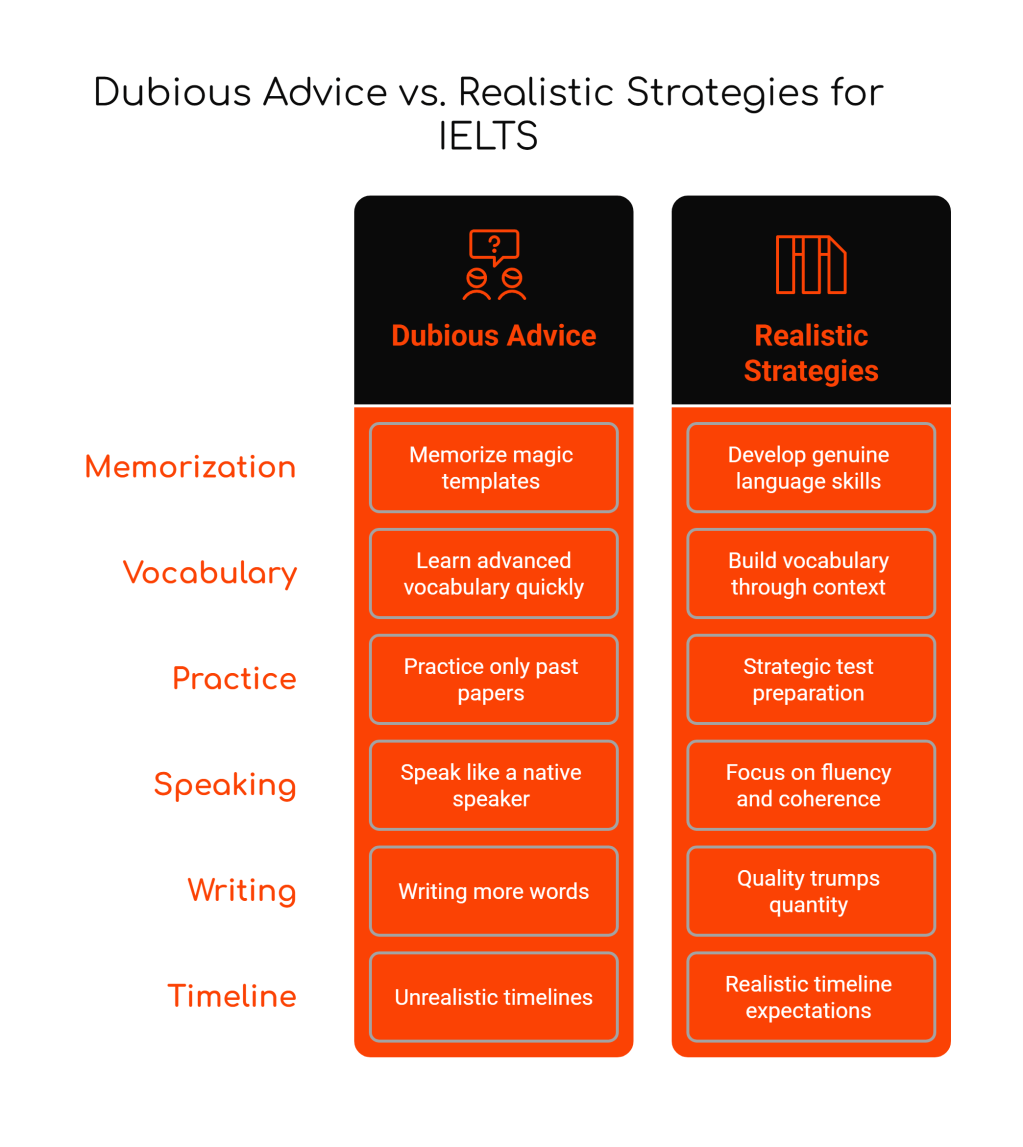
The IELTS (International English Language Testing System) preparation industry is flooded with questionable advice that promises unrealistic results. While some guidance is genuinely helpful, much of it can mislead test-takers and waste precious preparation time. Here’s a comprehensive breakdown of dubious advice versus realistic strategies that actually work.
Dubious Advice to Avoid
“Memorize These Magic Templates!”
The Myth: Many prep courses sell “foolproof templates” for Writing Task 1 and Task 2, claiming you can simply plug in information and guarantee high scores.
Why It’s Problematic:
- IELTS examiners are trained to spot templated responses and mark them down
- Templates often lead to awkward, unnatural language that doesn’t address the specific question
- Over-reliance on templates prevents development of genuine writing skills
- Many templates contain outdated or incorrect language patterns
“Learn 1000 Advanced Vocabulary Words in 10 Days”
The Myth: Cramming sophisticated vocabulary will automatically boost your band score across all sections.
Why It’s Misleading:
- Using advanced words incorrectly actually lowers your score
- IELTS rewards appropriate vocabulary use, not complexity for its own sake
- Memorized word lists often lack context and proper usage examples
- Native speakers don’t typically use “advanced” vocabulary in everyday communication
“Practice Only Past Papers for Maximum Results”
The Myth: Doing endless practice tests without other preparation will lead to significant improvement.
The Reality Check:
- Practice tests show your current level but don’t teach new skills
- Without analyzing mistakes and working on weaknesses, scores plateau quickly
- Many “past papers” online are fake or poorly constructed
- Real improvement requires targeted skill development, not just test familiarity
“Speak Like a Native to Get Band 9”
The Myth: You must sound exactly like a British or American speaker to achieve top scores.
Why This Is Wrong:
- IELTS assesses communication effectiveness, not accent mimicry
- Many Band 9 speakers have non-native accents
- Forcing an unnatural accent often leads to pronunciation errors
- Clear, intelligible speech matters more than sounding “native”
“Writing More Words = Higher Scores”
The Myth: Exceeding word limits significantly will impress examiners and boost scores.
The Truth:
- Quality trumps quantity in IELTS writing
- Examiners may stop reading after the recommended word count
- Longer essays often contain more errors and irrelevant information
- Meeting requirements precisely demonstrates better task management
Realistic Guidance That Works
Develop Genuine Language Skills
Reading Section:
- Read diverse English materials daily (news, academic articles, magazines)
- Practice skimming for main ideas and scanning for specific information
- Build vocabulary through context, not memorization
- Time yourself regularly but focus on comprehension accuracy first
Listening Section:
- Listen to various English accents through podcasts, BBC, documentaries
- Practice note-taking while listening to lectures or talks
- Focus on understanding meaning, not catching every single word
- Use authentic materials, not just IELTS practice tests
Writing Section:
- Learn to analyze questions thoroughly before writing
- Practice planning and organizing ideas logically
- Study model answers to understand structure, not to memorize phrases
- Get feedback from qualified instructors on your writing
- Focus on clarity, coherence, and task response over complexity
Speaking Section:
- Practice speaking on various topics for 1-2 minutes daily
- Record yourself to identify areas for improvement
- Focus on fluency and coherence over perfect grammar
- Develop opinions on common IELTS topics (education, environment, technology)
- Practice with English speakers when possible, but don’t worry about accent
Strategic Test Preparation
Understand the Assessment Criteria:
- Learn exactly what each band score represents for each skill
- Understand that different sections have different marking schemes
- Focus on meeting criteria rather than impressing examiners
Time Management:
- Practice under timed conditions regularly
- Learn to pace yourself appropriately for each section
- Don’t spend too much time on difficult questions in Reading/Listening
- Allocate planning time for Writing tasks
Target Your Weaknesses:
- Take diagnostic tests to identify specific areas needing improvement
- Dedicate more practice time to your weakest skills
- Address fundamental language issues before focusing on test techniques
Realistic Timeline Expectations
For Most Test-Takers:
- Expect 3-6 months of consistent preparation for significant improvement
- Band score improvements typically happen in 0.5 increments
- Your current English level largely determines how quickly you can improve
- Intensive study (2-3 hours daily) yields better results than sporadic cramming
Setting Achievable Goals:
- Aim for scores that match your current language ability with focused improvement
- Don’t expect to jump from Band 5 to Band 8 in a few weeks
- Consider your target institution’s actual requirements, not just the highest possible score
Red Flags in IELTS Prep Materials
Watch out for these warning signs in courses, books, or online resources:
- Guaranteed band scores: No legitimate prep can guarantee specific results
- “Secret techniques” or “insider tricks”: IELTS is transparent about its assessment
- One-size-fits-all solutions: Effective prep must address individual weaknesses
- Unrealistic timelines: Claims of major improvements in days or weeks
- Focus only on test tricks: Real improvement requires genuine language development
- Expensive “exclusive” materials: Quality prep resources are widely available at reasonable costs
Building a Realistic Study Plan
Assessment Phase (Week 1)
- Take a complete practice test under exam conditions
- Identify your current band scores for each section
- Analyze specific weaknesses and error patterns
- Set realistic target scores based on your needs and timeline
Skill Development Phase (Ongoing)
- Dedicate 60% of study time to improving English skills
- Spend 30% on test-specific strategies and practice
- Reserve 10% for full practice tests and review
Regular Monitoring
- Take practice tests monthly to track progress
- Adjust study focus based on results
- Seek feedback from qualified instructors when possible
The Bottom Line
Effective IELTS preparation requires honest assessment of your current abilities, realistic goal-setting, and consistent work on genuine language skills. While test strategies and familiarity with the format are important, they cannot substitute for solid English proficiency.
Avoid quick fixes and magic solutions. Instead, invest in systematic skill development, use authentic materials, and give yourself adequate time to improve. Remember that IELTS is designed to assess real English ability for academic and professional contexts – and that’s exactly what your preparation should develop.
The most successful IELTS candidates treat the test as motivation to genuinely improve their English, not as an obstacle to overcome with tricks and shortcuts. This approach not only leads to better test scores but also provides the language skills needed for success in English-speaking academic and professional environments.
#IELTSGuidePhil #IELTS #IELTSPrep #IELTSMyths #IELTSReality #IELTSStudyTips #IELTSAdvice #IELTSGuidance #IELTSSuccess #IELTSMistakes #IELTSFacts #IELTSStrategy
 IELTS Guide Phil
Leave a comment