
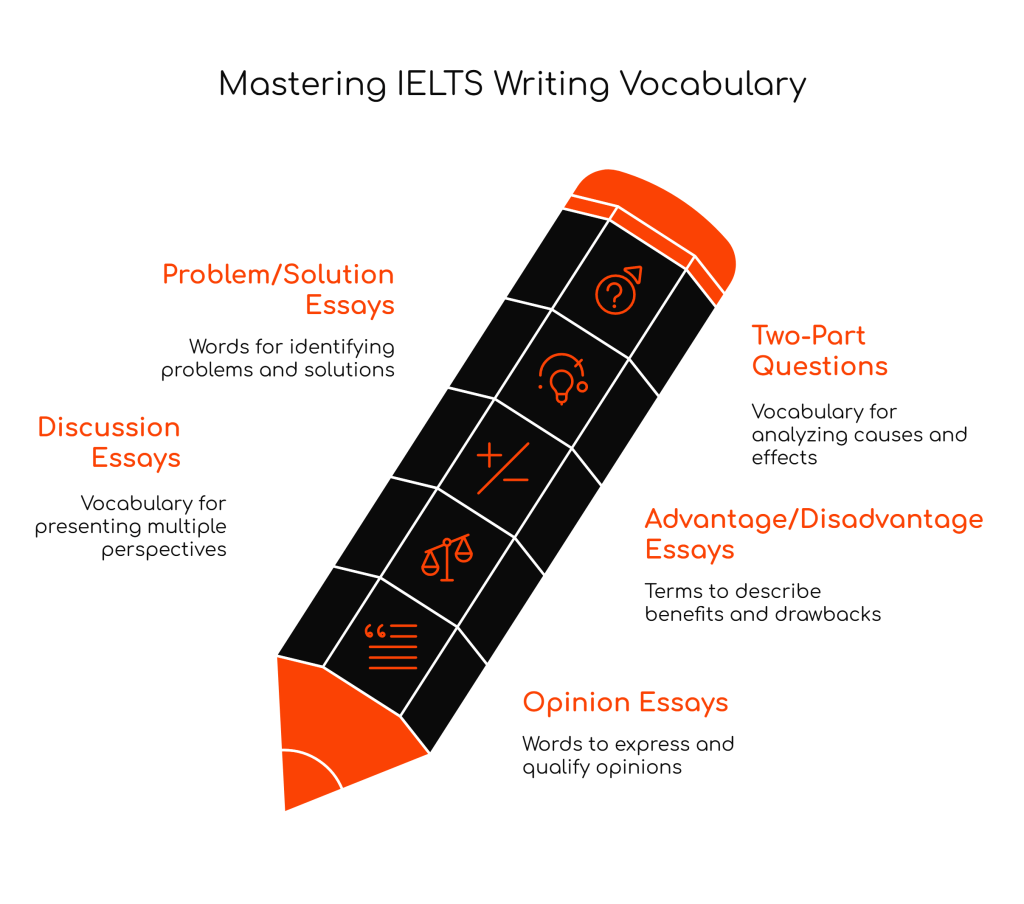
Success in IELTS Writing Task 2 requires not only strong ideas and clear organization but also sophisticated vocabulary that matches your essay type. Each of the five main Task 2 essay types—Opinion, Discussion, Advantage/Disadvantage, Problem/Solution, and Two-Part Questions—requires specific vocabulary to express ideas effectively and achieve higher band scores. This comprehensive guide presents 100 carefully selected vocabulary words organized by essay type, complete with definitions and contextual examples. You can watch this YouTube video explainer by IELTS Guide Phil.
Opinion Essays (20 words)
Expressing Strong Opinions (10 words)
- Adamant – Refusing to be persuaded or to change one’s mind
I am adamant that education should be free for all children. - Conviction – A firmly held belief or opinion
It is my firm conviction that technology enhances learning outcomes. - Staunchly – In a very committed or loyal way
I staunchly believe that environmental protection should be prioritized. - Unequivocally – In a way that leaves no doubt
I unequivocally support the implementation of renewable energy policies. - Categorically – In a way that is unqualified and absolute
I categorically reject the notion that money guarantees happiness. - Wholeheartedly – With complete sincerity and commitment
I wholeheartedly endorse the idea of universal healthcare. - Emphatically – In a forceful way
I emphatically disagree with the statement that art is unnecessary. - Resolutely – In an admirably determined way
I resolutely maintain that hard work leads to success. - Unwaveringly – In a steady, unchanging way
I unwaveringly support the rights of all individuals to quality education. - Fervently – With passionate intensity
I fervently believe that cultural diversity strengthens society.
Qualifying and Moderating Opinions (10 words)
- Tentatively – In a careful, uncertain way
I would tentatively suggest that technology has both benefits and drawbacks. - Arguably – It may be argued that; possibly
Social media is arguably the most influential invention of the 21st century. - Presumably – Used to convey that what is asserted is very likely
Parents presumably want the best educational opportunities for their children. - Ostensibly – As appears or is stated to be true, though not necessarily so
The policy was ostensibly designed to help students, but critics question its effectiveness. - Purportedly – As appears or is claimed to be true
The new teaching method purportedly improves student engagement. - Allegedly – Used to convey that something is claimed to be the case
The program allegedly reduces dropout rates, though evidence is mixed. - Conceivably – It is possible to imagine or believe
Technology could conceivably replace traditional classroom teaching. - Plausibly – In a way that seems reasonable or probable
One could plausibly argue that experience is more valuable than formal education. - Potentially – With the capacity to develop into something in the future
Online learning could potentially revolutionize education systems worldwide. - Ostensibly – Apparently but perhaps not actually
The measure was ostensibly introduced to improve safety standards.
Discussion Essays (20 words)
Presenting Multiple Perspectives (10 words)
- Proponents – People who advocate for or support something
Proponents of homeschooling argue that it provides personalized education. - Advocates – People who publicly support or recommend something
Advocates of renewable energy emphasize its environmental benefits. - Adherents – People who support and follow a particular belief
Adherents to this philosophy believe that competition drives innovation. - Opponents – People who disagree with or resist something
Opponents of standardized testing claim it narrows educational focus. - Detractors – People who criticize or disparage something
Detractors of social media highlight its negative impact on mental health. - Critics – People who express disapproval or find fault
Critics of globalization argue that it increases economic inequality. - Skeptics – People who question or doubt accepted opinions
Skeptics of artificial intelligence worry about job displacement. - Dissidents – People who oppose official policy
Dissidents argue that current educational policies are inadequate. - Contenders – People who assert or maintain something
Contenders in this debate present compelling evidence for both sides. - Pundits – Experts who offer opinions on particular subjects
Educational pundits disagree about the effectiveness of online learning.
Balancing Arguments (10 words)
- Conversely – Introducing a statement contrary to previous one
Technology offers convenience; conversely, it may reduce human interaction. - Nevertheless – In spite of that; however
The program has limitations; nevertheless, it has achieved significant success. - Nonetheless – Despite what has just been said
The policy faces criticism; nonetheless, it has popular support. - Notwithstanding – Although; in spite of
Notwithstanding these challenges, the initiative has merit. - Paradoxically – In a way that seems contradictory
Paradoxically, increased connectivity has led to greater social isolation. - Ironically – In a way that is contrary to what is expected
Ironically, labor-saving devices have made people busier than ever. - Juxtaposed – Placed side by side for comparison
When juxtaposed with traditional methods, online learning shows clear advantages. - Contrarily – In a way that is opposite or contrary
Some embrace technology; contrarily, others resist digital advancement. - Alternatively – As another option
Students can attend university; alternatively, they might pursue vocational training. - Correspondingly – In a way that matches or is similar
As technology advances, educational methods must evolve correspondingly.
Advantage/Disadvantage Essays (20 words)
Describing Benefits (10 words)
- Advantageous – Creating favorable circumstances
Online learning is advantageous for students with busy schedules. - Beneficial – Resulting in good effects
Regular exercise is beneficial for both physical and mental health. - Conducive – Making a certain situation likely or possible
A quiet environment is conducive to effective studying. - Favorable – Giving or indicating a good chance of success
The new policy creates favorable conditions for small businesses. - Propitious – Giving reason to hope for success; favorable
The current economic climate is propitious for investment. - Auspicious – Conducive to success; favorable
The merger created auspicious circumstances for expansion. - Optimal – Best or most favorable
Flexible working hours provide optimal work-life balance. - Instrumental – Serving as a means of pursuing an aim
Technology has been instrumental in improving healthcare delivery. - Pivotal – Of crucial importance
Education plays a pivotal role in social mobility. - Invaluable – Extremely useful; indispensable
Experience gained through internships is invaluable for career development.
Describing Drawbacks (10 words)
- Detrimental – Tending to cause harm
Excessive screen time can be detrimental to children’s development. - Counterproductive – Having the opposite of the desired effect
Strict rules may be counterproductive in encouraging creativity. - Impediment – A hindrance or obstruction
Language barriers can be an impediment to effective communication. - Hindrance – Something that provides resistance or obstruction
Bureaucracy often serves as a hindrance to innovation. - Liability – A person or thing likely to cause problems
Outdated equipment has become a liability for the company. - Predicament – A difficult, unpleasant, or embarrassing situation
The economic downturn has created a predicament for many families. - Dilemma – A situation requiring a choice between difficult alternatives
Parents face a dilemma between career advancement and family time. - Quandary – A state of perplexity or uncertainty
The conflicting research findings have left policymakers in a quandary. - Adverse – Preventing success or development; harmful
The adverse effects of pollution on health are well-documented. - Prohibitive – Forbidding or restricting; extremely expensive
The prohibitive cost of education limits access for many students.
Problem/Solution Essays (20 words)
Identifying Problems (10 words)
- Predicament – A difficult or unpleasant situation
Urban overcrowding has created a serious predicament for city planners. - Conundrum – A confusing and difficult problem
Climate change presents a complex conundrum for policymakers. - Dilemma – A situation requiring a difficult choice
The unemployment dilemma requires immediate government intervention. - Crisis – A time of intense difficulty or danger
The housing crisis affects millions of families worldwide. - Epidemic – A widespread occurrence of a problem
The obesity epidemic requires comprehensive public health measures. - Scourge – A cause of great trouble or suffering
Drug addiction remains a scourge affecting communities globally. - Plague – A cause of continual trouble or distress
Traffic congestion continues to plague major cities. - Menace – A person or thing likely to cause harm
Cybercrime has become a serious menace to personal security. - Ailment – A minor health problem; a cause of distress
Social inequality is a persistent ailment in modern society. - Malady – A disease or ailment; a serious problem
Environmental degradation is a malady requiring urgent attention.
Proposing Solutions (10 words)
- Remedy – A means of counteracting or eliminating something undesirable
Education is often seen as the best remedy for poverty. - Panacea – A solution for all problems or difficulties
Technology is not a panacea for educational challenges. - Antidote – Something that counteracts an unpleasant situation
Community engagement serves as an antidote to social isolation. - Initiative – An act to resolve a difficulty
The government launched an initiative to combat unemployment. - Intervention – Action taken to improve a situation
Early intervention programs help at-risk children succeed academically. - Measure – An action taken to achieve a particular purpose
Strict measures are needed to address environmental pollution. - Strategy – A plan designed to achieve a long-term aim
The education strategy focuses on improving literacy rates. - Implement – To put a decision or plan into effect
Schools must implement new safety protocols immediately. - Alleviate – To make suffering, deficiency, or a problem less severe
These policies aim to alleviate poverty in rural areas. - Mitigate – To make less severe, serious, or painful
Green spaces help mitigate the effects of urban pollution.
Two-Part Questions (20 words)
Analyzing Causes (10 words)
- Precipitate – To cause something to happen suddenly
Economic instability can precipitate social unrest. - Catalyst – A person or thing that causes change
The internet has been a catalyst for educational transformation. - Impetus – The force that makes something happen
Government funding provided the impetus for research advancement. - Trigger – Something that causes an event to happen
The pandemic was a trigger for widespread educational reform. - Underlying – Used to identify the cause of something
The underlying cause of student failure is often inadequate preparation. - Root cause – The fundamental reason for something
Addressing the root cause of crime requires examining social conditions. - Attributable – Able to be attributed to a cause
The success is attributable to dedicated teachers and supportive parents. - Stem from – To originate from or be caused by
Educational problems often stem from inadequate funding. - Emanate – To issue or spread from a source
The benefits of education emanate throughout society. - Spawn – To give rise to; generate
Technological advancement has spawned new educational opportunities.
Predicting Effects and Consequences (10 words)
- Ramification – A consequence of an action or event
The ramifications of climate change will affect future generations. - Repercussion – An unintended consequence
The policy changes had unexpected repercussions for students. - Implication – A possible result or consequence
The implications of artificial intelligence for employment are significant. - Corollary – A natural consequence or result
Improved education is a corollary of increased government investment. - Upshot – The eventual outcome or conclusion
The upshot of these reforms will be better educational outcomes. - Culmination – The highest or climactic point University graduation represents the culmination of years of study.
- Inevitable – Certain to happen; unavoidable
Technological integration in education seems inevitable. - Paramount – Of the highest importance
Student safety is of paramount importance in educational settings. - Pivotal – Of crucial importance in relation to development
The next decade will be pivotal for educational reform. - Trajectory – The path followed by something over time
Current trends suggest a positive trajectory for educational achievement.
Essay Type Quick Reference Guide
Opinion Essays
Purpose: Present and defend your viewpoint Key Language: Strong opinion words, conviction markers, qualifying language Structure: Clear thesis → Supporting arguments → Counterargument acknowledgment → Conclusion
Discussion Essays
Purpose: Present multiple viewpoints fairly Key Language: Perspective markers, balancing phrases, neutral analysis Structure: Introduce topic → Present view A → Present view B → Balanced conclusion
Advantage/Disadvantage Essays
Purpose: Examine positive and negative aspects Key Language: Benefit/drawback vocabulary, comparative structures Structure: Introduction → Advantages → Disadvantages → Balanced conclusion
Problem/Solution Essays
Purpose: Identify problems and propose solutions Key Language: Problem identification, solution vocabulary, implementation terms Structure: Introduction → Problem analysis → Solution proposals → Conclusion
Two-Part Questions
Purpose: Address multiple specific questions Key Language: Cause/effect vocabulary, analytical terms, specific response markers Structure: Introduction → Address question 1 → Address question 2 → Conclusion
Strategic Vocabulary Tips
Match Vocabulary to Essay Type: Use opinion language for opinion essays, analytical language for discussion essays, etc.
Vary Your Language: Don’t repeat the same words. Use synonyms like “beneficial,” “advantageous,” and “favorable” instead of just “good.”
Consider Intensity: Match the strength of your vocabulary to your argument. Use “adamant” for strong positions, “tentatively” for uncertain ones.
Academic Register: Maintain formal, academic tone throughout. Avoid contractions and overly casual language.
Precision Over Complexity: Choose words that express your meaning precisely rather than just using the most complex vocabulary you know.
Cohesion: Use linking words and phrases to connect ideas smoothly between paragraphs and within arguments.
Remember, the most effective IELTS essays combine sophisticated vocabulary with clear organization, relevant examples, and precise expression of ideas. Practice incorporating these words naturally into your writing to achieve the lexical variety and accuracy that examiners reward with higher band scores.
#IELTSWritingTask2 #IELTSVocabulary #Band7Plus #IELTSEssayTypes #IELTSOpinionEssay #IELTSDiscussionEssay #IELTSAdvantageDisadvantage #IELTSProblemSolution #IELTSTwoPartQuestion #LexicalResource #IELTSLexis #IELTSWritingTips #IELTSGuidePhil #AcademicVocabulary #IELTSPreparation
 IELTS Guide Phil
Leave a comment