
For millions of English learners worldwide, navigating the alphabet soup of language proficiency frameworks can feel overwhelming. Two systems dominate the landscape: the Common European Framework of Reference for Languages (CEFR) and the International English Language Testing System (IELTS). Understanding how these frameworks relate to each other is crucial for anyone planning to study abroad, immigrate, or advance their career through English proficiency certification.
What is CEFR?
The Common European Framework of Reference for Languages, developed by the Council of Europe in the 1990s, provides a standardized way to describe language ability across Europe and increasingly, around the world. CEFR divides language proficiency into six clear levels, grouped into three broad categories:
Basic User:
- A1 (Breakthrough): Can understand and use familiar everyday expressions and very basic phrases. Can introduce themselves and ask simple personal questions.
- A2 (Waystage): Can communicate in simple, routine tasks requiring basic information exchange about familiar topics.
Independent User:
- B1 (Threshold): Can handle most situations while traveling, describe experiences and events, and give brief explanations for opinions and plans.
- B2 (Vantage): Can interact fluently with native speakers, understand complex texts, and produce detailed writing on various subjects.
Proficient User:
- C1 (Effective Operational Proficiency): Can use language flexibly for social, academic, and professional purposes with sophisticated expression.
- C2 (Mastery): Can understand virtually everything heard or read and express themselves spontaneously with precision and nuance.
The CEFR framework emphasizes practical communication ability rather than theoretical knowledge, focusing on what learners can actually do with the language in real-world situations.
Understanding IELTS
The International English Language Testing System, jointly owned by the British Council, IDP Education, and Cambridge Assessment English, is the world’s most popular English proficiency test for higher education and global migration. Unlike CEFR’s descriptive framework, IELTS provides a numerical score that measures English ability across four skills: Listening, Reading, Writing, and Speaking.
IELTS uses a 9-band scoring system, where each band corresponds to a specific level of English competence:
- Band 9: Expert user with full operational command
- Band 8: Very good user with occasional inaccuracies
- Band 7: Good user with occasional inaccuracies in unfamiliar situations
- Band 6: Competent user with some inaccuracies but effective communication
- Band 5: Modest user with partial command and frequent problems
- Band 4: Limited user with basic competence in familiar situations
- Band 3: Extremely limited user with general meaning in familiar contexts
- Band 2: Intermittent user with great difficulty understanding
- Band 1: Non-user with isolated words only
IELTS offers two versions: Academic (for university admission) and General Training (for immigration and work purposes), though both use the same scoring system.
The CEFR-IELTS Connection
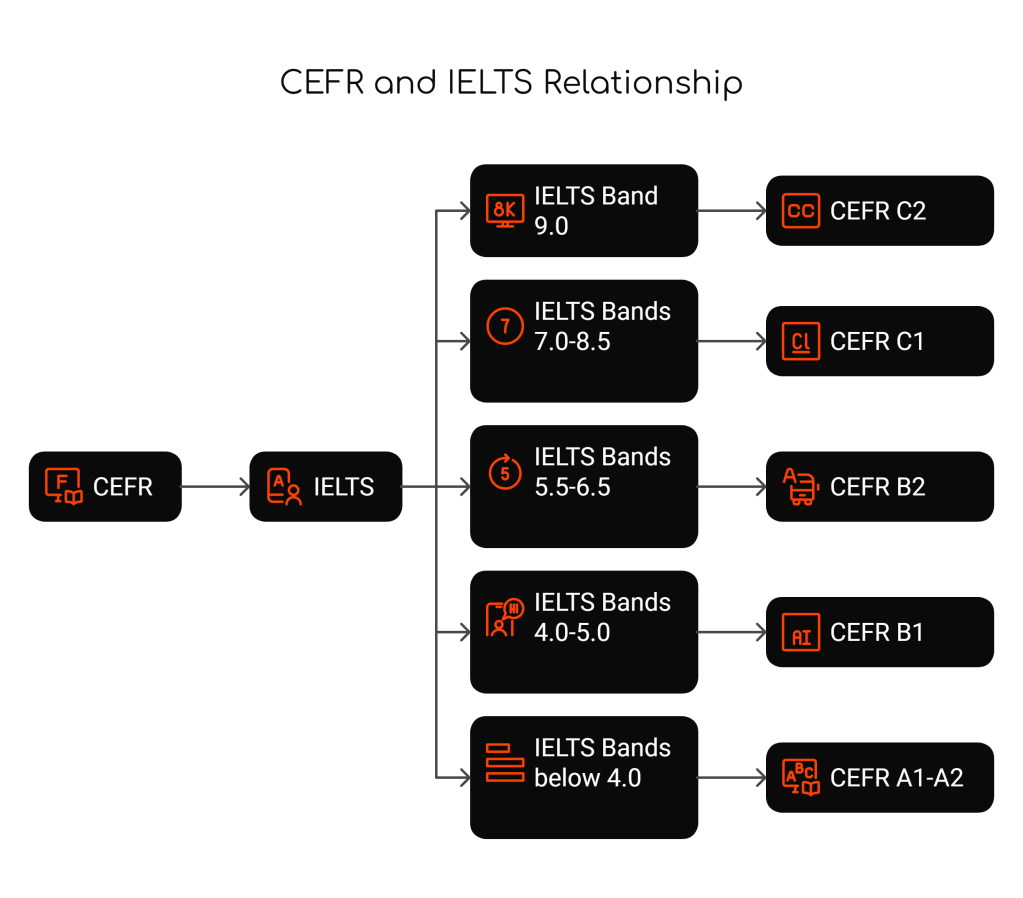
While CEFR and IELTS serve different purposes—one as a descriptive framework, the other as a testing system—understanding their relationship helps learners set realistic goals and interpret their results meaningfully. The official alignment, established through extensive research, shows clear correlations:
IELTS Band 9.0 corresponds to CEFR C2, representing mastery-level English with native-like fluency and precision. Test-takers at this level can handle any English-language situation with sophistication and nuance.
IELTS Bands 7.0-8.5 align with CEFR C1, indicating advanced proficiency suitable for academic study and professional work. Most universities require IELTS 6.5-7.5 for admission, placing successful applicants firmly in the C1 range.
IELTS Bands 5.5-6.5 correspond to CEFR B2, representing upper-intermediate proficiency. This level indicates functional English for most everyday situations, though academic and professional contexts may still present challenges.
IELTS Bands 4.0-5.0 match CEFR B1, showing intermediate ability suitable for basic communication and simple academic tasks with support.
IELTS Bands below 4.0 correspond to CEFR A1-A2 levels, indicating elementary proficiency requiring significant development before undertaking academic study or professional work in English.
Practical Implications for Test-Takers
Understanding this alignment helps learners make informed decisions about their English journey. If you’re currently at CEFR B1 level, you’ll likely score around IELTS 4.0-5.0, suggesting you need considerable preparation before attempting university admission, which typically requires IELTS 6.0-7.5.
The relationship also explains why IELTS preparation courses often seem to focus heavily on test strategy rather than general English improvement. Moving from IELTS 6.0 to 7.0 represents a significant jump from B2 to C1 proficiency—a transition that requires not just better test technique, but genuine advancement in English ability.
For immigration purposes, the alignment helps explain score requirements. Countries like Canada and Australia often require IELTS 6.0-7.0 for skilled migration, recognizing that B2-C1 proficiency enables successful integration into English-speaking societies.
Different Philosophies, Complementary Purposes
The key difference between CEFR and IELTS lies in their fundamental approaches. CEFR describes what learners can do with language, emphasizing practical communication in real-world contexts. It’s designed to be inclusive and encouraging, helping learners recognize their progress and plan their next steps.
IELTS, conversely, measures language ability under test conditions, focusing on academic and formal communication skills. It’s designed to be discriminating, helping institutions make selection decisions based on standardized criteria. The test format—with its time constraints, formal register, and specific task types—doesn’t always reflect how people actually use English in daily life.
This difference explains why some highly proficient English users struggle with IELTS despite having strong real-world communication skills. The test rewards specific competencies: academic writing conventions, formal speaking patterns, and rapid processing of complex texts—skills that may not develop naturally through everyday English use.
Global Impact and Future Trends
The CEFR-IELTS relationship reflects broader trends in global education and migration. As English becomes increasingly essential for international mobility, standardized proficiency measures become more important. The alignment between European educational frameworks and British-developed testing systems demonstrates the continuing influence of traditional English-speaking nations in setting global standards.
However, this dominance faces growing challenges. Other English proficiency tests like TOEFL, PTE, and Duolingo English Test offer alternative pathways to demonstrate ability. Some institutions now accept portfolios or interviews instead of standardized test scores, recognizing that test performance doesn’t always reflect real-world language competence.
The rise of artificial intelligence and automated language assessment may further transform this landscape. Future proficiency measures might focus more on practical communication ability rather than performance under artificial test conditions, potentially bringing assessment closer to CEFR’s descriptive approach.
Practical Advice for English Learners
For those navigating these frameworks, several strategies can help optimize your English learning journey:
Set CEFR-based goals rather than focusing solely on test scores. Understanding whether you’re working toward B2 or C1 proficiency helps you choose appropriate learning materials and realistic timelines.
Use IELTS strategically as a checkpoint rather than an endpoint. Regular practice tests can help gauge progress toward your CEFR goals while building familiarity with academic English formats.
Focus on genuine proficiency development rather than test-specific techniques. While test preparation is important, building real English ability through extensive reading, conversation practice, and authentic materials will serve you better long-term.
Understand institutional requirements in context. An IELTS 6.5 requirement typically means institutions expect B2+ proficiency—comfortable English use with occasional difficulties in complex situations.
Conclusion: Two Sides of the Same Coin
CEFR and IELTS represent different but complementary approaches to understanding English proficiency. CEFR provides the roadmap, describing the journey from basic communication to native-like fluency. IELTS offers the benchmark, measuring progress against standardized criteria that institutions worldwide recognize and trust.
Understanding their relationship empowers learners to make informed decisions about their English development. Whether you’re planning university study, seeking immigration opportunities, or advancing your career, knowing where you stand on both frameworks helps you chart a realistic path toward your goals.
The ultimate goal isn’t achieving a perfect test score, but developing the English proficiency that enables you to succeed in your chosen academic, professional, or personal endeavors. Both CEFR and IELTS are tools to help you get there—use them wisely, and they’ll serve as reliable guides on your English learning journey.
#IELTSGuidePhil #IELTS #IELTSPrep #IELTSPreparation #IELTSTest #IELTSExam #IELTSTips #IELTSPractice #IELTSTraining #IELTSCoach #IELTSSpeaking #IELTSWriting #IELTSReading #IELTSListening #IELTSSuccess #IELTSWithPhil #CEFR #CEFRLevels #CEFREnglish #A1toC2 #B2Level #C1English #CEFRAssessment #EnglishProficiency #LanguageLevels #CEFRScale
 IELTS Guide Phil
Leave a comment