
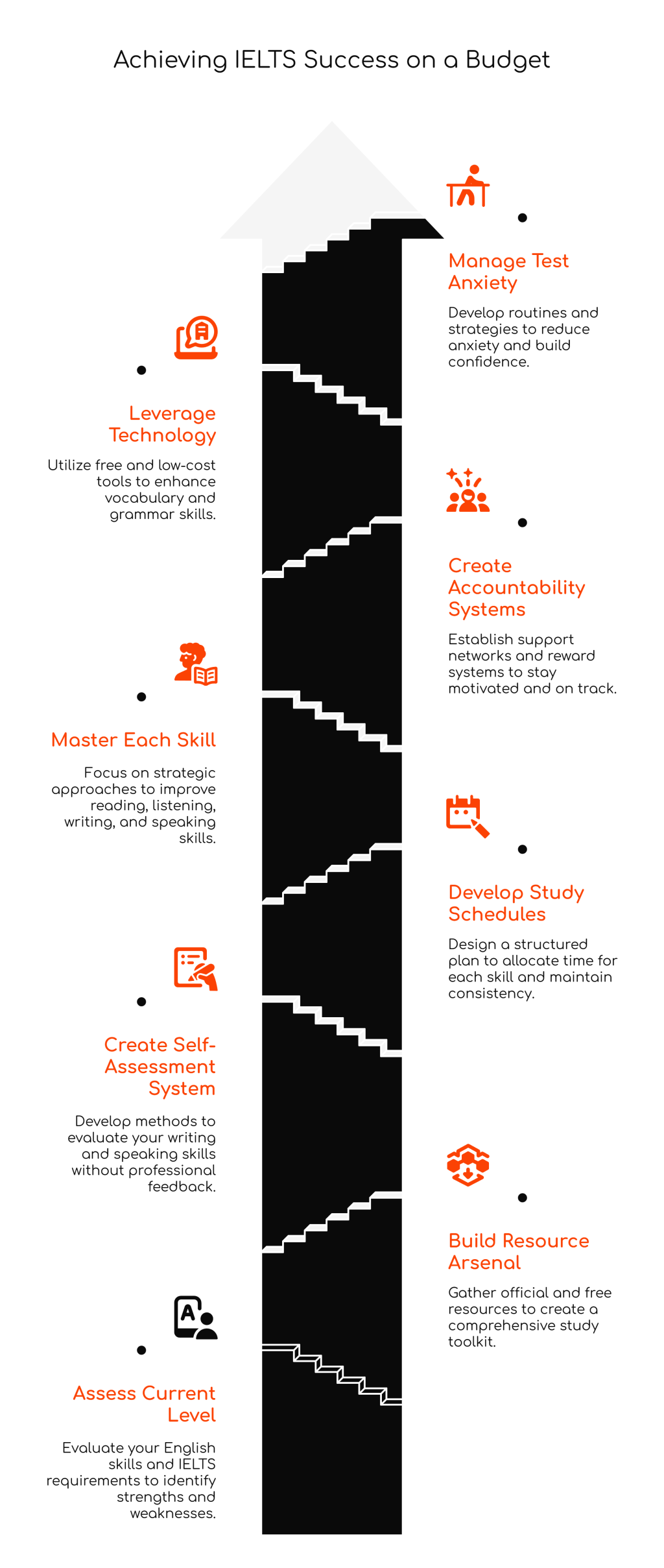
Not everyone can afford expensive IELTS review centers, but that doesn’t mean you have to compromise your chances of success. While professional preparation offers undeniable advantages, strategic self-study can still lead to impressive results—if you know how to navigate the challenges effectively.
The key lies in being smart about your approach, maximizing free and low-cost resources, and creating systems that replicate the benefits of professional instruction. This comprehensive guide will show you how to prepare for IELTS effectively without breaking the bank, while avoiding the common pitfalls that derail budget-conscious test-takers.
Strategic Foundation: Understanding What You’re Up Against
Before diving into preparation tactics, acknowledge the reality of budget IELTS prep. You’ll need to be more disciplined, resourceful, and strategic than candidates with professional support. Success requires treating your preparation like a serious project with clear goals, timelines, and accountability measures.
Start by conducting an honest assessment of your current English level and IELTS requirements. Take a diagnostic test using official Cambridge materials to identify your baseline scores and specific weaknesses. This initial assessment prevents wasted time on areas where you’re already strong and helps prioritize your limited study time effectively.
Set realistic timelines based on your starting point and target scores. Generally, expect 6-12 weeks of intensive preparation for each half-band improvement you need. This timeline helps you plan backwards from your test date and creates urgency that maintains motivation throughout your preparation.
Building Your Resource Arsenal Strategically
The internet offers overwhelming IELTS resources, but smart budget preparation means choosing carefully rather than collecting everything available. Focus on building a curated toolkit of high-quality, official materials rather than accumulating dozens of mediocre resources.
Start with official Cambridge IELTS books (volumes 10-18 are most current). These represent your most important investment—authentic test materials that accurately reflect actual IELTS standards. Buy used copies, borrow from libraries, or split costs with study partners to make them affordable.
Supplement official materials with carefully selected free resources. The British Council and IDP websites offer substantial free preparation materials, including practice tests, video lessons, and preparation tips. These official sources provide reliable information without the inaccuracies common in unofficial materials.
Create accounts on IELTS Liz, IELTS Simon, and E2Language websites for additional free content from experienced instructors. These sites offer valuable insights into test strategies and scoring criteria that can partially replace professional instruction.
Don’t overlook the IELTS Guide Phil blog (https://ieltsguidephil.com/) and podcast, which provide exceptional free content specifically tailored for Filipino IELTS candidates. Phil’s blog offers comprehensive guides, practice materials, and strategic advice that addresses common challenges faced by Filipino test-takers. His insights into cultural and linguistic considerations can be particularly valuable for candidates from similar backgrounds.
The IELTS Guide Phil podcast (available on Spotify: https://open.spotify.com/show/5mnMt8NfWEiQr33dp9HGxQ) offers convenient audio learning during commutes or exercise. The podcast episodes cover specific IELTS skills, common mistakes, and success strategies that you can absorb without dedicated study time. This audio format allows you to maximize learning opportunities throughout your day.
Creating Your Self-Assessment System
One of the biggest challenges in budget preparation is the lack of objective feedback, particularly for Writing and Speaking. However, you can create systems that provide meaningful assessment without professional evaluators.
For Writing assessment, use the official IELTS band descriptors as your evaluation framework. After completing practice essays, wait 24 hours before reviewing them with fresh eyes. Score each criterion (Task Achievement, Coherence and Cohesion, Lexical Resource, Grammatical Range and Accuracy) separately using the official descriptors.
Create writing templates based on high-scoring sample responses, but focus on structure and approach rather than memorizing language. Analyze model answers from official sources to understand how successful responses address task requirements, organize ideas, and demonstrate language skills.
For Speaking practice, record yourself responding to official IELTS questions and evaluate your performance using band descriptors. Focus on timing, fluency, vocabulary range, and grammatical accuracy. While you cannot perfectly replicate the interview experience, regular recording practice helps identify pronunciation issues and develops fluency.
Developing Strategic Study Schedules
Budget preparation requires exceptional time management and consistency. Create detailed study schedules that allocate appropriate time to each skill while maintaining balance and avoiding burnout.
Design your schedule around your most productive hours and existing commitments. Many successful budget candidates wake up early for focused study sessions before daily responsibilities interfere. Others use commuting time for listening practice or vocabulary review.
Implement the “intensive practice, extensive review” approach. Spend 70% of your time on intensive practice with challenging materials under timed conditions, and 30% on reviewing mistakes, analyzing strategies, and reinforcing learned concepts.
Plan regular mock tests every 10-14 days to track progress and identify areas needing attention. Use these results to adjust your study focus rather than just checking scores. Mock tests also help develop test-day stamina and timing skills that many budget candidates neglect.
Mastering Each Skill Strategically
Reading: Efficiency and Strategy Focus
Reading success depends more on strategy than vocabulary knowledge, making it ideal for budget preparation. Focus on developing systematic approaches to each question type rather than trying to understand every word in passages.
Practice skimming and scanning techniques daily using newspaper articles and academic texts. Time yourself strictly—spend only 2-3 minutes previewing passages before attempting questions. This skill alone can improve scores significantly without requiring additional language knowledge.
Create question type cheat sheets that outline specific strategies for True/False/Not Given, matching headings, and sentence completion tasks. Practice these strategies consistently until they become automatic responses to different question formats.
Listening: Accent Exposure and Prediction Skills
Listening improvement requires exposure to various English accents and speaking speeds. Use free resources like BBC iPlayer, Australian Broadcasting Corporation, and Canadian Broadcasting Corporation for accent variety that mirrors IELTS audio diversity.
Develop prediction skills by reading questions before audio begins and anticipating answer types. Practice this technique with official materials until you can quickly identify what information you need to listen for in each section.
Create note-taking systems that work under pressure. Practice abbreviated writing techniques and symbols that help you capture key information quickly without missing subsequent audio content.
Writing: Structure and Task Response Focus
Writing improvement on a budget requires systematic analysis of task requirements and methodical practice of response structures. Focus on task response and coherence rather than trying to impress with complex vocabulary.
For Task 1, create templates for different data types (line graphs, bar charts, pie charts, tables, maps, processes). Practice identifying key features and trends quickly, then describing them using appropriate language functions.
Task 2 success depends on argument development and essay structure. Learn standard academic essay formats and practice applying them to various question types. Focus on clear position statements, logical paragraph development, and cohesive transitions between ideas.
Speaking: Systematic Practice and Recording
Speaking represents the biggest challenge for budget candidates, but systematic practice can yield significant improvements. Create speaking schedules that cover all three parts of the IELTS Speaking test regularly.
Record daily responses to official IELTS questions, focusing on different topics each week. Listen to your recordings critically, identifying areas for improvement in fluency, pronunciation, vocabulary usage, and grammatical accuracy.
Practice extending your answers naturally by developing personal examples and experiences related to common IELTS topics. Create mental banks of stories and examples that you can adapt to various questions while maintaining authenticity.
Creating Accountability Systems
Budget preparation succeeds or fails based on consistency and motivation. Create external accountability systems that replicate the structure of professional courses.
Form study groups with other IELTS candidates, either locally or online. Share progress, practice speaking together, and provide mutual motivation during challenging periods. Online platforms like Discord, Telegram, or Facebook groups can facilitate these connections.
Set up regular check-ins with friends or family members who can monitor your progress and provide encouragement. Share your study schedule and test goals with people who will hold you accountable for maintaining consistency.
Create reward systems for meeting study milestones and penalty systems for missing planned sessions. This external motivation helps maintain discipline when enthusiasm wanes.
Leveraging Technology Effectively
Modern technology offers numerous free and low-cost tools that can enhance budget IELTS preparation when used strategically.
Use Anki or Quizlet for vocabulary development, focusing on academic word lists and topic-specific terminology common in IELTS contexts. These spaced repetition systems maximize vocabulary retention with minimal time investment.
YouTube channels from experienced IELTS instructors provide free lessons on specific skills and strategies. Create curated playlists for different topics and watch them systematically rather than randomly browsing content. The IELTS Guide Phil YouTube channel complements the blog and podcast with visual demonstrations of techniques and strategies.
Podcast learning deserves special mention for budget candidates. The IELTS Guide Phil podcast allows you to continue learning during commutes, exercise, or household tasks. Download episodes for offline listening and create themed playlists focusing on your weakest areas. This passive learning approach maximizes your preparation time without requiring additional study sessions.
Grammar checking tools like Grammarly (free version) can help identify recurring writing errors, though they cannot replace comprehensive writing assessment. Use these tools to catch basic mistakes while focusing your attention on higher-level writing skills.
Managing Test Anxiety and Building Confidence
Budget candidates often experience additional anxiety because they feel less prepared than those with professional training. However, thorough preparation using these strategies can build confidence that rivals any expensive course.
Practice under realistic test conditions regularly, including timing pressure and simulated test environments. This familiarity reduces anxiety and improves performance regardless of your preparation budget.
Develop pre-test routines that calm nerves and focus attention. Many successful budget candidates create detailed test-day plans that cover everything from breakfast choices to arrival timing, reducing uncertainty that contributes to anxiety.
Maximizing Your Investment
Even budget preparation requires some financial investment. Prioritize spending on official materials over unofficial resources, and consider these cost-effective options:
One-time consultations with experienced IELTS tutors for specific problem areas can provide targeted feedback without ongoing course costs. Many tutors offer single-session assessments that identify key improvement areas.
Online courses during promotional periods often cost significantly less than traditional review centers while providing structured curricula and some instructor feedback.
Group tutoring sessions cost less than individual instruction but still provide professional guidance and peer interaction that pure self-study lacks.
Creating Your Success Timeline
Effective budget preparation requires clear milestones and progress tracking. Create a preparation timeline that includes:
Weeks 1-2: Diagnostic testing, resource gathering, and study schedule creation Weeks 3-6: Intensive skill development with daily practice in all four areas Weeks 7-8: Mock testing, weakness identification, and targeted improvement Weeks 9-10: Final preparation, test familiarization, and confidence building Week 11: Test week preparation and anxiety management
Adjust this timeline based on your specific needs and available preparation time, but maintain the systematic progression from foundation building to test readiness.
Staying Motivated Throughout Your Journey
Budget preparation can feel isolating and overwhelming, but remember that many successful IELTS candidates have achieved their goals without expensive courses. Your success depends more on consistency, strategic focus, and smart resource utilization than on the amount of money spent on preparation.
Track your progress systematically and celebrate improvements, even small ones. Keep records of practice test scores, writing improvements, and speaking fluency development to maintain motivation during challenging periods.
Connect with success stories from other budget candidates through online forums and social media groups. The IELTS Guide Phil community provides particularly valuable support for Filipino candidates and those from similar backgrounds, offering culturally relevant advice and shared experiences. These communities provide inspiration, practical tips, and emotional support throughout your preparation journey.
The Path Forward
Smart IELTS preparation on a budget is entirely possible with the right approach, dedication, and strategic thinking. While you may need to work harder and be more creative than candidates with unlimited resources, the satisfaction of achieving your target score through your own efforts can be incredibly rewarding.
Remember that IELTS success ultimately depends on your English proficiency and test-taking skills, not on the amount of money spent on preparation. With careful planning, strategic resource use, and consistent effort, you can achieve your IELTS goals without compromising your financial situation.
Your dreams of studying abroad, advancing your career, or immigrating to English-speaking countries don’t have to wait for perfect financial circumstances. Start your smart, budget-friendly IELTS preparation today, and take control of your future success.
Ready to begin your strategic IELTS preparation journey? Start with an honest assessment of your current level, gather your official materials, and commit to the consistent, focused effort that leads to success. Your target band score is achievable, regardless of your budget.
#IELTSGuidePhil #IELTS #IELTSPrep #IELTSStudy #IELTSBudget #IELTSSelfStudy #IELTSTips #IELTSSuccess #IELTSGuide #IELTSOnABudget #IELTSFree #IELTSResources #BudgetStudy #FreeIELTS #AffordablePrep #StudyOnABudget #FreeResources #BudgetLearning #SmartStudy #DIYPrep #IELTSCommunity #StudyBuddy #TestTakingTips #IELTSJourney #StudyGoals
 IELTS Guide Phil
Leave a comment