
The English language has become the closest thing our world has to a truly global tongue. From Silicon Valley boardrooms to Tokyo classrooms, from Nigerian literature to Bollywood films, English serves as the bridge connecting billions of people across continents. At the heart of this linguistic phenomenon lies the Anglosphere—a collection of nations bound not just by shared history, but by the English language itself.
What is the Anglosphere?
The Anglosphere refers to the group of countries where English is the primary native language and which share common historical, cultural, and institutional roots stemming from British colonization. The core members are typically considered to be the United Kingdom, United States, Canada, Australia, and New Zealand. Some definitions extend to include Ireland and South Africa, given their significant English-speaking populations and British colonial histories.
These nations share more than just language. They possess similar legal systems based on common law, democratic traditions rooted in British parliamentary models, and cultural values that emphasize individual liberty, free markets, and rule of law. This shared foundation has created what some scholars call a “network civilization” that operates across national boundaries.
The Rise of Global English
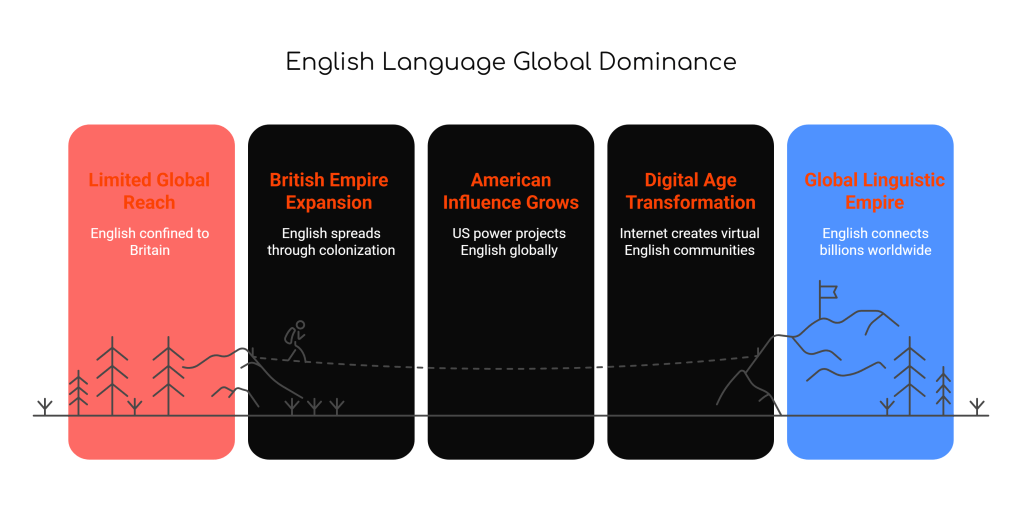
English didn’t become the world’s lingua franca by accident. Several historical forces converged to propel it to global dominance. The British Empire, at its height controlling nearly a quarter of the world’s landmass, planted English seeds across six continents. From India to Hong Kong, from Nigeria to Jamaica, British colonial administration, education, and trade established English as the language of governance and commerce.
The 20th century sealed English’s global ascendancy. Two world wars left Britain exhausted but elevated the United States as the dominant global superpower. American economic might, technological innovation, and cultural exports—Hollywood movies, popular music, television—carried English into homes worldwide. The internet revolution, largely driven by American companies and initially conducted primarily in English, further accelerated this process.
Today, English serves as the international language of business, science, technology, diplomacy, and aviation. It’s estimated that over 1.5 billion people worldwide speak English to some degree, with about 380 million native speakers and over a billion learning it as a second language.
This global demand for English proficiency has created a massive testing and certification industry. The International English Language Testing System (IELTS), developed jointly by British Council, IDP Education, and Cambridge Assessment English, has become the world’s most popular English proficiency test. Over 4 million people take IELTS annually across more than 140 countries, using their scores to gain admission to universities, secure employment, or obtain immigration visas—particularly to Anglosphere nations. The test’s dominance reflects not just the practical need for English skills, but also the continuing influence of British educational standards in setting global benchmarks for English competency.
Cultural and Economic Influence
The Anglosphere’s influence extends far beyond raw numbers. These five core nations represent roughly 6% of the world’s population but account for approximately 40% of global GDP. They dominate global financial markets, with London and New York serving as the world’s primary financial centers. The cultural output is equally impressive—Hollywood entertainment, British television, Canadian literature, and Australian media reach global audiences.
This soft power influence shapes how people worldwide think about democracy, capitalism, and individual rights. The Anglosphere nations consistently rank among the world’s most prosperous and free societies, creating an aspirational model that attracts immigrants and influences policy makers globally.
Challenges and Criticisms
The concept of the Anglosphere isn’t without controversy. Critics argue that it represents a form of neo-colonialism, privileging English speakers and Western values while marginalizing other languages and cultures. The dominance of English can threaten linguistic diversity, potentially leading to the extinction of minority languages.
There’s also the question of who truly belongs in the Anglosphere. Countries like India, Nigeria, and Singapore have hundreds of millions of English speakers, often with more sophisticated English-language institutions than some traditionally recognized Anglosphere nations. The definition risks excluding these diverse, dynamic societies simply because English isn’t their first language.
Within the core Anglosphere itself, tensions exist. Brexit highlighted divergent visions between Britain and its former colonies. Trade disputes, different approaches to China, and varying responses to global challenges reveal that shared language doesn’t guarantee unified policy.
The Digital Age Transformation
The internet has fundamentally altered the Anglosphere’s dynamics. Social media platforms, online education, and digital commerce have created virtual English-speaking communities that transcend national boundaries. A programmer in Bangalore can collaborate seamlessly with colleagues in Seattle, London, and Sydney, participating in what amounts to a global English-language workspace.
This digital connectivity has also democratized English-language content creation. YouTube creators from the Philippines, Indian tech entrepreneurs, and African writers can reach global audiences without traditional gatekeepers. The result is a more diverse, multipolar English-speaking world where the traditional Anglosphere nations no longer monopolize English-language discourse.
Future Prospects
The future of English and the Anglosphere faces several competing trends. On one hand, English continues spreading as more countries prioritize English education and global business increasingly operates in English. China’s rise hasn’t diminished English’s importance—if anything, Chinese companies and institutions are investing heavily in English-language capabilities to compete globally.
On the other hand, technology may be leveling the playing field. Real-time translation tools are becoming increasingly sophisticated, potentially reducing English’s monopoly on international communication. Artificial intelligence could enable seamless multilingual interaction, allowing people to participate in global conversations without abandoning their native languages.
The Anglosphere nations themselves are becoming more diverse through immigration, potentially changing the cultural character that has defined these societies. Cities like London, Toronto, and Sydney are now majority-minority, with residents speaking dozens of languages at home while using English in public life.
Conclusion: A Living Network
The relationship between English and the Anglosphere represents one of history’s most successful examples of linguistic and cultural networking. What began as British imperial expansion evolved into American global leadership and has now transformed into a decentralized, digital-age phenomenon that includes billions of people worldwide.
The traditional Anglosphere nations remain important nodes in this network, but they’re no longer the only ones that matter. The future of English is increasingly being written in classrooms in South Korea, tech hubs in India, and creative studios in Nigeria. The language that once served as the tool of empire has become the medium of global collaboration, creativity, and connection.
Whether this represents cultural imperialism or genuine democratization depends largely on perspective. What’s undeniable is that English and the broader English-speaking world have created something unprecedented in human history: a truly global linguistic community that transcends traditional boundaries of nation, race, and culture. How this community evolves will shape not just the future of English, but the nature of global communication itself.
The story of English and the Anglosphere is far from over. As new voices join the conversation and technology reshapes how we communicate, this global linguistic empire continues to adapt, expand, and redefine what it means to speak the world’s language.
#IELTSGuidePhil #IELTS #Anglosphere #EnglishLanguage #GlobalEnglish #LinguaFranca #EnglishEmpire #UnitedKingdom #UnitedStates #Canada #Australia #NewZealand #BritishEmpire #AmericanInfluence #Education #Learning #Culture #History #International #Global #English #Language
 IELTS Guide Phil
Leave a comment