
So you’ve got an IELTS exam coming up in just a few days or weeks, and you’re feeling the pressure? Don’t panic. While consistent, long-term preparation is ideal, you can still make significant improvements to your score with focused, strategic last-minute preparation. This guide will help you maximize your performance when time is running short.
Understanding the IELTS Format
Before diving into preparation strategies, ensure you understand the test structure:
Academic IELTS:
- Listening: 30 minutes + 10 minutes transfer time (40 questions)
- Reading: 60 minutes (40 questions, 3 passages)
- Writing: 60 minutes (Task 1: 150 words, Task 2: 250 words)
- Speaking: 11-14 minutes (3 parts)
General Training IELTS:
- Same format as Academic, except Reading and Writing tasks are different
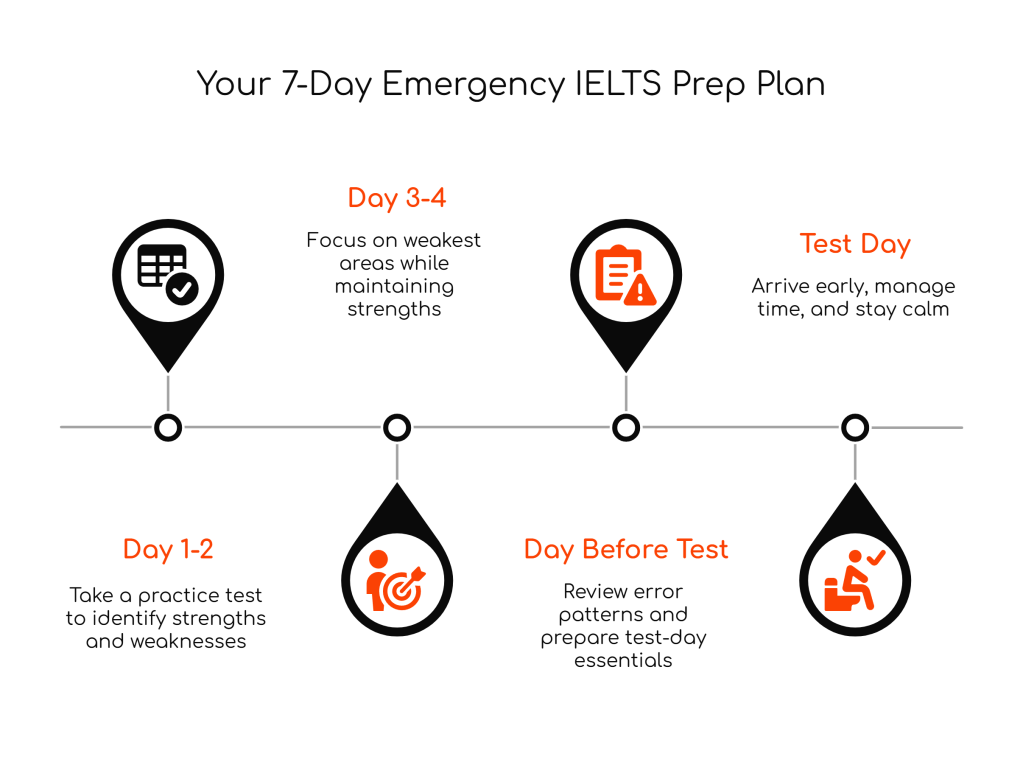
Your 7-Day Emergency Prep Plan
Day 1-2: Diagnostic and Strategy
Take a Practice Test Complete a full-length practice test under timed conditions to identify your strengths and weaknesses. This will help you allocate your limited preparation time effectively.
Analyze Your Results
- Which section scored lowest?
- What types of questions caused the most difficulty?
- Were timing issues a problem?
Set Realistic Targets If you need a 7.0 overall, aim for balanced scores rather than perfecting one section while neglecting others.
Day 3-4: Intensive Skill Development
Focus on your weakest areas while maintaining your strengths.
Section-Specific Last-Minute Strategies
Listening Section
Key Strategies:
- Prediction Practice: Read questions before audio begins and predict possible answers
- Keyword Recognition: Identify key words in questions and listen for synonyms in the audio
- Note-Taking System: Develop shorthand for common words and phrases
- Common Traps: Watch for distractors where the speaker mentions multiple options but chooses one
Quick Wins:
- Practice with various accents (British, Australian, American, Canadian)
- Learn common IELTS vocabulary themes: education, environment, technology, health
- Master number and date formats
- Practice spelling under pressure
Reading Section
Time Management:
- Spend 20 minutes per passage maximum
- Skim first, then scan for specific information
- Don’t get stuck on difficult vocabulary
Question Types to Master:
- Multiple Choice: Eliminate wrong options first
- True/False/Not Given: Distinguish between False (contradicts text) and Not Given (no information)
- Matching Headings: Read headings first, identify main ideas in paragraphs
- Gap Fills: Consider grammar and word limits
Last-Minute Tips:
- Read questions before the passage
- Underline key words in questions
- Look for paraphrasing and synonyms
- Don’t leave blanks – guess if necessary
Writing Section
Task 1 (Academic): Describing visual information
- Structure: Introduction → Overview → Key Features → Other Features
- Language: Use varied vocabulary for trends (increase, surge, decline, fluctuate)
- Time: Spend 20 minutes maximum
Task 1 (General): Letter writing
- Formal Letters: Dear Sir/Madam, Yours faithfully
- Informal Letters: Dear [Name], Best regards
- Semi-formal: Dear Mr./Ms. [Name], Yours sincerely
Task 2: Essay writing (both Academic and General)
- Structure: Introduction → Body Paragraph 1 → Body Paragraph 2 → Conclusion
- Thesis Statement: Clearly state your position in the introduction
- Body Paragraphs: Topic sentence → Explanation → Example → Link to next paragraph
- Time: Spend 40 minutes (more important than Task 1)
Essential Writing Tips:
- Plan for 5 minutes before writing
- Aim for 4-5 sentences per paragraph
- Use linking words naturally (however, furthermore, consequently)
- Check grammar and spelling in final 3-5 minutes
- Practice common essay topics: education, environment, technology, government
Speaking Section
Part 1: Personal questions (4-5 minutes)
- Prepare answers for common topics: hometown, work/study, hobbies, family
- Extend answers with reasons and examples
- Practice speaking for 30-45 seconds per question
Part 2: Individual long turn (3-4 minutes)
- 1 minute preparation: Make quick notes covering all bullet points
- 2 minutes speaking: Structure with clear beginning, middle, and end
- Practice describing: people, places, objects, events, experiences
Part 3: Discussion (4-5 minutes)
- Express and justify opinions
- Speculate about future trends
- Compare past and present situations
- Use complex grammatical structures
Speaking Enhancement:
- Record yourself and listen for pronunciation issues
- Practice common collocations and phrasal verbs
- Work on fluency by eliminating long pauses
- Use stress and intonation to convey meaning
Final 48 Hours: Peak Performance Preparation
Day Before the Test
What to Do:
- Take a shorter practice test focusing on timing
- Review your error patterns and key strategies
- Prepare everything for test day (ID, stationery, directions)
- Get adequate sleep (7-8 hours)
- Eat a healthy meal
What NOT to Do:
- Don’t cram new vocabulary
- Avoid trying new strategies
- Don’t stay up late studying
- Avoid heavy meals or excessive caffeine
Test Day Strategy
Before the Test:
- Arrive 30 minutes early
- Bring valid ID and required materials
- Stay hydrated but don’t overdrink
During the Test:
- Read all instructions carefully
- Manage time strictly
- Stay calm if you encounter difficult sections
- For Writing, leave 5 minutes to check your work
- In Speaking, maintain eye contact and speak clearly
Emergency Vocabulary Building
Focus on high-frequency IELTS vocabulary themes:
Academic Word List: Analyze, concept, structure, significant, approach, method, factor, process, theory, research
Topic-Specific Vocabulary:
- Environment: Conservation, sustainability, pollution, renewable energy, carbon footprint
- Education: Curriculum, pedagogy, literacy, tuition, enrollment
- Technology: Innovation, automation, artificial intelligence, digital divide
- Health: Prevention, epidemic, nutrition, sedentary lifestyle, mental health
Common Mistakes to Avoid
Listening:
- Writing answers while listening to new information
- Spelling mistakes (practice common IELTS spellings)
- Missing plural forms or capitalization
Reading:
- Spending too much time on difficult questions
- Bringing outside knowledge to True/False/Not Given questions
- Ignoring word limits in gap-fill exercises
Writing:
- Not addressing all parts of the question
- Using informal language in formal tasks
- Poor time management between Task 1 and Task 2
- Memorizing and reproducing model essays
Speaking:
- Giving very short answers in Part 1
- Not using the full 2 minutes in Part 2
- Being too nervous to speak naturally
Mental Preparation and Test-Day Mindset
Confidence Building:
- Focus on what you know rather than what you don’t
- Remember that IELTS tests communication, not perfection
- Visualize successful completion of each section
Stress Management:
- Practice deep breathing techniques
- Use positive self-talk
- Remember that you can retake the test if needed
Time Pressure Handling:
- Practice with strict time limits
- Develop a personal pace for each section
- Learn when to move on from difficult questions
Technology and Resources for Quick Prep
Essential Apps and Websites:
- Official IELTS practice materials
- Cambridge IELTS practice tests (Books 15-18 are most recent)
- IELTS Liz for tips and strategies
- BBC Learning English for pronunciation practice
YouTube Channels:
- IELTS Advantage
- E2 IELTS
- IELTS Simon
Final Reminders
Remember that last-minute preparation is about optimization, not transformation. Focus on:
- Familiarizing yourself with test format and timing
- Practicing your weakest areas intensively
- Developing test-taking strategies
- Building confidence through focused practice
- Maintaining physical and mental health
While extensive preparation over months is ideal, strategic last-minute preparation can still lead to meaningful score improvements. Stay focused, practice efficiently, and approach the test with confidence. Your preparation time may be limited, but your potential is not.
Good luck with your IELTS exam!
#IELTSGuidePhil #IELTS #IELTSPrep #LastMinuteIELTS #IELTSTips #IELTSExam #IELTSStrategy #EnglishTest #IELTSStudy #TestPreparation #IELTSSuccess #QuickIELTSPrep
 IELTS Guide Phil
Leave a comment