
Understanding IELTS Writing Task 2
IELTS Writing Task 2 is an essay writing task that requires you to present a clear, well-organized argument on a given topic. This task is identical for both Academic and General Training candidates and carries more weight than Task 1 in your overall Writing score.
Key Features:
- Time allocation: 40 minutes (recommended)
- Word count: Minimum 250 words (aim for 270-300)
- Task type: Argumentative/discursive essay
- Scoring weight: Contributes to 2/3 of your overall Writing score
- Topics: Social, educational, environmental, technological, and cultural issues
What Makes Task 2 Crucial:
Task 2 is worth twice as much as Task 1, making it the most important component of your Writing test. It evaluates your ability to:
- Present and justify opinions
- Compare and contrast ideas
- Analyze problems and propose solutions
- Organize ideas coherently
- Use appropriate academic language
Assessment Criteria and Scoring
Four Assessment Criteria (Each worth 25%):
1. Task Response
What it measures: How well you address the question and develop your ideas
Band 9 Requirements:
- Fully addresses all parts of the task
- Presents a fully developed position with relevant, extended, and supported ideas
- Stays completely on topic throughout
Key Elements:
- Answer the question directly: Address every part of the prompt
- Take a clear position: Have a definite stance on the issue
- Develop ideas fully: Provide explanations, examples, and evidence
- Stay relevant: All content must relate to the question
Common Task Response Issues:
- Partially addressing the question
- Unclear or inconsistent position
- Underdeveloped main ideas
- Including irrelevant information
2. Coherence and Cohesion
What it measures: How logically your ideas are organized and connected
Band 9 Requirements:
- Uses cohesion in such a way that it attracts no attention
- Skillfully manages paragraphing
- Creates seamless flow of ideas
Key Elements:
- Logical organization: Ideas presented in clear sequence
- Effective paragraphing: Each paragraph has one main idea
- Cohesive devices: Appropriate use of linking words and phrases
- Clear progression: Smooth transitions between ideas
Essential Cohesive Devices:
- Addition: furthermore, moreover, additionally, also
- Contrast: however, nevertheless, on the other hand, despite
- Cause/Effect: consequently, therefore, as a result, due to
- Example: for instance, such as, namely, specifically
3. Lexical Resource
What it measures: Range and accuracy of vocabulary usage
Band 9 Requirements:
- Uses wide range of vocabulary with natural and sophisticated control
- Rare minor errors occur only as ‘slips’
- Uses vocabulary precisely and appropriately
Key Elements:
- Vocabulary range: Variety of words and phrases
- Precision: Exact word choice for intended meaning
- Collocations: Natural word combinations
- Spelling accuracy: Consistent correct spelling
Vocabulary Enhancement Strategies:
- Learn topic-specific vocabulary sets
- Master academic word families
- Practice collocations and phrasal verbs
- Use synonyms to avoid repetition
4. Grammatical Range and Accuracy
What it measures: Variety and correctness of sentence structures
Band 9 Requirements:
- Uses wide range of structures with full flexibility and accuracy
- Rare minor errors occur only as ‘slips’
- Produces error-free sentences consistently
Key Elements:
- Sentence variety: Mix of simple, compound, and complex sentences
- Tense usage: Appropriate and consistent tense forms
- Grammar accuracy: Minimal errors that don’t impede communication
- Punctuation: Correct use of all punctuation marks
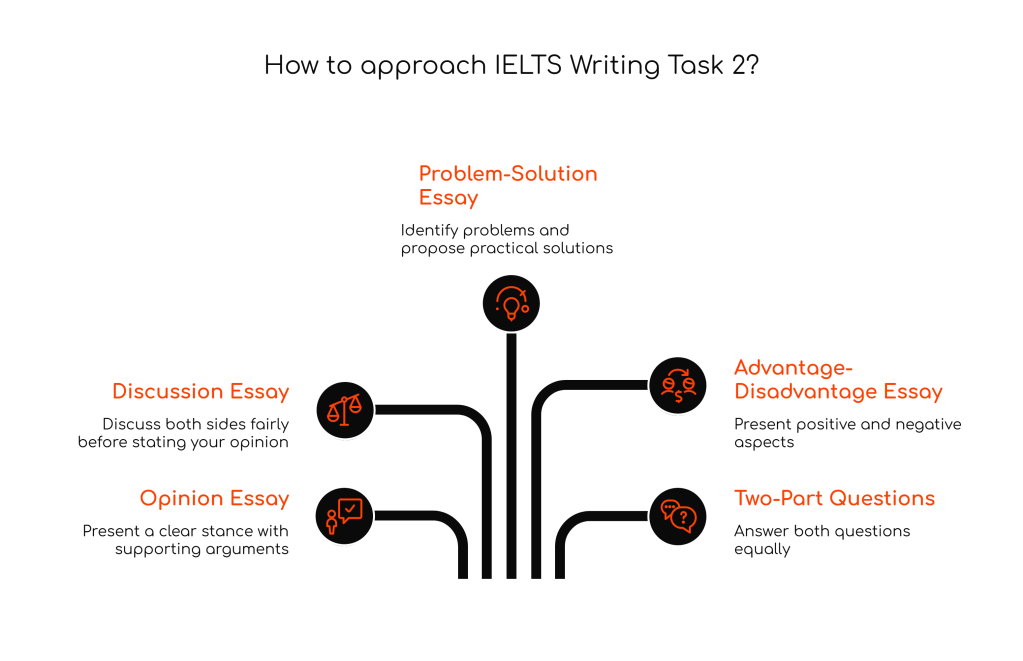
Types of Essay Questions
1. Opinion Essays (Agree/Disagree)
Question format: “To what extent do you agree or disagree?” Key requirement: Present your opinion with supporting arguments Structure: Introduction → Body paragraphs supporting your view → Conclusion
Example prompt: “Some people believe that university students should pay the full cost of their education. To what extent do you agree or disagree?”
2. Discussion Essays
Question format: “Discuss both views and give your opinion” Key requirement: Present both sides fairly, then state your position Structure: Introduction → Body paragraph 1 (View A) → Body paragraph 2 (View B) → Your opinion → Conclusion
Example prompt: “Some people think that parents should teach children how to be good members of society. Others believe that school is the place to learn this. Discuss both views and give your opinion.”
3. Problem-Solution Essays
Question format: Questions about problems and solutions Key requirement: Identify problems and propose practical solutions Structure: Introduction → Problems → Solutions → Conclusion
Example prompt: “In many countries, the proportion of older people is steadily increasing. What problems will this cause? What solutions can you suggest?”
4. Advantage-Disadvantage Essays
Question format: “What are the advantages and disadvantages?” Key requirement: Present both positive and negative aspects Structure: Introduction → Advantages → Disadvantages → Conclusion (with your view)
Example prompt: “More and more people are working from home. What are the advantages and disadvantages of this trend?”
5. Two-Part Questions
Question format: Two separate questions requiring different responses Key requirement: Answer both questions equally Structure: Introduction → Answer to Question 1 → Answer to Question 2 → Conclusion
Example prompt: “Why do some people choose to be vegetarian? What are the benefits of a vegetarian diet?”
Essential Essay Structure
Standard 4-Paragraph Structure:
Introduction (50-60 words)
Components:
- Background statement: Paraphrase the topic
- Thesis statement: Your main argument/position
- Outline statement: Preview of main points
Template: “[Background about the topic]. I believe that [your position] because [reason 1] and [reason 2]. This essay will examine [preview of main points].”
Body Paragraph 1 (100-120 words)
Components:
- Topic sentence: Main idea of the paragraph
- Explanation: Develop the main idea
- Example: Specific illustration or evidence
- Analysis: Explain how this supports your argument
Body Paragraph 2 (100-120 words)
Same structure as Body Paragraph 1
- Present your second main argument
- Provide different supporting evidence
- Maintain logical flow from previous paragraph
Conclusion (40-50 words)
Components:
- Restate thesis: Rephrase your main argument
- Summarize key points: Brief recap of main ideas
- Final thought: Broader implication or call to action
Alternative 5-Paragraph Structure:
Use when you have three strong main points or when discussing both sides requires more space.
Opinion Essays: Complete Guide
Understanding Opinion Essays
Opinion essays require you to take a clear stance on an issue and defend it with logical arguments and evidence. The key is maintaining consistency throughout your essay.
Types of Opinion Questions:
- “To what extent do you agree or disagree?”
- “Do you agree or disagree?”
- “What is your opinion?”
- “Do you think this is a positive or negative development?”
Effective Approach Strategies:
Strategy 1: Completely Agree/Disagree
Best for: When you have strong, clear reasons for one side Structure: All body paragraphs support your position Language: “I completely agree…”, “I am convinced that…”
Strategy 2: Partially Agree/Disagree
Best for: Complex issues with valid points on both sides Structure: One paragraph agreeing, one disagreeing, conclude with your overall stance Language: “While I agree that…, I believe that…”, “To some extent…”
Strategy 3: Balanced View
Best for: “To what extent” questions where middle ground exists Structure: Present arguments for both sides, conclude with your measured position Language: “Although there are merits to both sides…”, “On balance, I believe…”
Sample Opinion Essay Structure:
Question: “Some people believe that social media has had a negative impact on society. To what extent do you agree or disagree?”
Outline (Partially Agree Approach):
- Introduction: Acknowledge both positive and negative impacts, state you partially agree
- Body 1: Negative impacts (cyberbullying, addiction, misinformation)
- Body 2: Positive impacts (global connectivity, business opportunities, social movements)
- Conclusion: Restate partial agreement, emphasize need for responsible use
Essential Language for Opinion Essays:
Expressing Strong Agreement:
- “I completely agree that…”
- “I am convinced that…”
- “There is no doubt in my mind that…”
- “I firmly believe that…”
Expressing Partial Agreement:
- “To some extent, I agree that…”
- “While I acknowledge that…, I believe…”
- “I partly agree with the view that…”
- “Although there is some truth to…”
Introducing Personal Views:
- “In my opinion…”
- “From my perspective…”
- “I would argue that…”
- “It seems to me that…”
Discussion Essays: Complete Guide
Understanding Discussion Essays
Discussion essays require you to present both sides of an argument fairly before giving your own opinion. Balance and objectivity are crucial before revealing your stance.
Key Requirements:
- Present both views equally: Give fair representation to each side
- Use neutral language initially: Avoid bias when presenting others’ views
- Clear opinion statement: Make your position evident
- Logical flow: Smooth transition from discussion to opinion
Effective Structure for Discussion Essays:
4-Paragraph Structure:
- Introduction: Introduce both views, indicate you’ll give your opinion
- Body 1: First viewpoint with supporting arguments
- Body 2: Second viewpoint with supporting arguments + Your opinion
- Conclusion: Restate your position and reasoning
5-Paragraph Structure:
- Introduction: Introduce both views
- Body 1: First viewpoint
- Body 2: Second viewpoint
- Body 3: Your opinion with justification
- Conclusion: Summary and final position
Language for Discussion Essays:
Introducing Different Views:
- “Some people argue that…”
- “It is often claimed that…”
- “Proponents of this view believe…”
- “Those who support… argue that…”
Contrasting Views:
- “On the other hand…”
- “Conversely…”
- “However, others contend that…”
- “In contrast to this view…”
Introducing Your Opinion:
- “Having considered both sides, I believe…”
- “While both views have merit, I am inclined to think…”
- “In my opinion, the stronger argument is…”
- “On balance, I would side with…”
Sample Discussion Essay Framework:
Question: “Some people think children should learn to compete, while others believe they should learn to cooperate. Discuss both views and give your opinion.”
Outline:
- Introduction: Present both educational philosophies, state your intention to discuss both
- Body 1: Benefits of competition (motivation, real-world preparation, excellence)
- Body 2: Benefits of cooperation (teamwork skills, social harmony, mutual support)
- Opinion: State your view that balance is needed, with slight preference for cooperation
- Conclusion: Reaffirm balanced approach with cooperative emphasis
Problem-Solution Essays: Complete Guide
Understanding Problem-Solution Essays
These essays require you to identify problems related to a given situation and propose practical, realistic solutions. Focus on feasibility and effectiveness of your suggestions.
Common Question Formats:
- “What problems does this cause? What solutions can you suggest?”
- “What are the causes of this problem? How can it be solved?”
- “Why is this happening? What can be done about it?”
Effective Structures:
Structure 1: Problems then Solutions
- Introduction: Introduce the issue
- Body 1: Identify main problems
- Body 2: Propose corresponding solutions
- Conclusion: Summarize and emphasize urgency
Structure 2: Problem-Solution Pairs
- Introduction: Introduce the issue
- Body 1: Problem 1 + Solution 1
- Body 2: Problem 2 + Solution 2
- Conclusion: Overall recommendations
Problem Identification Strategies:
Types of Problems to Consider:
- Social problems: Impact on communities, relationships, lifestyle
- Economic problems: Financial costs, resource allocation, market effects
- Environmental problems: Ecological damage, sustainability issues
- Health problems: Physical and mental health impacts
- Educational problems: Learning outcomes, skill development
Language for Describing Problems:
- “This leads to…”
- “As a consequence…”
- “The main issue is…”
- “A significant problem is…”
- “This results in…”
Solution Development Strategies:
Criteria for Good Solutions:
- Practical: Realistically implementable
- Specific: Clear and detailed
- Effective: Likely to solve the identified problem
- Feasible: Within reasonable resource constraints
Types of Solutions:
- Government action: Laws, policies, funding, regulation
- Individual responsibility: Personal choices, lifestyle changes
- Educational initiatives: Awareness campaigns, training programs
- Technological solutions: Innovation, automation, digital tools
- Community efforts: Local initiatives, volunteer programs
Language for Proposing Solutions:
- “One possible solution is…”
- “This problem could be addressed by…”
- “A practical approach would be to…”
- “Governments should consider…”
- “The most effective way to tackle this is…”
Sample Problem-Solution Essay:
Question: “In many cities, air pollution is becoming a serious problem. What are the main causes of this issue? What solutions can you suggest?”
Outline:
- Introduction: Acknowledge growing air pollution crisis in urban areas
- Causes: Vehicle emissions, industrial activities, construction dust, burning fossil fuels
- Solutions: Public transportation expansion, stricter industrial regulations, green energy transition, urban planning improvements
- Conclusion: Emphasize need for coordinated action from government, businesses, and individuals
Advantage-Disadvantage Essays: Complete Guide
Understanding Advantage-Disadvantage Essays
These essays require balanced analysis of positive and negative aspects of a given topic. You may or may not need to give your opinion, depending on the question wording.
Question Variations:
- “What are the advantages and disadvantages?” (No opinion required)
- “Do the advantages outweigh the disadvantages?” (Opinion required)
- “Is this a positive or negative development?” (Clear position required)
Effective Structures:
Structure 1: Separate Discussion (No Opinion)
- Introduction: Introduce topic and indicate balanced discussion
- Body 1: Advantages with examples
- Body 2: Disadvantages with examples
- Conclusion: Summarize both sides without taking position
Structure 2: With Opinion
- Introduction: Introduce topic, state your position on whether advantages outweigh disadvantages
- Body 1: Present advantages
- Body 2: Present disadvantages
- Conclusion: Restate your position with reasoning
Structure 3: Argument-Led (Strong Opinion)
- Introduction: Clear position on whether positive or negative
- Body 1: Stronger side (supporting your view)
- Body 2: Weaker side (acknowledging other perspective)
- Conclusion: Reinforce your position
Language for Advantage-Disadvantage Essays:
Introducing Advantages:
- “The main benefit of… is…”
- “One significant advantage is…”
- “A key positive aspect is…”
- “This brings several benefits, including…”
Introducing Disadvantages:
- “However, there are also drawbacks…”
- “The main disadvantage is…”
- “A significant negative aspect is…”
- “On the downside…”
Balancing Language:
- “While there are benefits, there are also concerns…”
- “Despite these advantages, we must consider…”
- “Although this has positive aspects, the negative effects…”
- “Weighing both sides…”
Sample Advantage-Disadvantage Essay:
Question: “More students are choosing to study abroad. Do the advantages of this trend outweigh the disadvantages?”
Outline (Advantages outweigh):
- Introduction: Acknowledge increasing trend, state that advantages outweigh disadvantages
- Advantages: Cultural exposure, language skills, better career prospects, personal growth
- Disadvantages: High costs, homesickness, academic adjustment challenges
- Conclusion: Reaffirm that long-term benefits justify short-term difficulties
Two-Part Questions: Complete Guide
Understanding Two-Part Questions
These essays present two distinct questions that require separate, equal treatment. The key is ensuring you address both parts thoroughly and maintain balance between them.
Common Formats:
- Cause + Effect: “Why is this happening? What are the effects?”
- Cause + Solution: “What causes this problem? How can it be solved?”
- Reason + Method: “Why do people do this? How can this be encouraged?”
- Problem + Solution: “What problems does this create? What can be done?”
Effective Structure:
- Introduction: Introduce both questions briefly
- Body 1: Address first question comprehensively
- Body 2: Address second question comprehensively
- Conclusion: Summarize both answers
Key Strategies:
Balance is Critical:
- Spend equal time and words on each question
- Develop each answer with examples and explanations
- Ensure both parts are clearly addressed
Link Questions When Possible:
- Show connections between causes and effects
- Demonstrate how solutions address specific problems
- Create coherent flow between the two parts
Sample Two-Part Essay:
Question: “Why do some people prefer to work from home? What are the benefits of working from home?”
Outline:
- Introduction: Acknowledge both personal preferences and objective benefits
- Why people prefer it: Flexibility, work-life balance, comfort, no commuting, better focus
- Benefits of working from home: Increased productivity, cost savings, environmental benefits, health advantages
- Conclusion: Summarize both personal motivations and broader advantages
Language and Grammar Strategies
Sentence Structure Mastery
Simple Sentences
Use for: Clear, direct statements Example: “Online education has become increasingly popular.”
Compound Sentences
Use for: Connecting related ideas of equal importance Example: “Online education offers flexibility, but it lacks face-to-face interaction.”
Complex Sentences
Use for: Showing relationships between ideas Example: “Although online education offers flexibility, many students miss the social aspects of traditional classrooms.”
Mixed Sentence Patterns
Combine different structures for variety and sophistication: “While technology has revolutionized education, creating unprecedented opportunities for remote learning, many educators argue that traditional classroom interaction remains irreplaceable for developing social skills and collaborative thinking.”
Advanced Grammar Structures
Conditional Sentences
First conditional: “If governments invest in renewable energy, they will reduce carbon emissions.” Second conditional: “If more people used public transportation, air pollution would decrease significantly.” Third conditional: “If we had acted sooner, we could have prevented this environmental crisis.”
Passive Voice
Use for: Academic tone and focus on actions rather than actors Examples:
- “Measures should be taken to address this issue.”
- “This problem has been recognized by experts worldwide.”
- “Solutions are being implemented in several countries.”
Relative Clauses
Use for: Adding detail and creating sophisticated sentences Examples:
- “Students who study abroad often develop greater independence.”
- “The policy, which was introduced last year, has proven effective.”
- “This is an issue that affects everyone in society.”
Tense Usage Guidelines
Present Tenses
Simple present: For facts, general truths, current situations “Social media influences modern communication.”
Present continuous: For current trends, ongoing situations “More people are choosing to work remotely.”
Present perfect: For recent developments, ongoing relevance “Technology has transformed the way we learn.”
Past Tenses
Simple past: For completed actions, historical examples “The internet revolutionized global communication.”
Present perfect: For past actions with current relevance “Research has shown that exercise improves mental health.”
Future Forms
Will: For predictions, general future statements “This trend will likely continue in the coming years.”
Going to: For planned actions, predictable outcomes “These changes are going to affect society significantly.”
Modal verbs: For possibility, probability, recommendations “Governments should/could/might consider implementing new policies.”
Vocabulary Enhancement Techniques
Academic Word Families
Master these high-frequency academic words and their variations:
Analysis Family
- Analyze (verb): to examine in detail
- Analysis (noun): detailed examination
- Analytical (adjective): involving analysis
- Analyst (noun): person who analyzes
Example usage: “Analysts have conducted a thorough analysis of the data, using analytical methods to analyze the trends.”
Significance Family
- Significant (adjective): important, notable
- Significantly (adverb): to a notable degree
- Significance (noun): importance, meaning
Topic-Specific Vocabulary Sets
Education Vocabulary
Basic terms: curriculum, pedagogy, assessment, literacy, numeracy Advanced terms: pedagogical approach, educational attainment, academic rigor, intellectual development Phrases: “foster critical thinking”, “enhance learning outcomes”, “bridge the achievement gap”
Technology Vocabulary
Basic terms: innovation, automation, digitalization, connectivity Advanced terms: technological advancement, digital transformation, artificial intelligence, cyber security Phrases: “embrace technological change”, “harness the power of technology”, “navigate the digital landscape”
Environment Vocabulary
Basic terms: pollution, conservation, sustainability, renewable energy Advanced terms: environmental degradation, ecological footprint, carbon neutrality, biodiversity Phrases: “environmental stewardship”, “sustainable development”, “ecological balance”
Collocations and Phrase Patterns
Common Academic Collocations
- Conduct research (not “do research”)
- Raise awareness (not “increase awareness”)
- Address concerns (not “solve concerns”)
- Draw conclusions (not “make conclusions”)
- Pose challenges (not “give challenges”)
Linking Phrase Patterns
Cause and effect: “as a result of”, “due to the fact that”, “consequently” Contrast: “in spite of”, “regardless of”, “contrary to popular belief” Addition: “in addition to this”, “furthermore”, “what is more” Example: “to illustrate this point”, “a case in point is”, “for instance”
Avoiding Repetition Strategies
Synonyms for Common Words
Important: significant, crucial, vital, essential, key, fundamental Problem: issue, challenge, difficulty, obstacle, concern, dilemma Solution: remedy, resolution, approach, strategy, measure, initiative People: individuals, citizens, members of society, the general public
Paraphrasing Techniques
Original: Many people believe that… Paraphrased: A significant number of individuals are of the opinion that…
Original: This is a big problem. Paraphrased: This represents a considerable challenge for society.
Coherence and Cohesion Mastery
Paragraph Unity and Development
Topic Sentence Guidelines
Position: Usually first sentence of paragraph Function: Introduces main idea clearly Connection: Links to thesis and previous paragraph
Example: “The primary advantage of remote work is the improved work-life balance it provides to employees.”
Supporting Sentence Patterns
- Explanation: Develop the topic sentence idea
- Example: Provide specific illustration
- Analysis: Explain significance or implications
- Link: Connect to next idea or paragraph
Cohesive Device Mastery
Reference Words
Pronouns: this, that, these, those, it, they Demonstratives: such, the former, the latter Usage: “This trend has several implications. These effects are particularly evident in…”
Substitution and Ellipsis
Substitution: “Some students prefer online learning, while others prefer traditional classes. The latter group values face-to-face interaction.” Ellipsis: “Some argue for stricter regulations, others [argue] against them.”
Lexical Cohesion
Repetition: Strategic repetition of key terms Synonyms: Using different words with similar meanings Hyponyms: Using specific terms under general categories Collocations: Words that naturally go together
Advanced Cohesion Techniques
Parallel Structure
Within sentences: “Education should be accessible, affordable, and adaptable.” Across sentences: “Firstly, technology improves efficiency. Secondly, it enhances communication. Finally, it reduces costs.”
Thematic Progression
Constant theme: Same subject across sentences “Social media connects people globally. It also provides platforms for business. Additionally, it serves as a news source.”
Linear progression: Information from previous sentence becomes topic of next “Online education offers flexibility. This flexibility allows students to balance work and study.”
Transition Strategies Between Paragraphs
Bridge Sentences
Link previous paragraph’s conclusion to next paragraph’s topic: “While the benefits of technology in education are clear, there are also significant challenges that must be addressed.”
Question Transitions
Use rhetorical questions to introduce new topics: “But how can we ensure that all students have equal access to these technological advantages?”
Contrasting Transitions
Highlight different perspectives or aspects: “Despite these advantages, critics argue that technology may actually hinder genuine learning.”
Common Mistakes and How to Avoid Them
Task Response Errors
Mistake 1: Off-Topic Writing
Problem: Including irrelevant information or straying from the question Example: Writing about benefits of exercise in an essay about online education Solution:
- Constantly refer back to the question
- Check each paragraph’s relevance
- Use the question keywords throughout your essay
Mistake 2: Incomplete Task Response
Problem: Not addressing all parts of the question Example: Only discussing advantages when asked for both advantages and disadvantages Solution:
- Underline all parts of the question
- Create a checklist of requirements
- Allocate specific paragraphs to each requirement
Mistake 3: Unclear Position
Problem: Not taking a clear stance in opinion essays Example: “Some people think X, others think Y” without stating your view Solution:
- Make your opinion clear in the introduction
- Use definitive language: “I believe”, “In my opinion”
- Maintain consistency throughout the essay
Coherence and Cohesion Errors
Mistake 4: Poor Paragraphing
Problem: Too many ideas in one paragraph or single-sentence paragraphs Example: Mixing advantages and disadvantages in the same paragraph Solution:
- One main idea per paragraph
- Aim for 3-5 sentences per paragraph
- Use topic sentences to introduce main ideas
Mistake 5: Overuse of Linking Words
Problem: Using too many or inappropriate connectors Example: “However, moreover, furthermore, in addition, also…” Solution:
- Use linking words naturally and sparingly
- Vary your connectors
- Sometimes simple coordination is better
Mistake 6: Repetitive Language
Problem: Using same words and phrases repeatedly Example: “I think… I think… I think…” or “important… important… important” Solution:
- Prepare synonym lists for common words
- Vary sentence structures
- Use pronouns and reference words appropriately
Lexical Resource Errors
Mistake 7: Inappropriate Register
Problem: Using informal language in academic essays Example: “Kids should learn stuff at school” instead of “Children should acquire knowledge through formal education” Solution:
- Learn formal alternatives to informal words
- Avoid contractions (don’t → do not)
- Use academic vocabulary appropriately
Mistake 8: Word Choice Errors
Problem: Using words incorrectly or inappropriately Example: “Economic of a country” instead of “Economy of a country” Solution:
- Learn word forms (noun, verb, adjective, adverb)
- Practice collocations
- Check meaning in context
Mistake 9: Spelling Mistakes
Problem: Consistent misspelling of common words Example: “goverment” instead of “government” Solution:
- Keep a list of commonly misspelled words
- Practice writing them correctly
- Allow time for proofreading
Grammatical Range and Accuracy Errors
Mistake 10: Sentence Fragment
Problem: Incomplete sentences lacking subject or verb Example: “Because technology is important.” (missing main clause) Solution:
- Ensure every sentence has subject and verb
- Check complex sentences are complete
- Read sentences aloud to check completeness
Mistake 11: Run-on Sentences
Problem: Multiple ideas joined incorrectly Example: “Technology is good it helps people communicate better and saves time and money” Solution:
- Use appropriate punctuation
- Break long sentences into shorter ones
- Use coordinating and subordinating conjunctions correctly
Mistake 12: Tense Inconsistency
Problem: Switching tenses without reason Example: “Technology helps people today and will helped them yesterday” Solution:
- Choose appropriate tense for your message
- Maintain consistency within paragraphs
- Use tense changes purposefully (past examples, future predictions)
Sample Essays with Analysis
Sample Essay 1: Opinion Essay
Question: “Some people think that parents should teach children how to be good members of society. Others believe that school is the place to learn this. To what extent do you agree or disagree?”
High-Band Model Answer:
The question of who bears primary responsibility for teaching children social values—parents or schools—has generated considerable debate in recent years. While educational institutions undoubtedly play a crucial role in character development, I firmly believe that parents should be the principal architects of their children’s moral foundation, with schools serving as important but supplementary influences.
The argument for parental primacy in moral education rests on several compelling factors. Firstly, parents have the earliest and most consistent contact with their children, beginning this crucial formation during the most impressionable years when fundamental values are established. A child’s first lessons about honesty, empathy, and respect typically occur within the family context through daily interactions and parental modeling. Furthermore, parents possess intimate knowledge of their child’s personality, strengths, and challenges, enabling them to tailor their guidance to individual needs in ways that teachers, responsible for numerous students, simply cannot match.
However, schools undeniably contribute valuable dimensions to social education that complement parental influence. The classroom environment provides children with their first significant exposure to diversity, teaching them to interact respectfully with peers from different backgrounds, cultures, and perspectives. Additionally, schools offer structured opportunities to practice democratic principles through student councils, collaborative projects, and conflict resolution processes. These experiences help children understand their roles and responsibilities within broader community contexts beyond the family unit.
Nevertheless, while acknowledging the importance of formal education, I maintain that parents remain the cornerstone of moral development. Schools can reinforce and expand upon values, but they cannot effectively instill fundamental principles if the home environment contradicts or neglects this foundation. The most well-rounded individuals typically emerge from homes where parents actively engage in moral guidance, regardless of the quality of their formal education.
In conclusion, although schools play a valuable supporting role in developing good citizens, parents bear the primary responsibility for teaching children how to be ethical members of society. The combination of early influence, intimate knowledge, and consistent contact makes parents uniquely positioned to shape their children’s moral compass, with educational institutions best serving to reinforce and broaden these fundamental lessons.
**Word count: 345
#IELTSGuidePhil #IELTSWriting #Band7Plus #IELTSPreparation #IELTSWritingTask2 #IELTSWritingTips #AcademicWriting #EssayWriting #IELTSEssay #WritingSkills #IELTSStudy #IELTS
 IELTS Guide Phil
Leave a comment