
Introduction to IELTS Speaking
The IELTS Speaking test is a face-to-face interview with a certified examiner that assesses your ability to communicate effectively in English. Unlike other components of the IELTS test, the Speaking section evaluates your spontaneous verbal communication skills, making it both challenging and rewarding for test-takers.
This comprehensive guide covers everything you need to know about the IELTS Speaking test, from understanding the format to mastering advanced techniques that can help you achieve your target band score.
Why the Speaking Test Matters
The Speaking test accounts for 25% of your overall IELTS score and is often considered the most natural way to demonstrate English proficiency. It tests your ability to:
- Express ideas clearly and coherently
- Use appropriate vocabulary and grammar
- Communicate effectively in real-world situations
- Demonstrate fluency and natural speech patterns
Test Format and Structure
Duration and Setting
- Total Time: 11-14 minutes
- Format: One-on-one interview with a certified examiner
- Recording: The entire session is recorded for quality assurance
- Setting: Private room or designated speaking area
The Three Parts
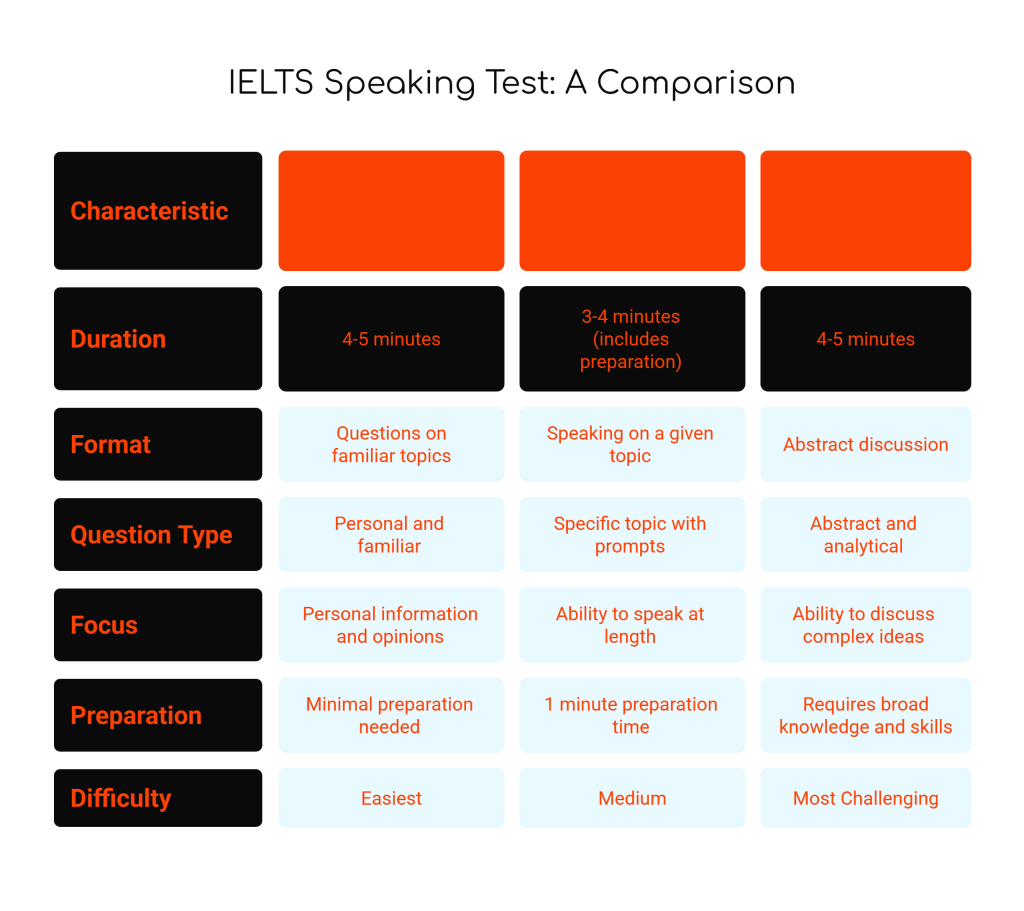
Part 1: Introduction and Interview (4-5 minutes)
- Personal introduction and ID verification
- Questions about familiar topics (home, family, work, studies, interests)
- 2-3 topic areas with 4-6 questions each
Part 2: Long Turn/Cue Card (3-4 minutes)
- 1 minute preparation time
- 1-2 minutes speaking on a given topic
- Follow-up questions from the examiner
Part 3: Two-Way Discussion (4-5 minutes)
- Abstract discussion related to Part 2 topic
- More complex questions requiring analysis and opinion
- Opportunity to demonstrate higher-level language skills
Assessment Criteria
Your speaking performance is evaluated across four key criteria, each weighted equally:
1. Fluency and Coherence (25%)
What it measures:
- Speech rate and flow
- Logical sequencing of ideas
- Use of cohesive devices
- Ability to maintain conversation
Band 7 characteristics:
- Speaks at length with occasional hesitation
- Uses range of connectives and discourse markers
- Develops topics coherently
Band 9 characteristics:
- Speaks fluently with minimal hesitation
- Uses wide range of connectives naturally
- Develops topics fully and appropriately
2. Lexical Resource (25%)
What it measures:
- Vocabulary range and accuracy
- Appropriateness of word choice
- Ability to paraphrase and explain
- Natural and idiomatic language use
Band 7 characteristics:
- Uses vocabulary resource flexibly
- Shows awareness of style and collocation
- Produces generally accurate vocabulary
Band 9 characteristics:
- Uses vocabulary with complete naturalness
- Uses idiomatic language appropriately
- Makes minimal errors in word choice
3. Grammatical Range and Accuracy (25%)
What it measures:
- Variety of grammatical structures
- Accuracy in grammar usage
- Complexity of sentence construction
- Error frequency and impact
Band 7 characteristics:
- Uses range of complex structures
- Produces frequent error-free sentences
- Shows good control of grammar
Band 9 characteristics:
- Uses full range of structures naturally
- Makes minimal errors
- Demonstrates complete grammatical control
4. Pronunciation (25%)
What it measures:
- Individual sound clarity
- Word and sentence stress
- Rhythm and intonation
- Overall intelligibility
Band 7 characteristics:
- Shows all positive features frequently
- Accent has minimal effect on intelligibility
- Uses stress and intonation effectively
Band 9 characteristics:
- Uses wide range of pronunciation features
- Sustains flexible use throughout
- Accent has no effect on intelligibility
Part 1: Introduction and Interview
Part 1 serves as a warm-up and covers familiar, everyday topics. The examiner will introduce themselves and verify your identity before proceeding with questions.
Common Topic Areas
Personal Information:
- Where are you from?
- Do you work or study?
- What do you like about your hometown?
Home and Accommodation:
- Do you live in a house or apartment?
- What’s your favorite room?
- Would you like to move to a different home?
Work/Studies:
- What subject are you studying?
- What’s the most interesting part of your job?
- Do you enjoy your work/studies?
Hobbies and Interests:
- What do you do in your free time?
- Do you prefer indoor or outdoor activities?
- Have your interests changed over time?
Strategies for Part 1
1. Give Extended Answers Instead of: “Yes, I like my job.” Try: “Yes, I really enjoy my job as a graphic designer because it allows me to be creative and work on diverse projects. Every day brings new challenges, which keeps the work interesting and engaging.”
2. Use Personal Examples Make your answers more engaging by including specific details and personal experiences.
3. Stay Natural Don’t over-prepare rehearsed answers. The examiner can easily identify memorized responses, which may negatively impact your score.
4. Show Enthusiasm Use varied intonation and express genuine interest in the topics discussed.
Sample Questions and Model Answers
Question: “Do you enjoy cooking?”
Band 6-7 Answer: “Yes, I do enjoy cooking, especially on weekends when I have more time. I like trying new recipes from different cuisines, particularly Italian and Thai food. Cooking helps me relax after a busy week, and I find it satisfying to create something delicious from simple ingredients.”
Band 8-9 Answer: “Absolutely! I’m quite passionate about cooking, actually. It’s become something of a creative outlet for me, especially during the pandemic when I had more time at home. I particularly enjoy experimenting with fusion cuisine, combining traditional dishes from my culture with international flavors. There’s something incredibly therapeutic about the process of chopping vegetables and watching ingredients transform into something completely different. Plus, I love the satisfaction of sharing a home-cooked meal with friends and family.”
Part 2: Long Turn (Cue Card)
Part 2 requires you to speak for 1-2 minutes on a specific topic. You’ll receive a cue card with prompts and have 1 minute to prepare.
Understanding the Cue Card Structure
Every cue card follows a similar pattern:
- Main topic (what you should talk about)
- 3-4 bullet points (aspects to cover)
- Final instruction (explain why/how this is important)
Sample Cue Card
Describe a skill you would like to learn in the future.
You should say:
- What the skill is
- How you would learn it
- Why you want to learn this skill
- And explain how this skill would be useful in your life
The PREP Method
Use this structure to organize your response:
Point – State your main topic clearly
Reason – Explain why you chose this topic
Example – Provide specific details and examples
Point – Conclude or connect back to the question
Preparation Strategy (1 minute)
Step 1: Choose your topic quickly (10 seconds) Don’t overthink – go with the first reasonable idea that comes to mind.
Step 2: Plan your structure (20 seconds)
- Introduction sentence
- Address each bullet point
- Conclusion/final thought
Step 3: Note key vocabulary and ideas (30 seconds) Write down:
- Key vocabulary related to your topic
- Specific examples or details
- Transition phrases
Sample Response Structure
Introduction (10-15 seconds): “I’d like to talk about learning to play the piano, which is a skill I’ve always wanted to develop.”
Main content (80-90 seconds):
- Address each bullet point systematically
- Use specific examples and details
- Include personal experiences and feelings
Conclusion (15-20 seconds): “So that’s why learning piano is something I’m really keen to pursue in the near future.”
Advanced Techniques
1. Use Descriptive Language Instead of: “I want to learn cooking.” Try: “I’m eager to master the art of French pastry making.”
2. Include Emotions and Opinions “I’ve always been fascinated by…” “What really appeals to me is…” “I find it incredibly rewarding when…”
3. Connect Ideas Smoothly Use linking phrases: “Furthermore,” “On top of that,” “What’s more,” “Additionally”
4. Vary Your Tenses
- Past: “I used to think…”
- Present: “Currently, I believe…”
- Future: “I’m planning to…” “I hope to…”
Common Part 2 Topics
People:
- A person who influenced you
- Someone you admire
- A family member
Places:
- A place you’d like to visit
- Your favorite restaurant
- A historical building
Objects:
- A gift you received
- Something you own that’s important
- A piece of technology
Events:
- A memorable celebration
- A time you helped someone
- An important decision
Activities:
- A hobby you enjoy
- A skill you learned
- An interesting conversation
Part 3: Two-Way Discussion
Part 3 is the most challenging section, requiring you to discuss abstract concepts related to your Part 2 topic. The examiner will ask follow-up questions that test your ability to analyze, compare, and express complex ideas.
Types of Questions
Opinion Questions: “Do you think social media has changed how people communicate?”
Comparison Questions: “How do you think education today differs from education in the past?”
Speculation Questions: “What changes do you think we’ll see in technology in the next decade?”
Analysis Questions: “Why do you think some people are more successful than others?”
Advanced Language Functions
1. Expressing Opinions Sophisticatedly
- “I’m inclined to believe that…”
- “From my perspective…”
- “I’d argue that…”
- “It seems to me that…”
2. Presenting Both Sides
- “On one hand… On the other hand…”
- “While it’s true that… we must also consider…”
- “Despite the advantages… there are also drawbacks…”
3. Speculating About the Future
- “I anticipate that…”
- “It’s likely that…”
- “I wouldn’t be surprised if…”
- “There’s a good chance that…”
4. Making Comparisons
- “In contrast to…”
- “Unlike previous generations…”
- “Whereas in the past…”
- “Compared to today…”
Sample Part 3 Discussion
Examiner: “Do you think people today are happier than people in the past?”
Band 6-7 Response: “That’s an interesting question. I think it depends on how you define happiness. In some ways, people today have more opportunities and better living conditions than in the past. We have better healthcare, education, and technology that makes life easier. However, I also think modern life can be more stressful because of social media and the pressure to succeed. So I’m not sure if people are actually happier overall.”
Band 8-9 Response: “That’s a fascinating question that I think requires us to consider multiple dimensions of wellbeing. On one hand, there’s no denying that material conditions have improved dramatically – we have unprecedented access to healthcare, education, and opportunities for personal growth. However, I’d argue that happiness is far more complex than material prosperity.
While previous generations might have faced physical hardships, they often had stronger community bonds and perhaps a clearer sense of purpose. Today’s society, despite its technological marvels, has introduced new forms of anxiety – social media comparison, career uncertainty, and perhaps what psychologists call ‘the paradox of choice’ where too many options can actually decrease satisfaction.
I’m inclined to think that happiness levels might be relatively constant across time periods, but the sources of joy and stress have simply evolved. What’s changed is our awareness of mental health and our vocabulary for discussing psychological wellbeing.”
Strategies for Part 3 Success
1. Think Before You Speak Take a moment to organize your thoughts. It’s acceptable to pause briefly to consider your response.
2. Acknowledge Complexity Show that you understand issues aren’t black and white: “It’s a complex issue with several factors to consider…”
3. Use Examples Support your points with concrete examples: “For instance, in my country…”
4. Show Cultural Awareness Demonstrate understanding of different perspectives: “This varies greatly between cultures…”
5. Extend Your Ideas Don’t just answer the question – develop your response with explanations, examples, and implications.
Essential Preparation Strategies
1. Build Topic-Specific Vocabulary
Create vocabulary banks for common IELTS topics:
Education:
- Academic achievement, curriculum, pedagogical approaches
- Distance learning, practical skills, theoretical knowledge
- Educational reform, literacy rates, vocational training
Technology:
- Digital revolution, artificial intelligence, automation
- Cybersecurity, privacy concerns, digital divide
- Innovation, disruption, technological advancement
Environment:
- Climate change, sustainability, renewable energy
- Conservation efforts, biodiversity, ecosystem
- Carbon footprint, environmental degradation, green initiatives
2. Practice Fluency Building Exercises
Shadow Reading: Listen to native speakers and repeat what they say simultaneously. This improves rhythm and intonation.
Describe Your Day: Spend 2-3 minutes daily describing your activities, thoughts, and observations.
Opinion Practice: Choose controversial topics and practice expressing your views for 2 minutes without stopping.
3. Record and Analyze Your Speaking
Weekly Recording Sessions:
- Record yourself answering practice questions
- Listen for pronunciation errors, hesitations, and grammatical mistakes
- Note areas for improvement and track progress
Self-Assessment Checklist:
- Did I speak for the full time allocation?
- Did I address all parts of the question?
- Did I use varied vocabulary and grammar?
- Was my pronunciation clear and natural?
4. Develop Cultural Knowledge
Stay informed about:
- Current global events and trends
- Social issues and debates
- Cultural differences and similarities
- Historical context of contemporary issues
This knowledge will help you provide more sophisticated and well-informed responses in Part 3.
Common Mistakes to Avoid
1. Over-Memorization
The Problem: Using obviously rehearsed answers that don’t directly address the question.
The Solution: Prepare flexible ideas and vocabulary rather than complete scripts. Practice adapting your knowledge to different question variations.
2. Rushing Through Answers
The Problem: Speaking too quickly and making more errors.
The Solution: Focus on clear articulation and natural pacing. It’s better to speak clearly at a moderate pace than to rush and make mistakes.
3. Not Addressing All Parts of the Question
The Problem: Focusing on only one aspect of a multi-part question.
The Solution: In Part 2, systematically address each bullet point. In Parts 1 and 3, make sure you fully answer what’s being asked.
4. Using Inappropriate Register
The Problem: Being too formal or too casual for the context.
The Solution: Maintain a conversational but respectful tone throughout. Avoid slang or overly academic language.
5. Giving Up When You Don’t Know a Word
The Problem: Stopping mid-sentence when you can’t think of a specific word.
The Solution: Learn paraphrasing techniques: “What I mean is…” “In other words…” “It’s similar to…”
6. Not Expanding Ideas
The Problem: Giving short, basic answers that don’t demonstrate language ability.
The Solution: Always extend your responses with explanations, examples, and personal experiences.
7. Ignoring the Examiner
The Problem: Treating the test like a monologue rather than a conversation.
The Solution: Make eye contact, respond to the examiner’s reactions, and maintain conversational flow.
Advanced Tips for High Scores (Band 7+)
1. Master Discourse Markers
Sequencing:
- Initially, Subsequently, Furthermore, Finally
- To begin with, Moving on to, In addition to this
Contrasting:
- Nevertheless, Nonetheless, Conversely, In contrast
- Having said that, Despite this, On the contrary
Emphasizing:
- Particularly, Especially, Specifically, Notably
- What’s more, Above all, Most importantly
2. Use Sophisticated Grammar Structures
Conditional Sentences:
- “Were I to pursue this skill, I would need considerable dedication.”
- “Had I learned this earlier, my career path might have been different.”
Passive Constructions:
- “It’s widely believed that…”
- “This approach is often recommended by experts.”
Inversion for Emphasis:
- “Not only does this benefit individuals, but it also…”
- “Rarely have I encountered such an interesting perspective.”
3. Demonstrate Lexical Sophistication
Use Collocations:
- “Fierce competition” instead of “strong competition”
- “Vested interest” instead of “personal interest”
- “Tangible benefits” instead of “real benefits”
Employ Idiomatic Expressions (Carefully):
- “It’s a double-edged sword”
- “The jury’s still out on this issue”
- “It’s not rocket science”
4. Show Metacognitive Awareness
Demonstrate that you’re thinking about your thinking:
- “That’s an intriguing question that requires careful consideration…”
- “I need to think about this from multiple angles…”
- “This issue is more nuanced than it initially appears…”
5. Use Hedging Language
Show academic sophistication by avoiding absolute statements:
- “It tends to be the case that…”
- “There’s a tendency for people to…”
- “It would seem that…”
- “To some extent…”
Practice Resources and Mock Tests
Official IELTS Resources
IELTS.org Official Materials:
- Sample speaking tests with band score examples
- Speaking test videos showing different band levels
- Official practice materials and guidelines
Cambridge IELTS Books:
- Authentic past exam questions
- Model answers with examiner comments
- Audio recordings for pronunciation reference
Online Platforms
IELTS Speaking Practice Apps:
- IELTS Speaking Assistant
- IELTS Prep App by British Council
- Magoosh IELTS Speaking
YouTube Channels:
- IELTS Liz (comprehensive speaking guidance)
- IELTS Simon (expert tips and strategies)
- E2 IELTS (method-based approach)
Creating Your Own Practice Sessions
Weekly Mock Tests:
- Use official question banks
- Time yourself strictly
- Record your responses
- Self-assess using band descriptors
- Focus on one improvement area per week
Topic-Based Practice:
- Monday: Education and Work
- Tuesday: Technology and Media
- Wednesday: Environment and Society
- Thursday: Culture and Traditions
- Friday: Health and Lifestyle
- Weekend: Review and mixed practice
Finding Speaking Partners
Language Exchange Platforms:
- HelloTalk
- Tandem
- ConversationExchange
IELTS Study Groups:
- Local libraries and community centers
- Facebook groups and online communities
- University English language departments
Final Preparation Checklist
One Month Before the Test
✓ Assessment and Planning
- Take a complete mock speaking test
- Identify your current band level
- Create a focused study plan targeting weak areas
- Gather all necessary practice materials
✓ Core Skills Development
- Build vocabulary banks for major topics
- Practice fluency exercises daily
- Work on pronunciation and intonation
- Study grammar structures for accuracy
Two Weeks Before the Test
✓ Intensive Practice
- Complete daily mock speaking sessions
- Focus on timing and task completion
- Practice with authentic IELTS questions
- Record and analyze your performance
✓ Fine-Tuning
- Polish your best topic responses
- Prepare flexible ideas for common questions
- Work on smooth transitions and natural flow
- Practice cultural and abstract discussions
One Week Before the Test
✓ Final Preparations
- Complete final mock tests under exam conditions
- Review common question types and strategies
- Prepare comfortable, appropriate clothing
- Confirm test center location and timing
✓ Mental Preparation
- Practice relaxation techniques
- Maintain regular sleep schedule
- Stay updated on current events
- Build confidence through positive self-talk
Test Day
✓ Before Leaving Home
- Eat a light, nutritious meal
- Arrive at test center 30 minutes early
- Bring required identification documents
- Review key strategies one final time
✓ At the Test Center
- Stay calm and focused
- Listen carefully to examiner instructions
- Speak clearly and at natural pace
- Show enthusiasm and maintain eye contact
Conclusion
Success in IELTS Speaking requires a combination of language proficiency, strategic preparation, and confident delivery. This comprehensive guide provides you with the knowledge and tools necessary to approach the test with confidence and achieve your target band score.
Remember that improvement in speaking skills takes time and consistent practice. Focus on gradual progress rather than perfection, and don’t hesitate to seek feedback from qualified instructors or native speakers.
The key to IELTS Speaking success lies not just in knowing what to say, but in how you say it. Develop your ability to communicate naturally, express complex ideas clearly, and engage meaningfully with the examiner. With dedicated preparation and the strategies outlined in this guide, you’ll be well-equipped to demonstrate your English speaking abilities and achieve your IELTS goals.
Final Tips for Success:
- Practice regularly and consistently
- Focus on communication over perfection
- Stay informed about current events and cultural topics
- Maintain confidence and enthusiasm throughout the test
- Remember that the examiner wants you to succeed
Good luck with your IELTS Speaking test preparation!
#IELTSGuidePhil #IELTSSpeaking #IELTSBand8 #AdvancedGrammar #IELTSVocabulary #IELTSTips #FluencyInEnglish #EnglishSpeaking #IELTSPreparation #GrammarSkills
 IELTS Guide Phil
Leave a comment