
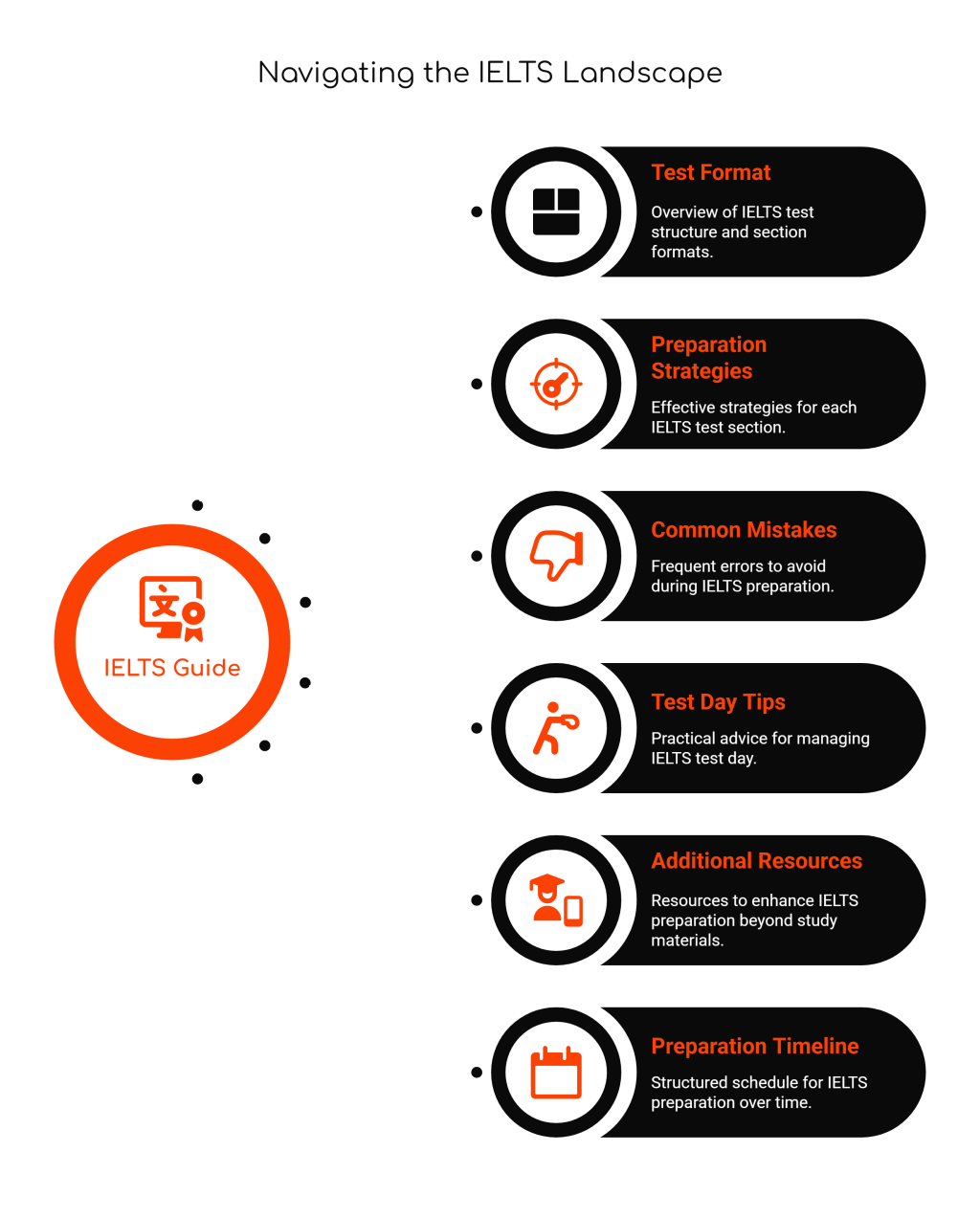
The International English Language Testing System (IELTS) is one of the world’s most recognized English proficiency tests, taken by over 3 million people annually. Whether you’re planning to study abroad, immigrate to an English-speaking country, or advance your career, achieving your target IELTS score is crucial for opening doors to new opportunities.
This comprehensive guide covers everything you need to know about IELTS, from understanding the test format to developing effective preparation strategies that will maximize your chances of success.
What is IELTS?
IELTS is a standardized test designed to assess the English language proficiency of non-native speakers. Developed jointly by the British Council, IDP Education, and Cambridge Assessment English, IELTS is accepted by over 11,000 organizations worldwide, including universities, employers, immigration authorities, and professional bodies.
The test evaluates your ability to communicate effectively in English across four key language skills: Listening, Reading, Writing, and Speaking. Your performance is measured on a 9-band scoring system, where 9 represents expert user level and 1 indicates non-user level.
IELTS Academic vs General Training
IELTS offers two distinct test versions, each tailored to different purposes and requirements.
IELTS Academic
The Academic version is designed for individuals planning to pursue higher education or professional registration in English-speaking environments. Universities and professional bodies typically require IELTS Academic scores for admission or certification purposes.
The Academic test features more complex vocabulary and formal language patterns. The Reading section includes passages from academic journals, books, and newspapers, while the Writing Task 1 requires you to describe, summarize, or explain visual information such as graphs, charts, or diagrams.
IELTS General Training
The General Training version focuses on practical, everyday English skills needed for work, training programs, or immigration purposes. Immigration authorities often require General Training scores for visa applications.
This version emphasizes social and workplace contexts. The Reading section includes materials from newspapers, advertisements, company handbooks, and guidebooks. Writing Task 1 involves composing letters (formal, semi-formal, or informal) based on given situations.
Test Format and Structure
Understanding the IELTS test structure is fundamental to effective preparation. The test consists of four sections completed over approximately 2 hours and 45 minutes.
Listening Section (30 minutes)
The Listening section contains four recordings featuring native English speakers from various countries, reflecting the global nature of English communication. You’ll hear conversations between two people, monologues in social contexts, conversations among multiple people in educational settings, and academic lectures or talks.
Each recording is played only once, making active listening skills essential. The section includes 40 questions in various formats: multiple choice, matching, plan/map/diagram labeling, form completion, note completion, table completion, flowchart completion, summary completion, sentence completion, and short-answer questions.
The recordings progress in difficulty, with Sections 1 and 2 focusing on social and general contexts, while Sections 3 and 4 concentrate on educational and academic situations. You’re given time to read questions before each recording and additional time to transfer answers to the answer sheet.
Reading Section (60 minutes)
The Reading section differs between Academic and General Training versions but both contain 40 questions across three passages. You have exactly 60 minutes to complete this section, with no additional time for transferring answers.
For IELTS Academic, passages are taken from books, journals, magazines, and newspapers, covering topics of general interest suitable for university-level students. The texts may include descriptive, factual, discursive, or analytical content, and at least one passage contains detailed logical argument.
IELTS General Training features texts from books, magazines, newspapers, notices, advertisements, company handbooks, and guidelines. The first section contains social survival texts, the second focuses on work-related contexts, and the third presents more complex, general interest topics similar to those in academic settings.
Question types include multiple choice, identifying information, identifying writer’s views/claims, matching headings, matching features, matching sentence endings, sentence completion, summary completion, note completion, table completion, flowchart completion, diagram label completion, and short-answer questions.
Writing Section (60 minutes)
The Writing section requires you to complete two tasks within 60 minutes, demonstrating your ability to organize ideas, use appropriate vocabulary and grammar, and maintain coherent arguments.
For IELTS Academic, Task 1 requires you to describe, summarize, or explain visual information in at least 150 words within 20 minutes. This might include graphs, charts, tables, diagrams, or maps. Task 2 presents an argument, problem, or point of view, requiring a written response of at least 250 words in 40 minutes.
In IELTS General Training, Task 1 involves writing a letter in response to a given situation, which may be formal, semi-formal, or informal in tone. Task 2 is similar to Academic, requiring an essay responding to an argument or problem, though topics tend to be more general interest rather than academic.
Task 2 carries twice the weight of Task 1 in scoring, making it crucial to allocate time appropriately and ensure comprehensive responses to both tasks.
Speaking Section (11-14 minutes)
The Speaking section is conducted as a face-to-face interview with a certified IELTS examiner, either on the same day as the other sections or up to seven days before or after. This personal interaction allows for a more natural assessment of your spoken English abilities.
The test consists of three parts. Part 1 involves general questions about yourself, your home, family, work, studies, and interests, lasting 4-5 minutes. This section helps you relax and provides a warm-up opportunity.
Part 2 presents a task card with a specific topic and prompts. You have one minute to prepare notes before speaking for 1-2 minutes on the given topic. The examiner may ask one or two follow-up questions.
Part 3 engages you in a discussion of more abstract ideas related to the Part 2 topic, lasting 4-5 minutes. This section assesses your ability to express and justify opinions, analyze, discuss, and speculate about issues.
Scoring System
IELTS uses a 9-band scoring system to measure English proficiency levels. Each of the four skills (Listening, Reading, Writing, Speaking) receives an individual band score, and these are averaged to produce an Overall Band Score, reported in whole and half bands.
Band 9 represents an Expert User with full operational command of the language, while Band 1 indicates a Non-User who has no ability to use the language beyond possibly a few isolated words. Band 4 typically represents Limited User level, Band 6 indicates Competent User status, and Band 7 signifies Good User proficiency.
Most universities require Overall Band Scores between 6.0-7.5, with specific requirements for individual skills. Immigration programs often require scores between 6.0-8.0 depending on the visa category and country requirements.
Understanding that there’s no pass or fail in IELTS is important. Your score reflects your current English proficiency level, and different institutions or organizations have varying score requirements based on their specific needs.
Preparation Strategies by Section
Effective IELTS preparation requires targeted strategies for each test section, focusing on developing specific skills while building overall English proficiency.
Listening Preparation
Developing strong listening skills requires consistent practice with various English accents and speaking speeds. Expose yourself to British, American, Australian, and Canadian English through podcasts, news broadcasts, documentaries, and academic lectures.
Practice note-taking while listening to identify key information quickly. Focus on understanding main ideas, specific details, speakers’ attitudes, and the purpose of conversations or monologues. Pay attention to signal words that indicate transitions, contrasts, or emphasis.
Familiarize yourself with different question types and practice predicting answers based on context clues. During practice, simulate test conditions by listening to recordings only once and working within time constraints.
Improve your ability to follow conversations with multiple speakers by practicing with group discussions or meetings. Pay attention to how speakers interrupt, agree, disagree, or change topics, as these situations commonly appear in the test.
Reading Preparation
Enhance your reading speed and comprehension through regular practice with academic and general texts. Focus on skimming for main ideas and scanning for specific information, as these skills are crucial for completing 40 questions in 60 minutes.
Develop vocabulary systematically by keeping a journal of new words encountered during practice, noting their meanings, collocations, and usage in context. Pay special attention to academic vocabulary for IELTS Academic or workplace terminology for General Training.
Practice different reading techniques for various question types. For example, when matching headings to paragraphs, focus on identifying the main idea of each paragraph rather than getting caught up in details. For True/False/Not Given questions, distinguish carefully between information that contradicts the passage versus information that isn’t mentioned.
Work on understanding inference and implication, as many questions require you to understand what the writer suggests rather than what they explicitly state. Practice identifying writers’ attitudes, purposes, and arguments within texts.
Writing Preparation
Develop a systematic approach to both writing tasks, focusing on task achievement, coherence and cohesion, lexical resource, and grammatical range and accuracy—the four criteria used in IELTS Writing assessment.
For Task 1 Academic, practice describing trends, comparing data, and explaining processes using varied vocabulary and sentence structures. Learn specific language for describing graphs, charts, and diagrams, including appropriate verb tenses and expressions for showing changes over time.
For Task 1 General Training, familiarize yourself with different letter formats and appropriate language for formal, semi-formal, and informal correspondence. Practice organizing letters with clear purposes, appropriate tone, and logical structure.
For Task 2 in both versions, develop strong essay writing skills including clear thesis statements, logical paragraph organization, and effective conclusions. Practice brainstorming and organizing ideas quickly, as planning time is limited during the actual test.
Focus on expanding your vocabulary and using more sophisticated sentence structures while maintaining accuracy. Avoid memorizing templates, as examiners can identify and penalize overly formulaic responses.
Speaking Preparation
Building confidence in spoken English requires regular practice with various topics and question types. Record yourself speaking to identify areas for improvement in pronunciation, fluency, vocabulary usage, and grammatical accuracy.
Practice speaking about familiar topics from Part 1, such as your hometown, hobbies, work, or studies. Develop the ability to extend your answers beyond simple yes/no responses by providing examples, explanations, or personal experiences.
For Part 2, practice organizing your thoughts quickly and speaking coherently for 1-2 minutes on unfamiliar topics. Use the preparation time effectively to plan your response structure and key points you want to cover.
Prepare for Part 3 by practicing expressing and justifying opinions on abstract topics. Develop your ability to compare, analyze, speculate, and discuss issues in depth, using appropriate language for expressing certainty, uncertainty, agreement, and disagreement.
Work on pronunciation by focusing on word stress, sentence stress, and intonation patterns. Practice linking words naturally and using appropriate pace and pausing to enhance your overall fluency.
Common Mistakes to Avoid
Understanding frequent errors can help you avoid pitfalls that prevent students from achieving their target scores.
Many test-takers spend too much time on difficult questions in the Reading section, leaving insufficient time for easier questions later. Practice time management by setting strict time limits for each passage and moving on when necessary.
In the Listening section, avoid trying to understand every word. Focus on identifying key information and don’t let missed answers distract you from subsequent questions. Keep writing while listening, as recordings continue regardless of your progress.
Writing task mistakes often include not addressing all parts of the question, writing under the minimum word count, or spending too much time on Task 1 at the expense of the higher-weighted Task 2. Always read questions carefully and ensure your response fully addresses all requirements.
Speaking section errors frequently involve giving very short answers in Part 1, not using the full time available in Part 2, or being unable to develop ideas in Part 3. Practice extending your responses appropriately and developing ideas with examples and explanations.
Across all sections, avoid leaving blank answers. Even educated guesses are better than no answers, as there’s no penalty for incorrect responses in IELTS.
Test Day Tips
Proper preparation extends beyond studying content to managing the practical aspects of test day effectively.
Arrive at the test center early to complete check-in procedures and settle into the testing environment. Bring required identification documents and ensure they meet IELTS requirements for validity and condition.
Dress comfortably and appropriately for the test duration and speaking interview. Consider the test center’s climate and your comfort during several hours of concentration.
Manage your energy by eating a proper breakfast and staying hydrated, but avoid excessive liquids that might cause disruptions during the test. Bring permitted snacks if allowed at your test center.
During the test, read all instructions carefully and manage your time effectively. Use scratch paper for planning in the Writing section and note-taking during Listening.
Stay calm and focused if you encounter difficult questions. Remember that IELTS assesses overall proficiency, and perfect scores aren’t necessary to achieve your target band.
Preparation Timeline
Creating a structured preparation schedule depends on your current English level, target score, and available study time.
For students starting 3-6 months before their test date, begin with a diagnostic practice test to identify strengths and weaknesses. Allocate more time to challenging areas while maintaining skills in stronger sections.
Dedicate consistent daily study time rather than intensive cramming sessions. Aim for 1-2 hours of focused study daily, mixing different skills and incorporating both guided practice and independent study.
Plan your preparation in phases: initial assessment and familiarization, skill development and targeted practice, intensive practice with timed conditions, and final review and test simulation.
Include regular progress assessments through practice tests to track improvement and adjust your study plan accordingly. Take at least 2-3 complete practice tests under exam conditions before your actual test date.
Additional Resources and Support
Leverage various resources to enhance your IELTS preparation beyond traditional study materials.
Official IELTS materials from British Council, IDP Education, and Cambridge provide authentic practice materials and scoring criteria. These resources offer the most accurate representation of actual test content and standards.
Online platforms offer interactive practice exercises, video lessons, and progress tracking features. Many provide detailed explanations and feedback to help you understand your mistakes and improve performance.
Consider joining IELTS preparation courses or working with qualified tutors for personalized guidance and feedback, especially for Writing and Speaking sections where self-assessment can be challenging.
Practice with study partners or conversation groups to improve your speaking confidence and receive feedback from others learning English. Language exchange programs can provide opportunities to practice with native speakers.
Use English media consumption strategically by choosing materials that match IELTS content and difficulty levels. Academic podcasts, news broadcasts, and documentary films can improve both listening skills and knowledge of topics commonly featured in IELTS tests.
Conclusion
Success in IELTS requires a combination of English language proficiency, test-taking strategies, and thorough preparation. Understanding the test format, developing targeted skills for each section, and practicing consistently under timed conditions are essential elements of effective preparation.
Remember that IELTS measures your current English ability across practical communication scenarios you’ll encounter in academic, professional, or social contexts. Focus on developing genuine English skills rather than just test-taking techniques, as this approach will serve you well both in achieving your target score and in your future endeavors requiring English proficiency.
Start your preparation early, maintain consistent practice, and seek support when needed. With dedicated effort and strategic preparation, you can achieve the IELTS score necessary to reach your academic, professional, or immigration goals. The investment in developing your English proficiency through IELTS preparation will benefit you far beyond test day, providing skills essential for success in English-speaking environments worldwide.
#IELTSGuide #IELTSListening #IELTSreading #IELTSWriting #IELTSSpeaking #Academic #GeneralTraining #IELTSPreparation #AcademicEnglish #IELTSWithPhil #IELTSGuidePhil #LearnIELTS #IELTS2025 #IELTS
 IELTS Guide Phil
Leave a comment