
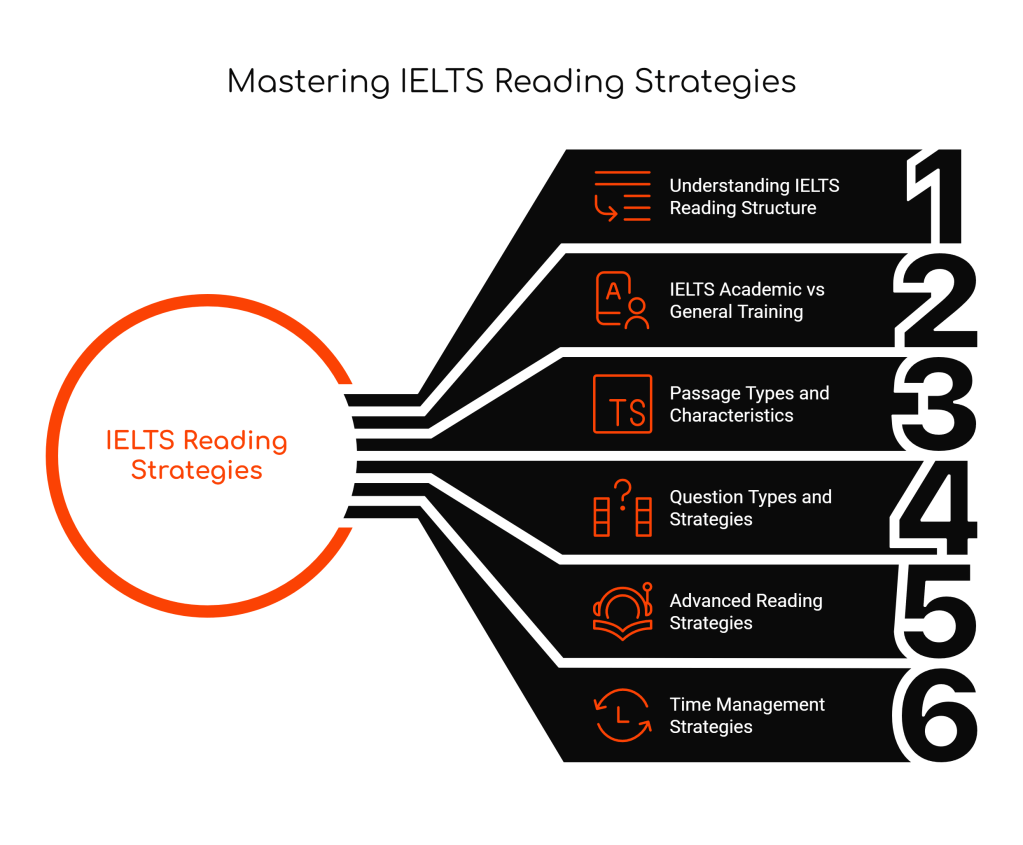
The IELTS Reading section is often perceived as one of the most time-intensive parts of the test, requiring you to read three lengthy passages and answer 40 questions in just 60 minutes. Success demands not only strong reading comprehension skills but also effective time management, strategic question-answering techniques, and the ability to quickly locate and process information from complex academic or general texts.
This comprehensive guide provides everything you need to excel in IELTS Reading, from understanding the fundamental differences between Academic and General Training versions to mastering advanced reading strategies that will maximize your band score.
Understanding IELTS Reading Structure
The IELTS Reading section consists of three passages with a total of 40 questions to be completed in exactly 60 minutes. Unlike other sections, there is no additional time for transferring answers, making efficient time management absolutely crucial for success.
Each passage contains approximately 700-900 words and is accompanied by 13-14 questions in various formats. The passages progress in difficulty, with the third passage typically being the most challenging in terms of vocabulary, concept complexity, and question sophistication.
The reading passages are drawn from authentic sources including books, journals, magazines, and newspapers, ensuring that the content reflects real-world reading scenarios you’ll encounter in academic or professional environments.
Understanding that every question carries equal weight emphasizes the importance of strategic time allocation and the need to attempt all questions, even if you must make educated guesses for some responses.
IELTS Academic vs General Training Reading
The fundamental structure remains consistent between both versions, but the content sources, topics, and complexity levels differ significantly to match the intended purposes of each test type.
IELTS Academic Reading
Academic Reading features passages taken from books, journals, magazines, and newspapers covering topics of general interest but suitable for university-level students. The content may be descriptive, factual, discursive, or analytical, with at least one passage containing detailed logical argument.
The vocabulary is more sophisticated and academic, incorporating technical terms, abstract concepts, and complex sentence structures commonly found in higher education contexts. Topics often include scientific research, historical analysis, social studies, environmental issues, technology developments, and cultural phenomena.
The complexity progresses throughout the three passages, with the final text typically presenting the most challenging vocabulary, concepts, and argumentation. This progression prepares you for the academic reading demands you’ll face in university-level study.
Question types tend to emphasize critical thinking skills such as identifying writer’s views, understanding implied meanings, and analyzing argument structures that reflect academic discourse requirements.
IELTS General Training Reading
General Training Reading features texts from books, magazines, newspapers, notices, advertisements, company handbooks, and guidelines that reflect everyday English language usage in social and workplace contexts.
Section 1 contains texts relevant to basic linguistic survival in English-speaking countries, such as advertisements, notices, timetables, and short articles describing facilities or services.
Section 2 focuses on work-related contexts, featuring texts such as job descriptions, company policies, training materials, and workplace guidelines that reflect professional communication needs.
Section 3 presents longer, more complex texts similar to those in academic settings but with topics of general rather than academic interest, such as newspaper articles, magazine features, or informational texts.
The vocabulary and concepts remain accessible to general audiences while still challenging your reading comprehension and analytical skills within practical contexts.
Passage Types and Characteristics
Understanding the different types of passages you’ll encounter helps you approach each text with appropriate reading strategies and expectations.
Descriptive Passages
Descriptive passages provide detailed information about topics, processes, places, or phenomena without necessarily presenting arguments or opinions. These texts focus on factual presentation and comprehensive explanation of subjects.
Common features include clear organizational structure, factual accuracy, neutral tone, and systematic coverage of topics. You’ll often encounter these in passages about scientific processes, historical events, geographical features, or cultural practices.
Reading strategies for descriptive passages should focus on identifying main topics, understanding relationships between different elements, and locating specific factual information efficiently.
Argumentative Passages
Argumentative passages present viewpoints, opinions, or debates about controversial or complex issues. These texts typically include thesis statements, supporting evidence, counterarguments, and conclusions that reflect critical thinking and persuasive writing.
Key features include clear position statements, logical progression of ideas, evidence and examples supporting arguments, acknowledgment of opposing viewpoints, and persuasive language designed to convince readers.
Success with argumentative passages requires identifying the writer’s main argument, understanding supporting evidence, recognizing bias or persuasive techniques, and distinguishing between facts and opinions.
Analytical Passages
Analytical passages examine topics in depth, breaking down complex issues into component parts for detailed examination. These texts often compare different approaches, analyze cause-and-effect relationships, or evaluate multiple perspectives on issues.
Characteristics include systematic examination of topics, comparison and contrast of different elements, evaluation of evidence or approaches, and synthesis of information from multiple sources or perspectives.
Effective reading of analytical passages requires following complex logical development, understanding relationships between different ideas, and grasping the writer’s analytical framework and conclusions.
Question Types and Strategies
IELTS Reading includes diverse question types that test different aspects of reading comprehension, from basic factual recall to sophisticated analysis of writer’s intentions and implicit meanings.
Multiple Choice Questions
Multiple choice questions test your understanding of main ideas, specific details, writer’s attitudes, or implied meanings. These questions typically offer three or four options, requiring you to select the most accurate response based on passage content.
The key to success lies in careful reading of both the question and all options before selecting your answer. Pay attention to qualifying words such as “always,” “never,” “usually,” or “sometimes” that can significantly affect meaning.
Be cautious of distractors that use words from the passage but distort their original meaning or context. The correct answer often paraphrases information from the text rather than using identical wording.
Practice eliminating obviously incorrect options first, then carefully compare remaining choices to identify the most accurate response based on passage content.
True/False/Not Given Questions
These questions test your ability to identify whether statements agree with information in the passage (True), contradict passage information (False), or address topics not covered in the text (Not Given).
True answers correspond to statements that match information explicitly stated or clearly implied in the passage, even if different words are used to express the same ideas.
False answers represent statements that directly contradict information provided in the passage, presenting opposite or conflicting information.
Not Given answers apply to statements about topics that are not addressed in the passage, regardless of whether the statements might be true in reality.
Success requires distinguishing carefully between information that is explicitly stated, clearly implied, contradicted, or simply not mentioned in the passage.
Yes/No/Not Given Questions
Similar to True/False/Not Given but focusing specifically on the writer’s views, opinions, or claims rather than factual information. These questions test whether you can identify the author’s perspective on specific issues.
Yes answers indicate that the writer’s opinion agrees with the statement, either through direct expression or clear implication from the overall argument or tone.
No answers show that the writer’s opinion contradicts or disagrees with the statement, as evidenced by explicit statements or clear implications from the text.
Not Given answers apply when the writer’s opinion on the specific topic is not expressed or cannot be determined from the passage content.
Matching Headings
Matching headings questions require you to select appropriate headings for paragraphs or sections from a list of possible options. This question type tests your ability to identify main ideas and understand paragraph organization.
Success requires distinguishing between main ideas and supporting details, as headings should reflect the primary focus of each paragraph rather than minor points or examples.
Read each paragraph carefully to identify its central theme, then compare this with available headings to find the best match. Be aware that some headings may be distractors that seem relevant but don’t accurately capture the paragraph’s main focus.
Practice identifying topic sentences and concluding statements that often contain or summarize the main ideas expressed in paragraphs.
Matching Information
These questions require you to identify which paragraph or section contains specific information mentioned in the question statements. This tests your ability to locate particular details within longer texts.
Approach these questions by identifying keywords in each statement, then scanning the passage for paragraphs containing related information or synonyms.
Be careful to match the specific information requested rather than just general topic similarity. The correct paragraph must contain the precise information mentioned in the question.
Practice developing efficient scanning techniques to locate specific information quickly without getting distracted by unrelated content.
Matching Features
Matching features questions require you to connect items from two lists, such as matching researchers with their discoveries, countries with their characteristics, or problems with their solutions.
Success depends on careful reading to understand the relationships between different elements mentioned in the passage. Pay attention to how the text connects different people, places, concepts, or ideas.
Make notes while reading to track which features or characteristics are associated with which items, as this information may be scattered throughout the passage.
Sentence Completion
Sentence completion questions provide incomplete sentences that you must finish using words from the passage. These test your ability to understand specific details and relationships between ideas.
Pay attention to grammatical requirements of the incomplete sentences to help identify what type of word or phrase is needed. The completed sentence must be grammatically correct and logically coherent.
Look for sentences in the passage that contain the information needed to complete the given statements, but remember that the completion may require paraphrasing rather than exact copying.
Summary Completion
Summary completion questions provide a summary of part or all of the passage with missing words that you must fill in from the text or from a given list of options.
These questions test your understanding of main ideas and key supporting details, as summaries focus on the most important information rather than minor details.
Read the summary carefully to understand its organization and logic, then identify which parts of the passage provide the missing information.
Diagram Label Completion
These questions require you to label diagrams, flowcharts, or other visual representations based on information provided in the passage. This tests your ability to understand processes, relationships, or structures described in the text.
Study the diagram carefully before reading to understand what type of information you need to identify. Pay attention to arrows, connections, or other visual elements that indicate relationships between different parts.
Look for descriptive passages that explain processes, structures, or relationships that correspond to the visual representation provided.
Advanced Reading Strategies
Developing sophisticated reading strategies is essential for managing the time constraints and complexity of IELTS Reading passages effectively.
Skimming for Main Ideas
Skimming involves reading quickly to identify main ideas, overall structure, and general content without focusing on specific details. This technique helps you understand passage organization and locate relevant sections for detailed reading.
Practice reading first and last paragraphs carefully, as these often contain thesis statements and conclusions. Skim topic sentences of body paragraphs to understand the progression of ideas throughout the passage.
Develop the ability to identify signal words that indicate main ideas, such as “importantly,” “significantly,” “in conclusion,” or “the main point is.”
Use skimming to create a mental map of passage content before attempting to answer questions, allowing you to locate specific information more efficiently.
Scanning for Specific Information
Scanning involves searching quickly for specific information, keywords, or details without reading every word. This technique is crucial for efficiently locating answers to factual questions.
Practice identifying keywords in questions, then scanning passages for these words or their synonyms. Remember that IELTS often uses paraphrasing, so look for similar meanings rather than identical words.
Develop systematic scanning patterns, such as reading left to right and top to bottom, to ensure you don’t miss relevant information.
Use formatting clues such as capital letters, numbers, dates, or italicized words to help locate specific information quickly.
Active Reading Techniques
Active reading involves engaging consciously with text content through prediction, questioning, summarizing, and connecting ideas. This approach improves comprehension and retention significantly.
Practice predicting content based on titles, headings, and introductory paragraphs. These predictions help focus your attention and improve understanding of how ideas develop throughout passages.
Ask yourself questions while reading: What is the main argument? What evidence supports this claim? How do these ideas connect? This internal dialogue enhances comprehension and critical thinking.
Vocabulary in Context
Developing the ability to understand unfamiliar vocabulary through context clues is essential, as IELTS passages often contain specialized or advanced vocabulary that may be unfamiliar.
Practice identifying context clues such as definitions, examples, synonyms, antonyms, or explanations that help clarify unfamiliar word meanings.
Learn to distinguish between essential vocabulary that affects overall comprehension and less important words that don’t significantly impact understanding.
Focus on understanding general meaning rather than every specific word, as excessive focus on individual vocabulary can slow reading speed and reduce overall comprehension.
Time Management Strategies
Effective time management is crucial for IELTS Reading success, as 60 minutes must cover three passages and 40 questions with no additional transfer time.
Strategic Time Allocation
Plan to spend approximately 20 minutes per passage, but be flexible based on passage difficulty and your personal strengths. Some candidates prefer spending less time on easier passages to allow more time for challenging ones.
Allocate time within each passage for initial skimming (2-3 minutes), question answering (15-16 minutes), and final review (1-2 minutes). This structure ensures comprehensive coverage while maintaining forward progress.
Track your time during practice to develop internal timing awareness that helps you maintain appropriate pace during the actual test.
Question Order Strategy
Consider answering questions in strategic order rather than sequential order. Some question types may be quicker to answer or easier to locate, allowing you to secure points efficiently.
Many candidates find it effective to answer factual questions (matching information, sentence completion) before tackling more complex analytical questions (writer’s views, inference questions).
However, maintain awareness of question numbering to ensure accurate transfer to answer sheets, as questions must be answered in the designated spaces regardless of the order you complete them.
Passage Approach Methods
Develop a consistent approach for tackling each passage that maximizes efficiency while ensuring thorough comprehension. Some candidates prefer reading the entire passage first, while others prefer previewing questions before reading.
The questions-first approach involves reading questions before the passage to focus attention on relevant information, potentially saving time by avoiding unnecessary detailed reading of irrelevant sections.
The passage-first approach involves reading the entire passage for general understanding before attempting questions, providing comprehensive context that may improve accuracy.
Experiment with both approaches during practice to determine which method works best for your reading style and comprehension preferences.
Common Challenges and Solutions
Understanding frequent difficulties helps you prepare for and overcome obstacles that prevent many candidates from achieving their target scores.
Time Pressure Management
Many candidates struggle with completing all questions within the 60-minute limit, leading to rushed answers or incomplete responses in later sections.
Build reading speed through regular practice with timed exercises, gradually increasing your pace while maintaining comprehension accuracy. Focus on developing efficient scanning and skimming techniques.
Practice with passages longer than those in actual tests to build reading stamina and improve your ability to process information quickly under pressure.
Learn to make educated guesses for uncertain answers rather than spending excessive time on individual questions, as all questions carry equal weight.
Vocabulary Challenges
Advanced vocabulary in academic passages can overwhelm candidates who focus too heavily on understanding every word rather than grasping overall meaning.
Develop systematic vocabulary building through regular reading of academic materials, newspapers, and magazines that match IELTS content complexity.
Practice using context clues to infer meaning from unfamiliar words rather than panicking when encountering unknown vocabulary.
Focus on understanding main ideas and key arguments even when specific vocabulary is unclear, as many questions test overall comprehension rather than specific word knowledge.
Question Type Confusion
Different question types require different strategies, and confusion about requirements can lead to incorrect answers even when comprehension is adequate.
Familiarize yourself thoroughly with all question types through targeted practice, ensuring you understand exactly what each format requires.
Practice identifying question types quickly and applying appropriate strategies automatically, reducing the mental processing time needed during the actual test.
Develop systematic approaches for each question type that you can apply consistently under test pressure.
Passage Complexity
The increasing difficulty of passages throughout the test can overwhelm candidates who don’t adjust their reading strategies appropriately.
Practice with progressively difficult materials to build tolerance for complex academic content and sophisticated argumentation.
Develop different reading approaches for different passage types, recognizing that descriptive, argumentative, and analytical texts require different comprehension strategies.
Preparation Techniques
Systematic preparation using varied techniques ensures comprehensive skill development and confidence building for test day performance.
Diagnostic Assessment
Begin preparation with a complete practice reading test under timed conditions to identify your current performance level and specific areas needing improvement.
Analyze errors carefully to understand whether mistakes result from time pressure, vocabulary gaps, question-type confusion, or comprehension difficulties.
Create a personalized study plan based on diagnostic results, focusing more attention on weak areas while maintaining strengths.
Targeted Skill Development
Practice specific reading skills through focused exercises rather than only taking complete practice tests. Work on individual areas such as skimming speed, scanning accuracy, or vocabulary inference.
Use authentic materials that match IELTS content and complexity, including academic journals, quality newspapers, and educational magazines.
Practice different question types separately before combining them in full test formats, ensuring mastery of each format’s specific requirements.
Progressive Difficulty Training
Structure practice to gradually increase difficulty, starting with easier texts and advancing to materials that match or exceed IELTS complexity.
Begin with shorter passages and fewer questions, gradually building up to full-length texts with complete question sets.
Practice with topics outside your comfort zone to build familiarity with diverse subject areas commonly featured in IELTS.
Regular Progress Monitoring
Schedule regular assessment tests to track improvement and identify areas needing continued attention. Maintain detailed records of practice performance.
Analyze patterns in your errors to identify persistent problems that require focused attention and strategy adjustment.
Adjust study plans based on progress assessments, shifting emphasis as skills develop and new challenges emerge.
Test Day Strategies
Effective test day performance requires preparation beyond reading skills, including practical strategies for optimizing performance under actual test conditions.
Pre-Test Preparation
Arrive early to settle into the testing environment and complete check-in procedures without stress. Familiarize yourself with desk space and materials organization.
Bring required identification and permitted materials, ensuring everything meets test center requirements.
Mentally prepare by reviewing key strategies and managing any pre-test anxiety through familiar relaxation techniques.
During the Test
Read instructions carefully for each question type, as specific requirements may vary slightly from practice materials.
Use scratch paper effectively for note-taking, time tracking, and organizing your approach to complex passages or question sets.
Maintain awareness of time without becoming obsessed with the clock. Check progress periodically but avoid constant time-checking that increases anxiety.
Stay focused on the task at hand rather than worrying about overall performance or comparing your progress to other candidates.
Answer Management
Fill in answer sheets carefully, ensuring responses correspond to correct question numbers. Double-check answer placement, especially if you answer questions out of order.
Make educated guesses for uncertain answers rather than leaving blanks, as there’s no penalty for incorrect responses.
Review completed answers if time permits, but avoid changing responses unless you’re confident about corrections, as first instincts are often accurate.
Building Long-Term Reading Skills
Developing strong English reading skills provides benefits extending far beyond IELTS success, supporting academic, professional, and personal growth in English-speaking environments.
Daily Reading Habits
Incorporate English reading into daily routines through newspapers, magazines, online articles, or books that match your interests and gradually increase in complexity.
Choose materials that engage your interest, as enjoyment enhances learning and retention while making skill development more sustainable.
Set specific reading goals such as completing certain numbers of articles weekly or reading for designated time periods daily.
Active Engagement Strategies
Transform passive reading into active learning through note-taking, summarizing, questioning, and discussing content with others.
Practice explaining or teaching content you’ve read, as this reinforces understanding and identifies comprehension gaps.
Connect reading content with writing and speaking practice, using articles as inspiration for discussions or essay topics.
Academic Reading Development
Gradually incorporate more academic content into your reading practice, including research articles, academic journals, and scholarly publications relevant to your field of interest.
Practice identifying academic writing features such as thesis statements, supporting evidence, argumentation patterns, and conclusion techniques.
Develop familiarity with academic vocabulary and concepts that appear frequently across different disciplines and subject areas.
Resources and Materials
Selecting appropriate practice materials ensures effective preparation that accurately reflects IELTS standards and requirements.
Official IELTS Materials
Official practice materials from British Council, IDP Education, and Cambridge provide the most accurate representation of actual test content, difficulty levels, and question formats.
These resources include complete practice tests, sample questions, and band descriptors that help understand performance expectations and scoring criteria.
Use official materials as benchmarks for your preparation, ensuring practice aligns with actual test standards.
Supplementary Reading Materials
Academic journals, quality newspapers, and educational magazines provide exposure to the types of content featured in IELTS Reading passages.
Online academic databases and educational websites offer authentic materials that match IELTS complexity and subject diversity.
Library resources including academic books, research publications, and periodicals provide extensive practice materials for skill development.
Technology and Online Resources
Online IELTS preparation platforms offer interactive exercises, progress tracking, and immediate feedback that supplement traditional study materials.
Reading applications and websites provide opportunities for daily practice with varied content and difficulty levels.
Digital tools for vocabulary building, reading speed improvement, and comprehension enhancement can support systematic skill development.
Conclusion
Mastering IELTS Reading requires developing sophisticated reading skills, strategic question-answering techniques, and effective time management abilities that work together under test pressure. Success depends on building genuine reading proficiency while familiarizing yourself with specific test formats and requirements.
The diversity of passage types, question formats, and time constraints demands systematic preparation that addresses both skill development and test-taking strategies. Regular practice with authentic materials, combined with targeted work on weak areas, provides the foundation for achieving your desired band score.
Remember that IELTS Reading skills transfer directly to academic and professional success in English-speaking environments. The ability to quickly comprehend complex texts, analyze arguments, and extract key information serves you well beyond test day in university studies, professional development, and lifelong learning.
Approach your preparation with patience and persistence, recognizing that reading skills develop gradually through consistent exposure to challenging materials. Focus on building comprehensive reading abilities while mastering test-specific techniques and time management strategies.
With systematic preparation, strategic practice, and effective test day execution, you can achieve your target IELTS Reading score while developing reading skills that will support your success in English-language academic and professional contexts.
#IELTSGuide #IELTSReading #Academic #GeneralTraining #IELTSPreparation #AcademicEnglish #IELTSWithPhil #IELTSGuidePhil #LearnIELTS #IELTS2025 #IELTS #AceIELTS #IELTSSuccess
 IELTS Guide Phil
Leave a comment