
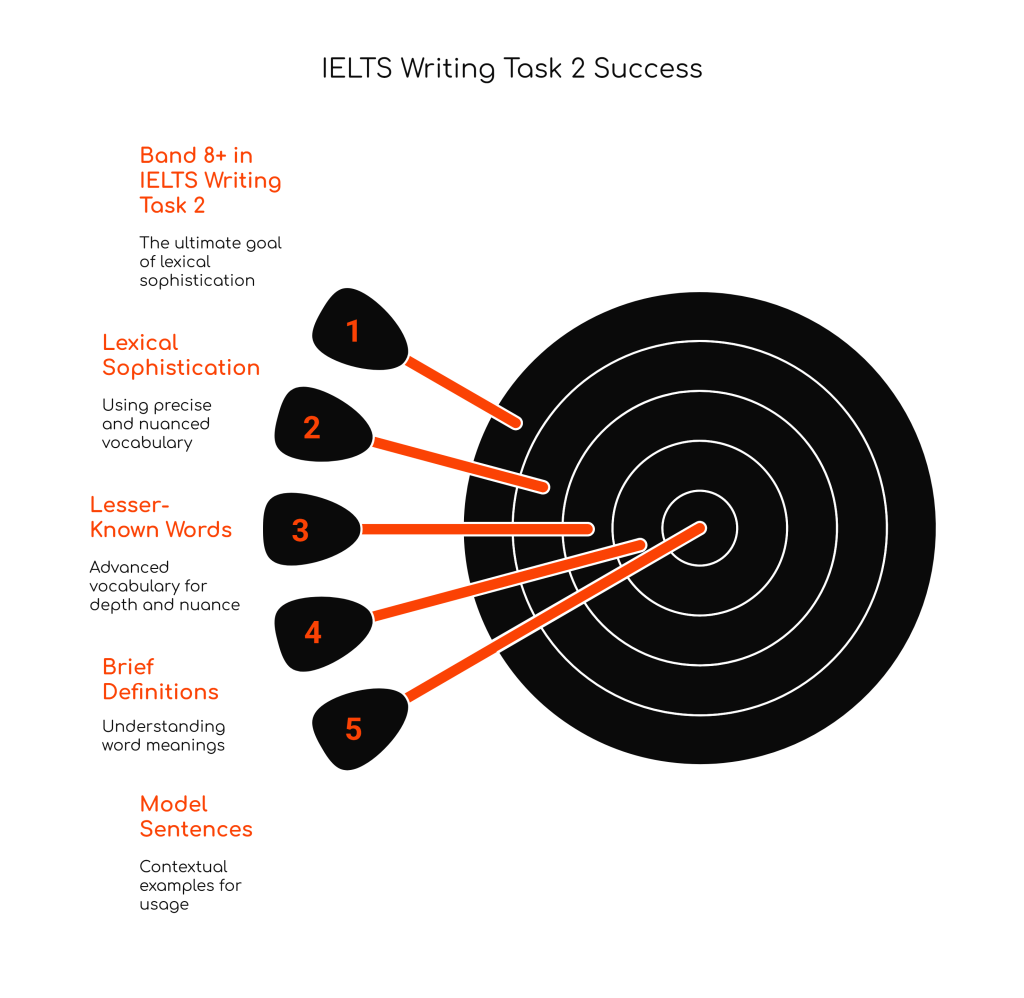
Achieving a Band 8+ in IELTS Writing Task 2 requires more than just correct grammar and structure—it demands lexical sophistication. While common words can express ideas clearly, lesser-known, high-precision words can add depth, nuance, and academic tone to your writing. This post introduces 100 advanced but natural words that are often overlooked, yet powerful for essays.
Each word is paired with a brief definition and a model sentence to show its use in IELTS Writing contexts.
100 Lesser-Known Academic Words
- abate – to reduce or lessen
Governments must act promptly to abate environmental degradation. - accrue – to accumulate or receive gradually
Benefits from educational reforms may accrue over decades. - affluent – wealthy or prosperous
Affluent nations have a greater responsibility toward global aid. - alleviate – to ease or relieve
Urban planning can alleviate traffic congestion. - anomaly – something that deviates from the norm
The rise in youth unemployment is a statistical anomaly. - arbitrary – based on personal whim rather than reason
Many workplace rules appear arbitrary and outdated. - augment – to increase or enhance
Technology can augment the quality of online education. - brevity – concise expression
The essay’s strength lies in its clarity and brevity. - catalyst – a trigger for change
Public protest can be a catalyst for legal reform. - coerce – to force or compel
People should not be coerced into unwanted medical procedures. - conducive – supportive; favorable to
Small class sizes are conducive to effective learning. - connotation – implied or suggested meaning
The word ‘discipline’ carries both positive and negative connotations. - dearth – scarcity or lack
A dearth of resources hampers rural development. - detrimental – harmful or damaging
Excessive screen time can be detrimental to children’s health. - disparity – inequality or difference
There remains a stark disparity in income between urban and rural areas. - elicit – to draw out a response or reaction
Surveys are useful to elicit public opinion. - emulate – to imitate or follow
Developing nations may emulate successful healthcare models. - entail – to involve or include
Urban expansion entails environmental consequences. - eradicate – to eliminate completely
Efforts must be made to eradicate poverty. - exacerbate – to worsen a situation
Inflation exacerbates social inequality. - feasible – possible and practical
It is not always feasible to implement zero-emission policies immediately. - fluctuate – to vary irregularly
Prices of essential commodities continue to fluctuate. - fortify – to strengthen or reinforce
Education fortifies individuals against exploitation. - foster – to promote or encourage
Public policies should foster innovation. - hinder – to obstruct or delay
Excessive regulation hinders business growth. - imperative – extremely important
It is imperative that governments address climate change. - incentivize – to motivate through rewards
Tax cuts can incentivize sustainable energy use. - incessant – continuous without pause
Incessant advertising contributes to consumerism. - indigenous – native or original to a place
Protecting indigenous cultures is vital to social diversity. - inevitable – certain to happen
Automation is an inevitable consequence of technological advancement. - integral – essential and necessary
Public participation is integral to democratic governance. - juxtapose – to place side by side for comparison
The essay juxtaposes traditional and modern parenting styles. - lucrative – highly profitable
Tourism is a lucrative industry for many countries. - mitigate – to lessen the impact
Green infrastructure can mitigate flood risks. - novel – new and original
A novel approach to education may yield better outcomes. - obsolete – outdated or no longer in use
Many manual jobs are becoming obsolete due to automation. - paramount – of utmost importance
Public health must remain a paramount concern. - pervasive – widespread or prevalent
Internet access is becoming increasingly pervasive. - plausible – believable and reasonable
The theory provides a plausible explanation for the trend. - precursor – something that precedes and indicates
The rise in pollution is a precursor to health crises. - prevalent – common or widespread
Obesity is prevalent in developed nations. - prolific – highly productive
She is a prolific researcher in environmental science. - propensity – a natural inclination
There is a growing propensity among youth to pursue entrepreneurship. - prospect – likelihood or chance
The prospect of global recession affects investment. - reiterate – to repeat for emphasis
It is important to reiterate the significance of early education. - reluctance – unwillingness
There is reluctance to change among older generations. - resilient – able to recover quickly
Resilient economies bounce back from financial shocks. - scrutiny – close examination
Government policies should undergo rigorous public scrutiny. - subsidize – to financially support
Governments should subsidize public transport. - suppress – to hold back or restrain
Strict laws can suppress free speech. - tangible – real and measurable
The new system has brought tangible benefits. - transient – temporary or short-lived
Most fashion trends are transient. - ubiquitous – present everywhere
Smartphones are now ubiquitous in modern life. - undermine – to weaken gradually
Corruption undermines institutional trust. - viable – capable of working successfully
Solar energy is a viable alternative to fossil fuels. - warrant – to justify or necessitate
The severity of the issue warrants urgent action. - yield – to produce or result in
Organic farming yields healthier produce. - zeal – great enthusiasm
Environmental activists approach the issue with zeal. - acquiesce – to accept reluctantly
Many citizens acquiesce to unfair laws. - belittle – to minimize or devalue
It is unfair to belittle the importance of arts education. - circumvent – to find a way around
Some companies circumvent tax laws through loopholes. - debunk – to expose as false
The study debunks myths about climate change. - equitable – fair and impartial
An equitable tax system benefits all citizens. - foreseeable – able to be predicted
In the foreseeable future, AI may dominate many fields. - harrowing – extremely distressing
The report describes harrowing conditions in refugee camps. - intermittent – occurring at irregular intervals
Intermittent internet access limits remote education. - lucid – clear and easy to understand
Her essay presents a lucid argument on migration. - menial – low-status and repetitive
Automation replaces many menial tasks. - nuanced – subtle and refined
The writer offers a nuanced view of the issue. - onerous – burdensome and difficult
Student loans are often seen as onerous. - polarize – to divide into opposing groups
The policy has polarized public opinion. - quintessential – the most typical example
She is the quintessential modern leader. - ramification – consequence or outcome
Ignoring climate change has serious ramifications. - scrupulous – extremely attentive to detail
Academic researchers must be scrupulous in citing sources. - tacit – understood without being stated
There is a tacit agreement to avoid conflict. - unprecedented – never done or known before
The pandemic led to unprecedented economic shutdowns. - vindicate – to prove right
The data vindicates the scientist’s hypothesis. - weary – tired or worn out
Citizens are growing weary of political instability. - yearning – deep longing
There is a yearning for better opportunities. - zealous – passionately devoted
He is zealous about educational reform. - altruistic – unselfishly concerned for others
Altruistic motives often drive social entrepreneurs. - bane – a source of harm
Plastic waste is the bane of marine ecosystems. - conspicuous – easily noticed
His absence was conspicuous during the debate. - delineate – to describe in detail
The essay delineates both sides of the argument. - elusive – difficult to find or define
Happiness is often an elusive concept. - fortitude – courage in adversity
Students need fortitude to face academic challenges. - glean – to gather bit by bit
Insights were gleaned from multiple case studies. - hegemony – leadership or dominance
Economic hegemony often dictates global policies. - imbue – to inspire with a quality
Good teaching imbues students with curiosity. - jeopardy – danger or risk
Failing to act puts biodiversity in jeopardy. - knack – a skill or ability
She has a knack for persuasive writing. - levy – to impose a tax or fee
The government levied new environmental taxes. - moratorium – a temporary halt
A moratorium was placed on nuclear testing. - nostalgia – sentimental longing
Nostalgia can cloud objective analysis of the past. - onus – burden or responsibility
The onus is on the state to ensure education. - precipitate – to cause something suddenly
The policy precipitated widespread protests. - rescind – to revoke or cancel
The law was rescinded after public backlash. - salient – most noticeable or important
The essay highlights salient features of urbanization. - tantamount – equivalent in seriousness
Ignoring the rules is tantamount to cheating. - usurp – to take power illegally or forcefully
The military usurped control of the nation.
Final Thoughts
To score Band 8+ in IELTS Writing Task 2, you must demonstrate a command of precise, nuanced vocabulary that enhances your clarity and argumentation. These lesser-known words are not just impressive—they are practical and help you write more academically, logically, and persuasively. Practice using them in context, and avoid overuse or misuse by learning their exact meaning and tone.
#IELTSWriting #IELTSBand8 #IELTSVocabulary #LexicalResource #IELTSEssay #AcademicWriting #IELTSPreparation #IELTSGuidePhil #WritingTask2 #AdvancedEnglish #IELTS
 IELTS Guide Phil
Leave a comment