
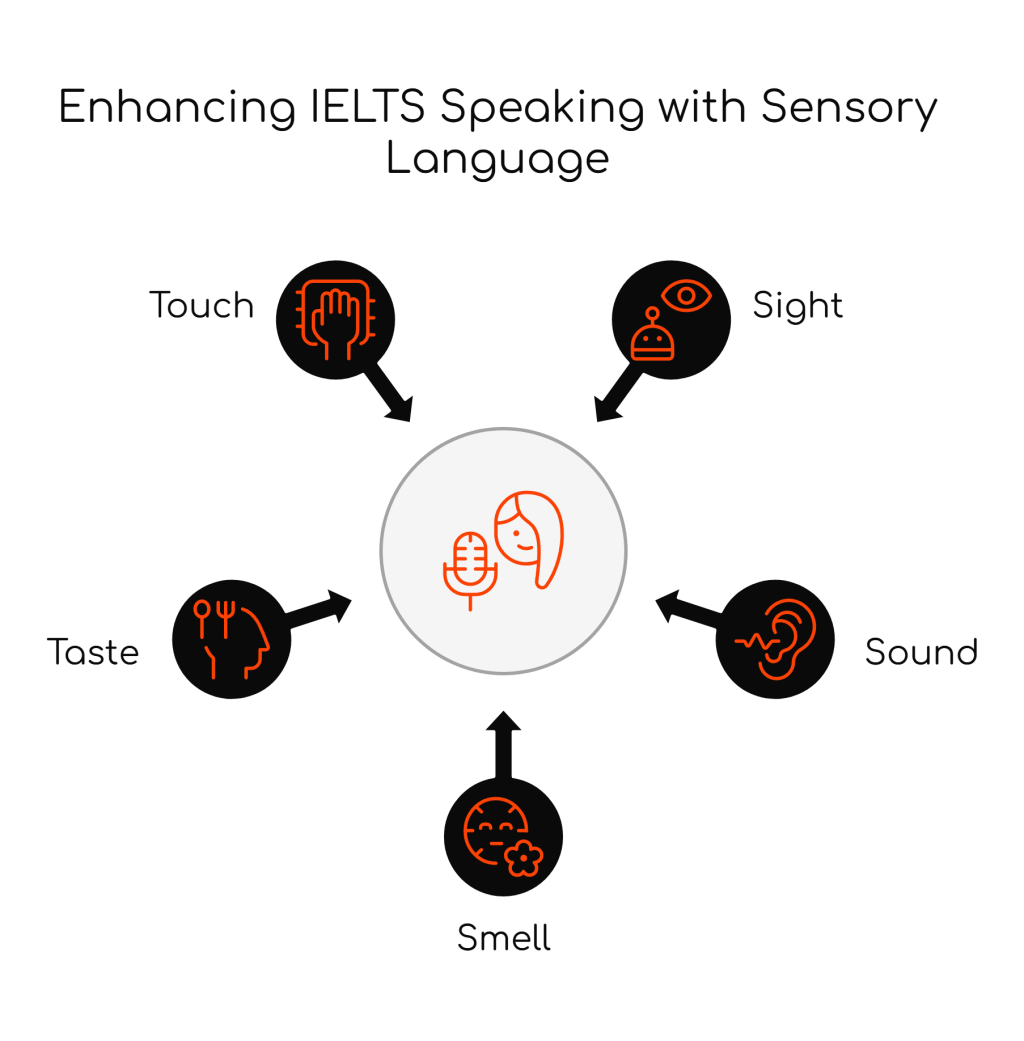
In IELTS Speaking, using descriptive and precise vocabulary can significantly boost your lexical resource score. One effective way to do this is through sensory language—words that appeal to the five senses (sight, sound, smell, taste, and touch). Sensory words allow you to create vivid, memorable responses and show the examiner your ability to communicate with nuance and clarity.
This post provides 100 high-scoring sensory verbs, nouns, adjectives, and adverbs, divided across the five senses. Each word comes with a brief definition and an example sentence tailored for IELTS Speaking.
Sight (Seeing)
Verbs
- Glimpse – to see something briefly
I glimpsed the mountain through the morning fog. - Spot – to notice or recognize
I spotted my friend in the crowded market. - Behold – to see something impressive
We beheld the beauty of the ancient temple. - Stare – to look fixedly
I stared at the painting for a long time. - Gawk – to look in a rude or amazed way
Tourists gawked at the street performers.
Nouns
- Glimpse – a brief view
I caught a glimpse of the sunset from the balcony. - Spectacle – a visually striking performance or scene
The fireworks were a spectacular spectacle. - Vision – the ability or power to see
He lost his vision after the accident. - Glow – a soft light
The lamp gave off a warm glow. - Panorama – an unbroken view of the whole region
We enjoyed a panorama of the city from the hill.
Adjectives
- Vivid – intensely deep or bright
The movie had vivid colors and imagery. - Glaring – very bright and hard to look at
The glaring sun made me squint. - Murky – dark and unclear
The water was murky and difficult to see through. - Dazzling – extremely bright or impressive
Her performance was absolutely dazzling. - Picturesque – visually attractive
We visited a picturesque village in the countryside.
Adverbs
- Clearly – in a clear manner
You can clearly see the difference in quality. - Sharply – with distinct clarity
The lines on the map were sharply defined. - Visibly – in a way that can be seen
He was visibly upset during the interview. - Dimly – in a faint or low light
The room was dimly lit. - Brilliantly – with brightness and clarity
The stars shone brilliantly in the night sky.
Sound (Hearing)
Verbs
- Echo – to repeat a sound
The sound of my voice echoed in the tunnel. - Whisper – to speak softly
She whispered her answer during the exam. - Rustle – to make a soft, crackling sound
The leaves rustled in the breeze. - Hiss – to make a sibilant sound
The kettle began to hiss as the water boiled. - Clatter – to make a loud, rattling noise
The plates clattered to the floor.
Nouns
- Echo – a sound reflected off surfaces
I heard the echo of my footsteps. - Murmur – a soft or indistinct sound
There was a murmur of voices in the background. - Creak – a harsh sound from pressure
The door creaked open slowly. - Buzz – a low, continuous sound
There was a buzz of excitement in the room. - Bang – a sudden loud noise
We heard a loud bang outside the building.
Adjectives
- Noisy – full of noise
The street was noisy and chaotic. - Deafening – extremely loud
The concert was deafening. - Muffled – unclear or softened
The sound was muffled by the thick walls. - Shrill – high-pitched and piercing
The alarm had a shrill tone. - Melodious – pleasant to hear
Her melodious voice calmed everyone down.
Adverbs
- Loudly – in a loud way
He spoke loudly to be heard over the crowd. - Softly – gently and quietly
The wind blew softly through the trees. - Clearly – in a way that is easy to hear
The speaker spoke clearly and slowly. - Harshly – in a rough or unpleasant manner
He was criticized harshly by his boss. - Rhythmically – in a patterned or regular way
The raindrops fell rhythmically on the roof.
Smell (Olfactory)
Verbs
- Sniff – to inhale quickly through the nose
I sniffed the food to check if it was still good. - Inhale – to breathe in
I inhaled the fresh mountain air deeply. - Reek – to smell very strongly and unpleasantly
The garbage reeked of rotten vegetables. - Waft – to carry a smell through the air
The scent of jasmine wafted through the window. - Scent – to detect or apply a smell
The dog scented the trail.
Nouns
- Aroma – a pleasant smell
The aroma of coffee filled the room. - Odor – a distinctive smell (often unpleasant)
There was a strange odor in the hallway. - Fragrance – a sweet or pleasant smell
She wore a lovely floral fragrance. - Stench – a strong, unpleasant smell
The stench from the sewer was unbearable. - Whiff – a brief smell
I caught a whiff of perfume as she passed.
Adjectives
- Pungent – strong and sharp
The cheese had a pungent odor. - Fragrant – sweet-smelling
The roses were beautifully fragrant. - Stale – old and unpleasant
The room smelled of stale cigarettes. - Earthy – having a smell like soil
There was an earthy aroma after the rain. - Acrid – bitter and irritating
The smoke had an acrid scent.
Adverbs
- Sweetly – in a pleasant-smelling way
The air was sweetly perfumed with flowers. - Faintly – lightly or slightly
The scent of lavender faintly lingered. - Strongly – with intensity
The kitchen strongly smelled of garlic. - Overpoweringly – too strong to bear
The room was overpoweringly scented with incense. - Subtly – in a delicate way
Her perfume was subtly noticeable.
Taste (Gustatory)
Verbs
- Savor – to enjoy the taste of
I savored every bite of the meal. - Nibble – to eat in small bites
I nibbled on some crackers. - Devour – to eat greedily
He devoured the entire pizza. - Chew – to crush food with teeth
I chewed slowly to enjoy the flavors. - Gulp – to swallow quickly
I gulped down the cold water.
Nouns
- Flavor – the distinctive taste
This dish has a unique flavor. - Aftertaste – the taste left in the mouth after eating
The medicine had a bitter aftertaste. - Zest – a strong taste, often citrusy
The cake had a hint of lemon zest. - Palate – sense of taste
I have a sweet palate—I love desserts. - Tinge – a slight taste or flavor
The soup had a tinge of spice.
Adjectives
- Savory – tasty and salty
The savory pie was my favorite. - Tangy – sharp and slightly sour
The sauce had a tangy flavor. - Bitter – sharp and unpleasant
The coffee was bitter without sugar. - Creamy – smooth in texture
The pasta sauce was rich and creamy. - Zesty – strong and spicy
The zesty salsa woke up my taste buds.
Adverbs
- Deliciously – in a tasty way
The cake was deliciously sweet. - Mildly – slightly in flavor
The curry was mildly spicy. - Richly – with strong flavor
The stew was richly flavored. - Bittersweetly – with both bitterness and sweetness
The dessert was bittersweetly satisfying. - Exquisitely – in a perfect or refined way
The chocolate was exquisitely crafted.
Touch (Tactile)
Verbs
- Graze – to touch lightly
I grazed the fabric to feel its texture. - Clutch – to hold tightly
He clutched the bag nervously. - Stroke – to move one’s hand gently over
She stroked the cat’s fur. - Tap – to strike lightly
He tapped my shoulder to get my attention. - Grip – to take hold of
I gripped the handle firmly.
Nouns
- Texture – the feel of a surface
The texture of the fabric was soft and smooth. - Sensation – a physical feeling
I had a tingling sensation in my fingers. - Chill – a cold feeling
I felt a sudden chill in the air. - Warmth – a comfortable heat
The warmth of the blanket made me sleepy. - Tingle – a slight stinging feeling
There was a tingle in my toes after the run.
Adjectives
- Rough – not smooth
The rock was rough to the touch. - Velvety – soft and smooth
Her skin felt velvety. - Sticky – glue-like or adhesive
My hands were sticky after eating mangoes. - Bumpy – uneven
The road was bumpy and hard to drive on. - Fluffy – light and soft
The pillows were fluffy and comfortable.
Adverbs
- Firmly – in a strong or secure way
He shook my hand firmly. - Lightly – gently
She touched my arm lightly. - Gently – softly and carefully
He gently placed the vase on the table. - Roughly – in a harsh manner
The ball was thrown roughly. - Smoothly – without roughness
The cloth glided smoothly over the surface.
Final Thoughts
Sensory language brings your speaking to life. By incorporating these 100 high-scoring sensory verbs, nouns, adjectives, and adverbs into your IELTS Speaking responses, you will demonstrate a high level of lexical resource and the ability to describe experiences vividly and naturally. These words help paint a picture in the examiner’s mind, which is exactly what a Band 7+ candidate should aim to do.
#IELTSSpeaking #IELTSVocabulary #SensoryLanguage #LexicalResource #Band7Plus #IELTSTips #IELTSGuidePhil #IELTSPreparation #DescriptiveLanguage #IELTSBlog #HighScoringVocabulary #SpeakingSuccess #IELTSResource #IELTS
 IELTS Guide Phil
Leave a comment