
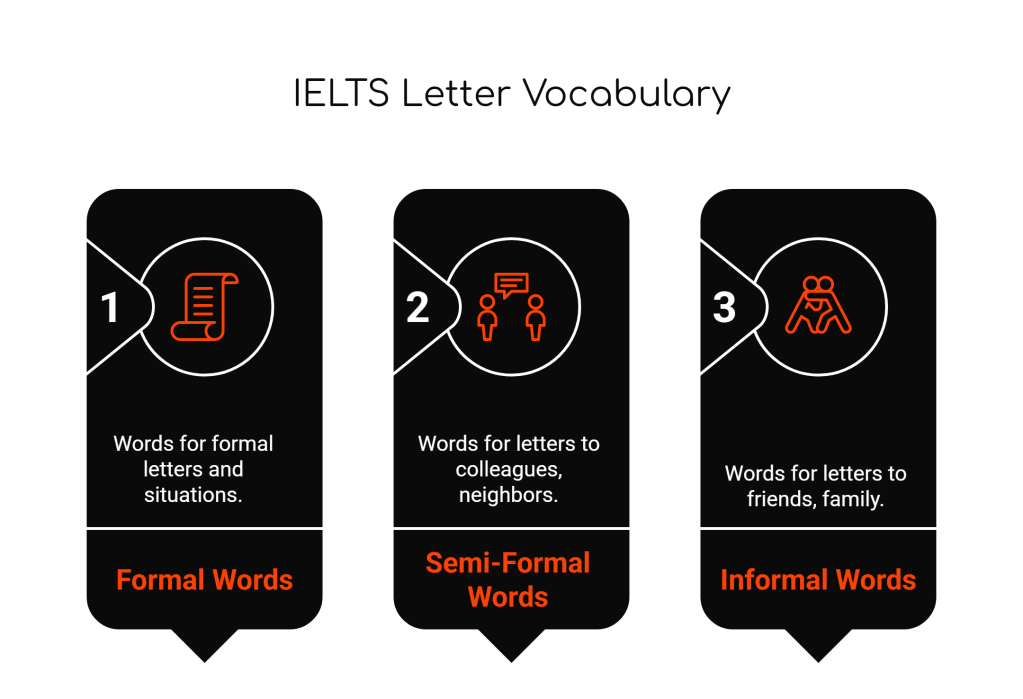
In IELTS General Training Writing Task 1, test-takers are expected to write formal, semi-formal, or informal letters. To score Band 8 or above, candidates need to demonstrate precise and varied vocabulary that suits the tone and task. While basic vocabulary may suffice for lower scores, less common, topic-appropriate words will distinguish high-level candidates.
Below is a list of 100 lesser-known words you can use in letters to impress the examiner and showcase your linguistic range.
1–40: For Formal Letters
- Remuneration (noun) – payment for services
The position offers a competitive remuneration package. - Recompense (noun) – compensation for harm or loss
I kindly request recompense for the damaged items. - Delineate (verb) – to describe in detail
Please delineate the changes made to the policy. - Expedite (verb) – to speed up a process
I would appreciate it if you could expedite the review process. - Rectify (verb) – to correct
Kindly rectify the error in my billing statement. - Inconvenience (noun) – trouble or difficulty caused
I apologize for any inconvenience this may have caused. - Allegation (noun) – a claim of wrongdoing
I wish to address the allegation made against our team. - Discrepancy (noun) – inconsistency
There appears to be a discrepancy in the invoice total. - Grievance (noun) – formal complaint
I am writing to file a grievance regarding unfair treatment. - Authorization (noun) – official permission
I am awaiting written authorization to proceed. - Liaise (verb) – to coordinate or communicate
I will liaise with the logistics team to resolve the issue. - Contingency (noun) – backup plan
Do you have a contingency in place for power failure? - Remedy (noun) – a solution to a problem
I propose the following remedy for your consideration. - Disposition (noun) – final arrangement or decision
What is the disposition of the returned goods? - Requisition (noun) – official request for items or services
Please submit a requisition for the replacement parts. - Documentation (noun) – official written records
The documentation required is attached herein. - Compliance (noun) – adherence to rules
We assure full compliance with safety standards. - Implementation (noun) – execution of a plan
The implementation will occur over the next month. - Solicit (verb) – formally request
We would like to solicit feedback from your department. - Commence (verb) – to begin
The training program is scheduled to commence next week. - Mandate (noun) – official order
We received a mandate to improve service quality. - Amendment (noun) – a change to a document or law
The amendment has been approved by management. - Mitigate (verb) – to lessen the impact
This solution could help mitigate future delays. - Reallocate (verb) – to assign resources differently
We may need to reallocate staff during the transition. - Pertinent (adjective) – relevant
Please submit only the pertinent documents. - Feasible (adjective) – workable or possible
Is it feasible to deliver before Friday? - Detrimental (adjective) – harmful
The policy change could be detrimental to staff morale. - Viable (adjective) – practical and possible
We need a viable plan before proceeding. - Precedent (noun) – prior example or decision
This sets a dangerous precedent for future projects. - Concession (noun) – a compromise or allowance
We are willing to make a concession under the new terms. - Acquisition (noun) – the act of obtaining something
The acquisition of new software has improved performance. - Expenditure (noun) – spending
We are reviewing our expenditure for potential savings. - Intimation (noun) – hint or indirect suggestion
There was no prior intimation of the cancellation. - Retraction (noun) – withdrawal of a statement or promise
We await a formal retraction from the editor. - Affirmation (noun) – confirmation
We received affirmation of your support for the policy. - Tenure (noun) – the period of holding a position
During my tenure, I led the team successfully. - Commendation (noun) – formal praise
He received a commendation for outstanding service. - Revocation (noun) – the act of canceling or withdrawing
The revocation of access was done without prior notice. - Allocation (noun) – distribution
Please confirm the allocation of budgeted funds. - Deferment (noun) – delay or postponement
We request a deferment of the inspection by one week.
41–70: For Semi-Formal Letters
These words are suitable for situations like writing to a teacher, landlord, neighbor, or colleague.
- Hinder (verb) – to obstruct
The loud construction continues to hinder my work. - Compensate (verb) – to make up for
I kindly request that you compensate for the damages. - Premises (noun) – building or property
The condition of the premises has deteriorated. - Notification (noun) – official notice
We received no prior notification of the event. - Clarify (verb) – to make something clear
Could you clarify the instructions? - Reimburse (verb) – to pay back
Please reimburse the cost of repairs. - Maintenance (noun) – upkeep
Regular maintenance is crucial for safety. - Obligation (noun) – responsibility
It is your obligation to inform tenants in advance. - Overdue (adjective) – late or delayed
This payment is long overdue. - Complication (noun) – problem or obstacle
We encountered a complication during installation. - Accessible (adjective) – easy to reach
The meeting room is not easily accessible. - Proximity (noun) – nearness
The proximity to the station is convenient. - Availability (noun) – state of being free
Kindly confirm your availability next Monday. - Negligence (noun) – lack of care
Due to staff negligence, the item was damaged. - Consent (noun) – permission
We require written consent before proceeding. - Durable (adjective) – long-lasting
The new furniture is more durable than expected. - Inspection (noun) – formal check
An inspection will be conducted next week. - Occupation (noun) – use of space or role
My current occupation is freelance consultant. - Improvement (noun) – enhancement
There’s been a noticeable improvement in service. - Adjustment (noun) – small change
A slight adjustment to the schedule is needed.
71–100: For Informal Letters
These can be used in letters to friends, relatives, or people you know well.
- Jot (verb) – to write down quickly
I’ll jot down your number and call you later. - Snag (noun) – small problem
There was a snag with the hotel booking. - Banter (noun) – playful conversation
I miss our morning banter over coffee! - Fuss (noun) – unnecessary worry or attention
Sorry for making such a fuss over nothing. - Catch up (verb) – reconnect
We really need to catch up soon! - Grumble (verb) – complain mildly
I don’t want to grumble, but the food was cold. - Knackered (adjective) – very tired (British slang)
I was absolutely knackered after the trip. - Cheeky (adjective) – playfully rude
That was a cheeky request, wasn’t it? - Gutted (adjective) – very disappointed
I was gutted to miss your birthday. - Spill (verb) – to share information casually
Spill the news—what happened on your trip? - Whinge (verb) – to complain (British slang)
He always whinges about his job. - Chuffed (adjective) – pleased or happy
I’m really chuffed with my exam results! - Bummed (adjective) – disappointed (American slang)
I was bummed that you couldn’t make it. - Mate (noun) – friend (British English)
Cheers, mate! - Giggle (verb) – laugh lightly
We had a good giggle about the old days. - Munch (verb) – eat noisily
We munched on popcorn during the movie. - Bash (noun) – a party
I’m throwing a bash this Friday! - Natter (verb) – to chat (British slang)
We had a good natter on the phone. - Rubbish (noun) – nonsense
Don’t believe him—it’s all rubbish! - Bloke (noun) – man (informal British)
He’s a decent bloke, really. - Perk up (verb) – become cheerful
A cup of coffee perked me up. - Chow down (verb) – eat enthusiastically
Let’s chow down before the movie starts. - Pop in (verb) – visit briefly
Feel free to pop in anytime! - Crash (verb) – sleep or stay informally
Can I crash at your place tonight? - Buzzing (adjective) – very excited
I’m buzzing for the concert next week! - Slumped (verb) – sat tiredly
I slumped on the sofa after work. - Dodgy (adjective) – suspicious or unreliable
That online shop looks dodgy to me. - Telly (noun) – television (British slang)
Let’s watch some telly later. - Gander (noun) – a quick look
Take a gander at this picture! - Gobsmacked (adjective) – utterly amazed
I was gobsmacked by your surprise visit!
Final Thoughts
Using less common but accurate and natural words helps you achieve a high lexical resource score in IELTS General Training Letters. Tailor your vocabulary to the formality of the situation, and practice using these words in sample tasks.
#IELTSVocabulary #IELTSGeneralTraining #GTWritingTask1 #IELTSBand8 #FormalLetterVocabulary #InformalLetterPhrases #IELTSTips #IELTSPreparation #AcademicEnglish #IELTSLetterWriting #IELTS
 IELTS Guide Phil
Leave a comment