
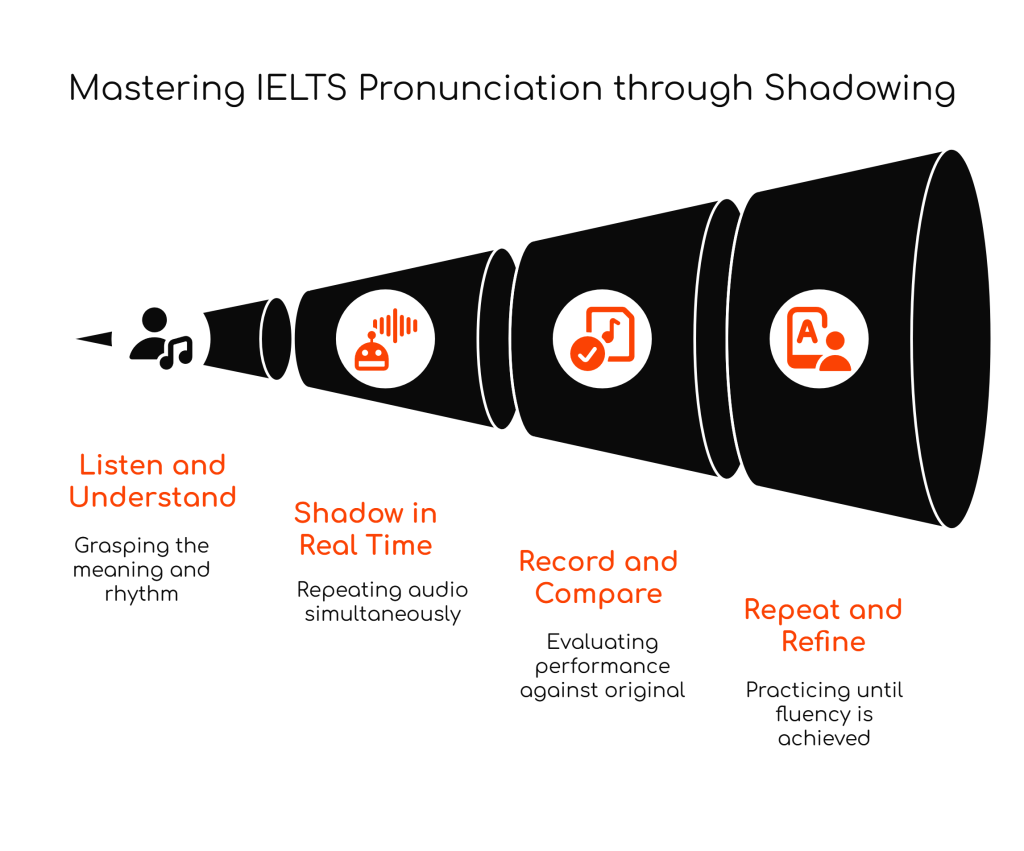
Want to sound more fluent, natural, and confident in the IELTS Speaking test? One of the most powerful (and underrated) strategies is the shadowing technique. Used by interpreters, polyglots, and public speakers, shadowing helps you absorb native-like rhythm, stress, intonation, and connected speech—all crucial for a high Pronunciation band score in IELTS.
In this post, we’ll explore what shadowing is, why it works, how to do it, common mistakes, and best practices for IELTS success.
What Is the Shadowing Technique?
Shadowing means listening to native English audio and repeating it immediately, out loud, as closely and quickly as possible—like a shadow. It’s different from repetition or imitation because you speak almost simultaneously with the speaker.
Example:
You listen to:
“Many people believe that education should be free.”
You immediately say:
“Many people believe that education should be free.” (matching the speaker’s speed, tone, and stress)
The goal is not just to repeat the words, but to mirror the:
- Rhythm
- Intonation
- Word stress
- Linking sounds
- Natural pauses and chunking
Why Use Shadowing for IELTS?
The IELTS Speaking Band Descriptors assess pronunciation, intonation, fluency, and natural speech delivery. Shadowing helps you:
Speak more fluently
Improve your sentence stress and chunking
Reduce your native accent interference
Use connected speech naturally (e.g., gonna, wanna, linking)
Train your brain to “think in English”
Key Features to Mirror During Shadowing
| Feature | Description | Example |
|---|---|---|
| Word Stress | Emphasizing syllables in multisyllabic words | EDU-cation, en-VI-ron-ment |
| Sentence Stress | Emphasizing key words in a sentence | “I WANT to PASS the IELTS EXAM.” |
| Intonation | Rising and falling pitch patterns | “Really?” (rising) / “I’m not sure.” (falling) |
| Linking | Connecting words in natural flow | “go out” → “go-wout”, “want to” → “wanna” |
| Pausing & Chunking | Natural divisions of ideas (thought groups) | “In my opinion / education should be free.” |
How to Practice Shadowing for IELTS
Step 1: Choose the Right Material
Select clear, native English audio with transcripts. Ideal sources:
- TED Talks (with subtitles)
- IELTS Speaking Band 9 model answers
- BBC Learning English
- IELTS Guide Phil Podcast 🎧
Step 2: Listen First (No Speaking)
Understand the meaning. Pay attention to rhythm, stress, and tone.
Step 3: Shadow in Real Time
Play a short clip (5–10 seconds), and speak at the same time as the speaker. Don’t pause.
Step 4: Repeat and Record
Repeat 2–3 times. Record yourself and compare.
Step 5: Slow It Down (If Needed)
Use apps like YouTube’s playback speed or tools like Audacity to slow down fast audio without changing pitch.
Shadowing Example for IELTS Speaking
Original:
“I think education is one of the most important investments a country can make.”
Practice:
- Listen carefully.
- Shadow immediately.
- Focus on:
- THINK
- EDUcation
- MOST imPORTant
- inVESTments
Repeat until your version matches the speaker’s rhythm and clarity.
Common Mistakes in Shadowing
| Mistake | Why It’s a Problem |
|---|---|
| Trying to shadow full paragraphs | Overwhelming—start with small chunks |
| Reading instead of listening | You won’t absorb rhythm or stress |
| Ignoring intonation | You’ll sound flat or robotic |
| Speaking too slowly | Breaks the natural pace of English |
Do’s and Don’ts
Do:
- Shadow short audio clips (10–30 seconds)
- Repeat daily for consistent improvement
- Use audio with transcripts to check your version
- Focus on intonation, not just pronunciation
Don’t:
- Shadow passively—engage your ears and mouth
- Skip the understanding step (know what you’re saying)
- Rely only on reading without listening
Frequently Asked Questions (FAQs)
Q: Can I use shadowing even if I’m a beginner?
A: Yes! Start slow, use simple audio, and build up gradually.
Q: Should I mimic the speaker’s accent?
A: Focus on clarity, stress, and natural rhythm—not accent copying.
Q: How often should I shadow for IELTS prep?
A: 15–30 minutes 4–5 times a week is ideal for noticeable improvement.
Top Strategies for IELTS Success
- Pair shadowing with Speaking practice
→ Use sample Speaking Part 2 responses and shadow them - Use YouGlish or ELSA Speak for pronunciation feedback
→ Get instant feedback on clarity and stress - Record your shadowing sessions weekly
→ Track progress and spot pronunciation issues - Integrate chunking with shadowing
→ Focus on grouping words naturally (e.g., “in my opinion / I believe…”) - Repeat the same clip daily for a week
→ Fluency increases through repetition
Final Thoughts
If you want to sound fluent, confident, and natural in your IELTS Speaking test, shadowing is your shortcut to success. It’s more than pronunciation—it’s pronunciation plus rhythm, plus control, plus confidence.
The more you shadow, the more English becomes automatic—and that’s the key to a high IELTS band score.
Keep Learning with IELTS Guide Phil
- Visit IELTSGuidePhil.com
- Listen to the IELTS Guide Phil Podcast on Spotify
- Join the IELTS Guide Phil Study Group on Facebook
#IELTSShadowing #IELTSSpeaking #FluencyTips #IELTSPronunciation #ShadowingTechnique #IELTSPreparation #IELTSGuidePhil #Band7Plus #SpeakEnglishFluently #IELTSIntonation #IELTS
 IELTS Guide Phil
Leave a comment