
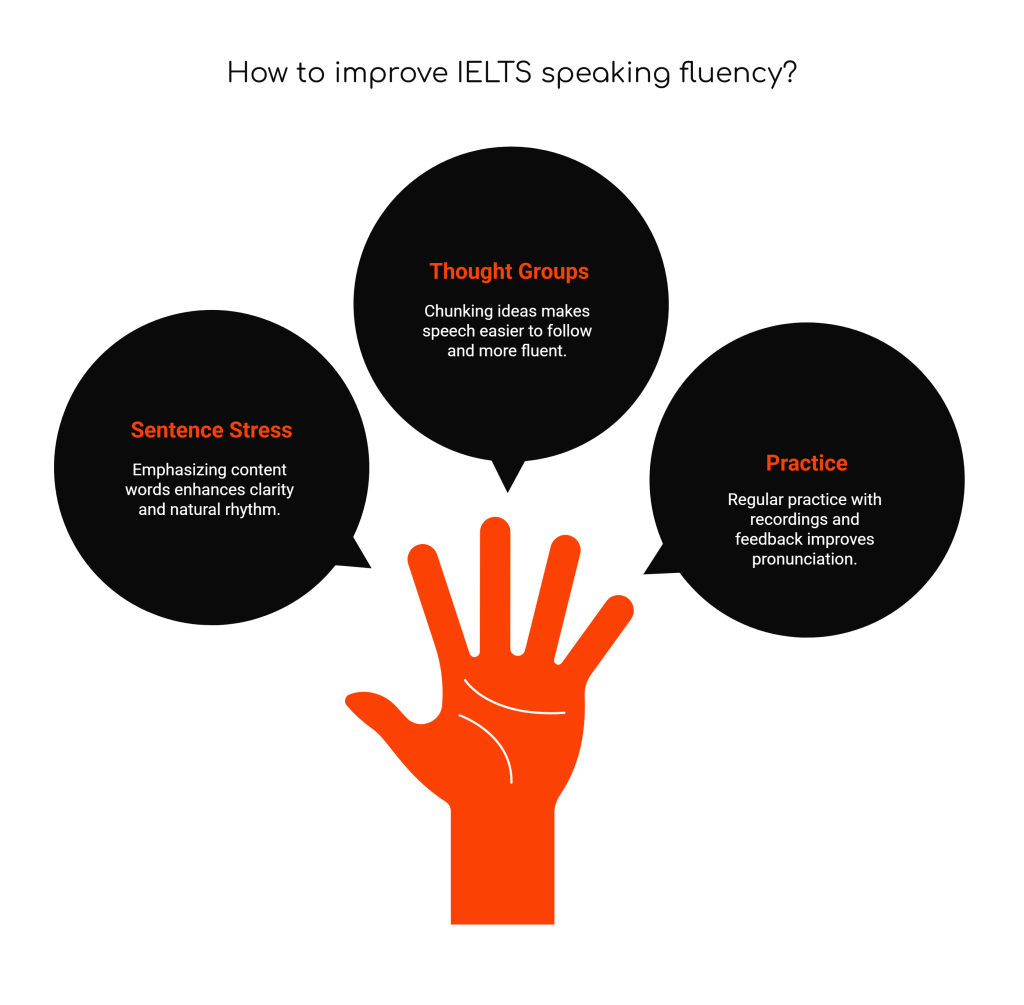
To sound fluent, confident, and clear in your IELTS Speaking test, you need more than just good grammar and vocabulary. One of the most important (but often overlooked) pronunciation skills is sentence stress and thought grouping—how you break your sentences into logical chunks and emphasize the right words.
This natural rhythm is something native speakers do effortlessly, and IELTS examiners listen for it closely. In this guide, you’ll learn what sentence stress and thought groups are, how to use them, and how mastering them can significantly boost your band score in Pronunciation. You can watch this YouTube video explainer by IELTS Guide Phil.
What Is Sentence Stress?
In English, not all words are spoken with equal emphasis. Sentence stress refers to how we highlight certain content words in a sentence, while others (usually grammar words) are spoken more quickly and softly.
Stressed Words:
- Nouns, main verbs, adjectives, adverbs
Unstressed Words:
- Articles (a, the), auxiliary verbs (is, do, have), prepositions, conjunctions
Example:
“I WANT to GO to the MARket.”
Here, “want,” “go,” and “market” carry the stress. The rest are said quickly and lightly.
What Are Thought Groups?
Thought groups (also called “intonation groups” or “chunks”) are short phrases that group related words together in speech. We naturally pause between these groups to make our message clearer.
Think of speech like building blocks:
“When I was a child, / I used to visit my grandparents / every summer.”
Each slash ( / ) represents a natural pause or thought break.
Why Sentence Stress and Thought Groups Matter in IELTS
| Benefit | Explanation |
|---|---|
| Clarity | Helps the examiner follow your ideas easily |
| Fluency | Makes your speaking more natural and smooth |
| Band Boost | Contributes directly to your Pronunciation and Fluency score |
| Avoids Misunderstanding | Poor chunking can cause confusion or awkward rhythm |
How to Chunk Ideas into Thought Groups
Tip: Each thought group contains one idea or unit of meaning.
| Sentence | Thought Groups |
|---|---|
| I went to the store because I needed milk. | I went to the store / because I needed milk. |
| If I had more time, I would travel more. | If I had more time, / I would travel more. |
| The most important thing / is to stay calm under pressure. | The most important thing / is to stay calm / under pressure. |
Sentence Stress + Thought Group = Natural Fluency
When you stress the key words in each thought group, you sound fluent and expressive.
“The first time / I went abroad, / I was nervous but excited.”
Notice how the important content is emphasized, and the sentence flows in meaningful chunks.
Common Mistakes IELTS Candidates Make
| Mistake | Problem |
|---|---|
| Stressing every word equally | Robotic, unnatural rhythm |
| No pauses between ideas | Hard to follow; ideas blur together |
| Wrong words stressed | Changes meaning or sounds awkward |
| Ending every sentence with a rising tone | Sounds unsure or unnatural |
Do’s and Don’ts
Do:
- Practice speaking in short phrases, not word-by-word
- Use pauses to give your listener time to process your message
- Stress the meaningful content words
- Use recordings to compare your rhythm with native speakers
Don’t:
- Speak in a monotone or rush through your sentences
- Pause randomly without a reason
- Stress grammar words like “the,” “is,” or “of”
Frequently Asked Questions
Q1: How long should a thought group be?
A: Typically, 4–7 words. It should reflect a complete idea or phrase.
Q2: Will poor sentence stress lower my IELTS score?
A: Yes. Pronunciation accounts for 25% of your Speaking band score, and stress is a key part of that.
Q3: How can I practice sentence stress?
A: Use “shadowing” – listen to a native speaker (e.g., from TED Talks or IELTS videos) and mimic their tone, stress, and pauses.
Practice Activity: Stress and Chunk
Read the sentence below and mark the stress and thought groups.
Sentence:
“I believe that technology has greatly improved the way we communicate with each other.”
Practice:
- Chunk: I believe / that technology has greatly improved / the way we communicate / with each other.
- Stress: I beLIEVE / that techNOlogy has GREATly imPROVED / the way we comMUniCATE / with each OTHer.
🎧 Record yourself and compare it to a fluent speaker. Adjust your rhythm and try again!
Top Strategies for IELTS Success
- Use chunking while answering Speaking Part 2
- Structure your answer by chunking: description / detail / example / feeling
- Practice aloud using TED Talks and IELTS sample answers
- Record & Reflect
- Use free apps like Voice Memos or Audacity
- Emphasize with emotion
- Let your intonation and stress reflect how you feel about the topic
- Get feedback
- Join speaking groups or work with a coach to fine-tune your natural delivery
Final Thoughts
Sentence stress and thought groups help you speak clearly, confidently, and naturally. When your speech is well-chunked and key words are stressed appropriately, the examiner will find your speaking easier to follow—and will reward you for it.
Remember: IELTS success is not just about what you say, but how you say it.
More from IELTS Guide Phil
#IELTSSpeaking #IELTSPronunciation #SentenceStress #ThoughtGroups #FluencyTips #Band7Plus #IELTSGuidePhil #IELTSPreparation #SpeakingPractice #NaturalEnglish #IELTS
 IELTS Guide Phil
Leave a comment