
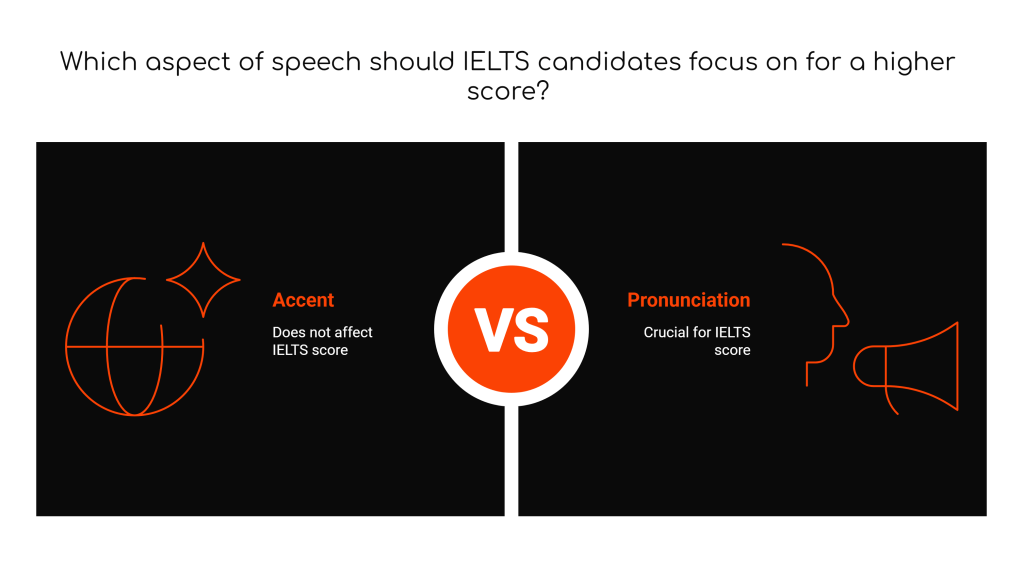
One of the most common myths about IELTS Speaking is that you need a British or American accent to get a high band score. This belief causes anxiety for many non-native speakers. But the truth is much simpler—and far more empowering:
Pronunciation matters. Accent does not.
In this post, we’ll debunk the myth of the “native-like accent,” highlight which pronunciation errors actually affect your IELTS score, and offer practical tips tailored to learners from specific language backgrounds such as Filipino, Indian, and Vietnamese.
Accent vs. Pronunciation: What’s the Difference?
- Accent: The way your speech sounds due to your native language. Includes intonation, rhythm, and sound substitution.
- Pronunciation: The clarity with which you say words and sounds in English. Includes word stress, syllables, linking, intonation, and individual sounds.
In IELTS:
- You are NOT marked down for your accent.
- You ARE assessed on clarity, stress, intonation, and fluency.
Examiners don’t care how you sound—they care whether they can understand you clearly and comfortably.
Common Pronunciation Features That Affect Your Score
Here are the pronunciation errors that can lower your score—regardless of your accent:
1. Incorrect Word Stress
- ❌ “com-FORT-able” → ✅ “COM-fort-a-ble”
- ❌ “pre-SENT” (verb) vs. ✅ “PRE-sent” (noun)
2. Flat or Monotone Intonation
- Speech that sounds robotic or lacks emotion affects coherence and naturalness.
3. Missing Final Consonants
- ❌ “I go to the marke” → ✅ “I go to the market”
4. Mispronounced Vowel Sounds
- ❌ “ship” vs. ✅ “sheep”
- ❌ “full” vs. ✅ “fool”
5. Misplaced Sentence Stress
- ❌ “I want to GO” (wrong emphasis) → ✅ “I WANT to go”
Myth: “You Need a Native-Like Accent”
False. Native-like accents are not required for Band 9.
What’s required:
- You speak fluently and confidently
- You use natural rhythm and stress
- You are easy to understand without repetition
Even Band 9 candidates often have noticeable accents. What matters is how well you control pronunciation features.
Accent-Specific Tips
Filipino Speakers
Common Challenges:
- Overemphasis on final syllables (due to syllable-timed rhythm)
- Flat intonation
- Difficulty with /f/ and /v/ (e.g., “fun” vs. “van”)
Tips:
- Practice sentence stress with thought groups
- Record yourself and exaggerate intonation first, then refine
- Focus on minimal pairs like fan–van, ferry–very
Indian Speakers
Common Challenges:
- Syllable-timed speech (less rhythm)
- Retroflex consonants (too strong /t/, /d/)
- Sound substitution (e.g., “ze” instead of “the”)
Tips:
- Practice word stress and linking
- Use shadowing with British or American audio
- Watch for dropped articles (“He is teacher” → “He is a teacher”)
Vietnamese Speakers
Common Challenges:
- Final consonant omission (e.g., “book” → “boo”)
- Tone interference from Vietnamese tonal patterns
- No clear distinction between long/short vowels
Tips:
- Drill final sounds like /k/, /d/, /t/
- Practice vowel pairs (bit–beat, pull–pool)
- Use apps like ELSA or Forvo to mimic native pronunciation
Do’s and Don’ts
Do:
- Focus on clarity and consistency
- Practice pronunciation daily—even 15 minutes helps
- Use tools like shadowing, minimal pairs, and IPA dictionaries
- Embrace your accent—make it clear, not “native”
Don’t:
- Force an unnatural accent
- Use memorized “accented” responses
- Ignore pronunciation until the last minute
- Obsess over sounding “British” or “American”
Frequently Asked Questions
Q: Will my accent lower my score?
A: No. Only unclear pronunciation or major pronunciation errors will lower your score.
Q: Is it better to choose British or American pronunciation?
A: Pick one and stick to it for consistency. IELTS accepts all native varieties.
Q: Do native speakers always get Band 9 in pronunciation?
A: Not always. Even native speakers lose marks if they mumble, speak too fast, or use poor intonation.
Top Strategies for IELTS Pronunciation Success
- Shadow Native Speakers
- Use TED Talks, IELTS model answers, or audiobooks
- Practice Minimal Pairs
- e.g., /i/ vs. /ɪ/, /t/ vs. /d/, /s/ vs. /ʃ/
- Record and Listen
- Identify recurring errors in your own speech
- Break Sentences into Thought Groups
- Helps with fluency and stress control
- Get Feedback
- Ask teachers or native speakers to highlight unclear parts
Final Thoughts
You don’t need to change who you are or how you speak to succeed in IELTS—you just need to speak clearly, confidently, and intelligibly.
Let go of the myth that you need a “native” accent. Instead, focus on:
- Word and sentence stress
- Natural rhythm and intonation
- Clear pronunciation of sounds
That’s what examiners are truly listening for.
Keep Improving with IELTS Guide Phil
- Visit IELTSGuidePhil.com
- IELTS Guide Phil Podcast on Spotify
- Join the IELTS Guide Phil Study Group on Facebook
#IELTSPronunciation #IELTSSpeakingTips #AccentVsPronunciation #IELTSGuidePhil #Band7Plus #IELTSPreparation #ClearSpeechIELTS #FilipinoIELTS #IndianIELTS #VietnameseIELTS #IELTS
 IELTS Guide Phil
Leave a comment