
When it comes to scoring high in the IELTS Speaking test, many candidates focus on vocabulary, grammar, and fluency—but often forget the vital role of pronunciation. Among the pronunciation criteria assessed by IELTS examiners, word stress—especially in multisyllabic words—can make or break your band score.
In this guide, we explore the importance of word stress, define it clearly, explain its types, provide examples, address common mistakes, and share top strategies to help you sound clear, confident, and fluent.
What Is Word Stress?
Word stress refers to emphasizing one syllable more than the others in a word. In English, this stress is marked by:
- Saying the stressed syllable louder
- Making it longer
- Saying it with a higher pitch
Example:
- DE-sert (noun: a dry area)
- de-SERT (verb: to abandon)
Notice how shifting the stress completely changes the word’s meaning and part of speech.
Why Word Stress Matters in IELTS
Word stress is part of the Pronunciation criterion in the IELTS Speaking band descriptors. Improper stress can:
- Make your speech hard to understand
- Lead to miscommunication
- Lower your Pronunciation band score, especially at Band 7+
Correct stress improves clarity, naturalness, and listener comfort—all of which IELTS examiners are trained to notice.
Types of Word Stress in Multisyllabic Words
1. Noun–Verb Stress Shift
Some words change meaning based on stress position.
| Noun (stress on 1st syllable) | Verb (stress on 2nd syllable) |
|---|---|
| RE-cord | re-CORD |
| PRE-sent | pre-SENT |
| CON-tract | con-TRACT |
| IN-sult | in-SULT |
IELTS Tip: These commonly appear in Part 3 or when explaining data in Speaking Part 2.
2. Adjective–Verb Stress Shift
Some adjectives and verbs also follow this pattern.
| Adjective | Verb |
|---|---|
| PER-fect | per-FECT |
| CON-tent | con-TENT |
3. Words Ending in Common Suffixes
Many English suffixes determine where the stress falls.
- Stress the syllable before the suffix:
- -ic → geo-GRAPH-ic
- -sion / -tion → deci-SION, educa-TION
- -ity → respon-SIB-ility
- -ical → bio-LOG-ical
- Stress on the 3rd syllable from the end (antepenultimate) in many longer words:
- e.g., e-LE-phant, cal-CU-late, *POS-itive
4. Compound Words
- Noun + Noun: First word is stressed
e.g., POST-man, TOOTH-brush - Adjective + Noun: Second word is stressed
e.g., bad TEMper, hard WORK
IELTS Tip: Master compound stress for Speaking Part 2 topics like jobs, routines, or descriptions.
Common Mistakes IELTS Test-Takers Make
| Mistake | Example | Why It’s a Problem |
|---|---|---|
| Stressing the wrong syllable | “pre-SENT” when meaning the noun “PRE-sent” | Confuses the listener and affects comprehension |
| Equal stress on all syllables | “re-cord” (flat) instead of “RE-cord” | Sounds robotic or unclear |
| Overcorrecting stress | “re-CORD” in all contexts | Shows lack of control over pronunciation rules |
Do’s and Don’ts
Do:
- Listen to native speakers and imitate stress patterns
- Use online dictionaries with IPA symbols and audio
- Record yourself and check for natural rhythm
- Practice shadowing native pronunciation from YouTube or podcasts
Don’t:
- Memorize only word definitions—learn how they sound
- Ignore how stress affects meaning
- Focus only on vocabulary without pronunciation practice
Frequently Asked Questions (FAQs)
Q: How important is word stress in the IELTS Speaking exam?
A: Very important. It’s part of the Pronunciation criterion and can influence comprehension, especially at Band 6.5+ levels.
Q: Will wrong word stress lower my score?
A: Yes—especially if it makes your speech hard to follow or confuses meaning.
Q: How can I check correct stress?
A: Use tools like:
- Cambridge Dictionary Online
- YouGlish for real-life examples
- Google: “word + pronunciation”
Top Strategies for IELTS Success
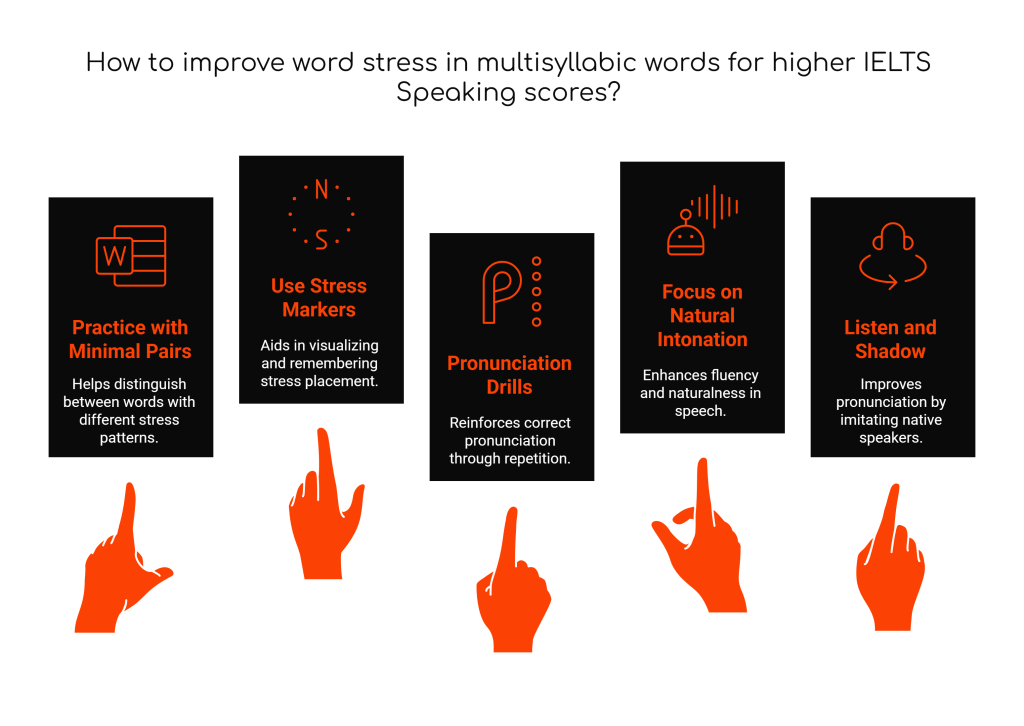
- Practice with Minimal Pairs
- E.g., RE-cord (noun) vs. re-CORD (verb)
- Use Stress Markers in Note-taking
- Mark syllables with CAPITAL LETTERS or stress symbols (ˈ)
- Do Pronunciation Drills
- Repeat difficult words aloud 10–15 times
- Focus on Natural Intonation
- Combine word stress with sentence rhythm and emotion
- Listen and Shadow
- Choose IELTS speaking samples, TED Talks, or BBC news—repeat sentences exactly as you hear them
Practice Activity
Practice stressing the correct syllables in these words. Mark where you think the stress falls:
- environment
- university
- photograph
- economics
- development
- object (noun) / object (verb)
Then use each in a sentence aloud and record yourself. Compare with a native pronunciation source.
Final Thoughts
Correct word stress in multisyllabic words is one of the most overlooked—but high-impact—areas in IELTS Speaking preparation. Mastering this skill helps you communicate clearly, avoid misunderstandings, and sound more fluent and natural.
Remember, it’s not just what you say, but how you say it.
Keep Learning with IELTS Guide Phil
- Explore the IELTS blog for pronunciation tips and grammar guides
- Listen to the IELTS Guide Phil Podcast on Spotify
- Join our IELTS community on Facebook
#IELTSPronunciation #IELTSSpeaking #WordStressIELTS #IELTSBand7 #IELTSGuidePhil #FluentEnglish #IELTSPreparation #MultisyllabicWords #SpeakingTipsIELTS #EnglishPronunciation #IELTS
 IELTS Guide Phil
Leave a comment