
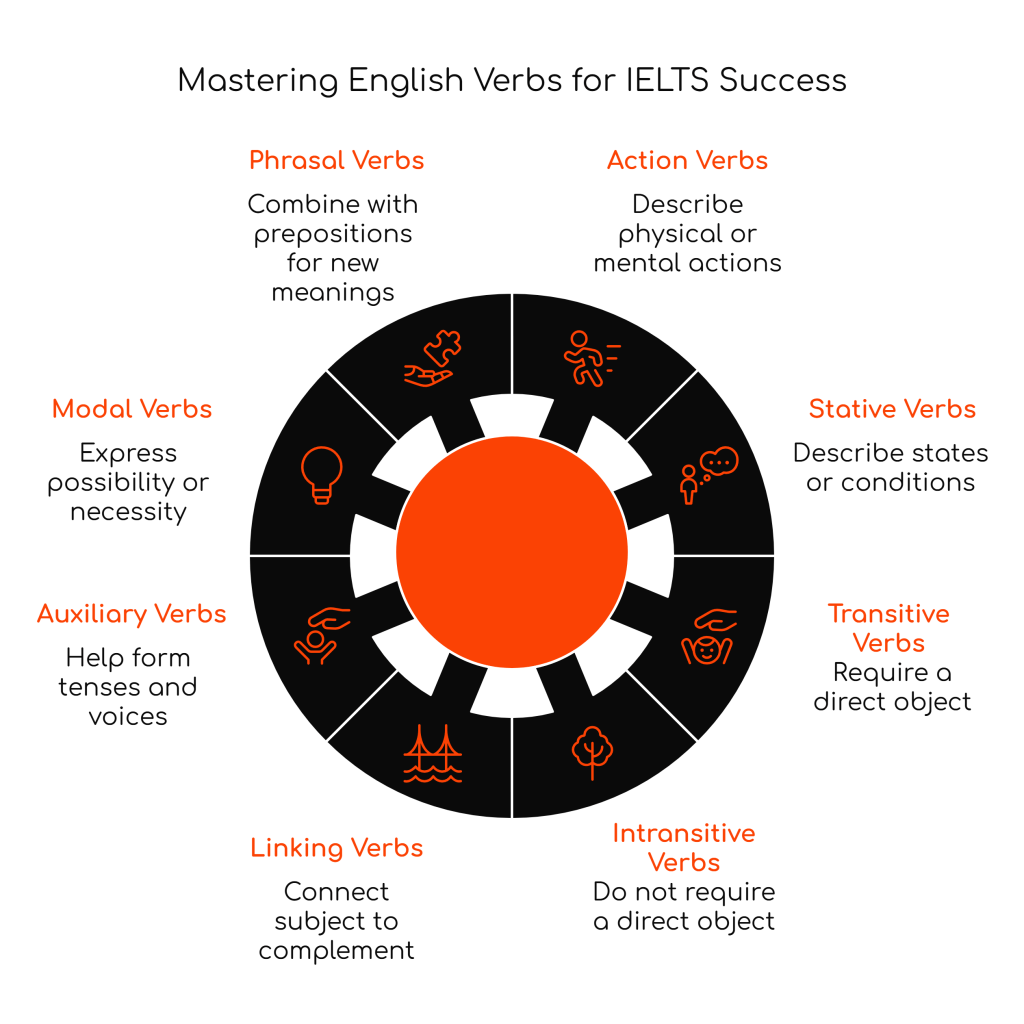
Verbs are the power engines of English sentences. Without strong and accurate verb use, your IELTS Writing and Speaking responses can appear vague, confusing, or grammatically flawed. To succeed in the IELTS exam—especially if you’re targeting Band 7 and above—you need to understand and use different types of verbs effectively and naturally.
In this post, we’ll cover verb types, definitions, usage examples, common mistakes, dos and don’ts, FAQs, and strategies for IELTS success.
What Are Verbs?
Verbs are words that describe actions, states, or occurrences. In IELTS, verbs are critical in forming clear arguments, expressing opinions, reporting trends, and describing changes or experiences.
Major Types of Verbs You Must Know
1. Action Verbs (Dynamic Verbs)
Describe physical or mental actions.
- Examples: write, discuss, analyze, decide, improve
- IELTS Use: “Students submit their assignments online.”
2. Stative Verbs
Describe a state, condition, or mental process—not a physical action.
- Examples: believe, seem, know, prefer, belong
Not usually used in continuous tenses - IELTS Use: “I believe online learning is beneficial.”
3. Transitive Verbs
Require a direct object to complete the meaning.
- Examples: give, provide, explain, affect
- IELTS Use: “This policy affects low-income families.”
4. Intransitive Verbs
Do not require a direct object.
- Examples: arrive, sleep, grow
- IELTS Use: “The population grew significantly in 2020.”
5. Linking Verbs
Connect the subject to a complement that describes it.
- Examples: be, seem, become, appear
- IELTS Use: “The results seem promising.”
6. Auxiliary Verbs (Helping Verbs)
Help main verbs form tenses, voices, or moods.
- Examples: be, do, have, will, can, should
- IELTS Use: “The issue has been discussed by many experts.”
7. Modal Verbs
Express possibility, necessity, ability, or advice.
- Examples: can, could, may, might, must, should, would
- IELTS Use: “Governments should invest more in education.”
8. Phrasal Verbs
Verbs combined with a preposition or adverb to create new meanings.
- Examples: look into, bring up, cut down on, turn out
- IELTS Use: “The research team looked into the causes of obesity.”
Use them more in Speaking, not formal writing.
Common Verb Tense Uses in IELTS
| Tense | IELTS Function | Example |
|---|---|---|
| Present Simple | Describing facts and trends | “This chart shows the data clearly.” |
| Past Simple | Referring to past events | “The population increased in 2010.” |
| Present Perfect | Reporting current relevance of past actions | “Scientists have discovered new data.” |
| Future (will/going to) | Making predictions or suggestions | “This issue will continue to grow.” |
Common Mistakes in Verb Use
| Mistake | Why It’s a Problem | Example |
|---|---|---|
| Using stative verbs in continuous form | Grammatically incorrect | ❌ “I am believing…” |
| Verb–subject disagreement | Affects grammar score | ❌ “People thinks…” |
| Incorrect modal combinations | Shows poor lexical control | ❌ “It must can help…” |
| Using informal phrasal verbs in writing | Too casual for academic tone | ❌ “We should deal with it…” (✓ in Speaking, ✘ in Writing) |
Do’s and Don’ts for IELTS Verbs
Do:
- Use precise academic verbs (e.g., argue, suggest, demonstrate)
- Vary verb tenses appropriately
- Use modals to express nuanced opinions
- Learn topic-specific verbs (e.g., “enforce,” “implement” for law topics)
Don’t:
- Repeat common verbs like “do,” “make,” “get”
- Use vague verbs without explanation
- Ignore subject-verb agreement rules
- Use contractions in writing (✓ for Speaking, ✘ for Writing)
Frequently Asked Questions (FAQs)
Q1: Should I use phrasal verbs in IELTS?
A: Use them in Speaking for a natural tone. In Writing, stick to formal equivalents.
- Speak out → express an opinion
- Cut down on → reduce
Q2: How many verb tenses should I use in an essay?
A: Stick mainly to Present Simple, Past Simple, and Present Perfect depending on the context. Avoid overcomplicating.
Q3: Can using a wide range of verbs improve my score?
A: Yes. A varied and accurate use of verbs shows strong lexical resource and grammatical range—key for Band 7+.
Top Strategies for IELTS Verb Mastery
- Keep a Verb Notebook
- Include new verbs, meanings, sample sentences, and collocations.
- Group Verbs by IELTS Topics
- Example: Education → teach, enroll, graduate, assess, motivate
- Practice Tense Transformations
- Rewrite sentences in different tenses for fluency control.
- Use IELTS Band 9 Essays for Modeling
- Highlight and analyze verbs used.
- Record and Review Speaking Answers
- Listen for verb variety and tense control.
Sample Sentence Upgrades
| Basic Sentence | Improved Version |
|---|---|
| People think education is good. | Many individuals believe education plays a crucial role in development. |
| The chart shows data. | The graph illustrates significant growth in population from 2000 to 2020. |
| I did my homework. | I completed my assignment before the deadline. |
Final Thoughts
Verbs are not just grammar points—they’re the heartbeat of communication. If you want to impress IELTS examiners and achieve Band 7+, focus on using a wide range of accurate, appropriate, and topic-specific verbs in both your Writing and Speaking tasks.
With regular practice and conscious application, you’ll move from basic expression to academic fluency.
📎 Stay Connected
- Visit IELTSGuidePhil.com
- Listen to the IELTS Guide Phil Podcast
- Join the IELTS Guide Phil Facebook Group
#IELTSVerbs #IELTSGrammar #IELTSWriting #IELTSSpeaking #Band7Plus #IELTSGuidePhil #VerbTenses #AcademicVerbs #IELTSVocabulary #EnglishVerbs #IELTS
 IELTS Guide Phil
Leave a comment