
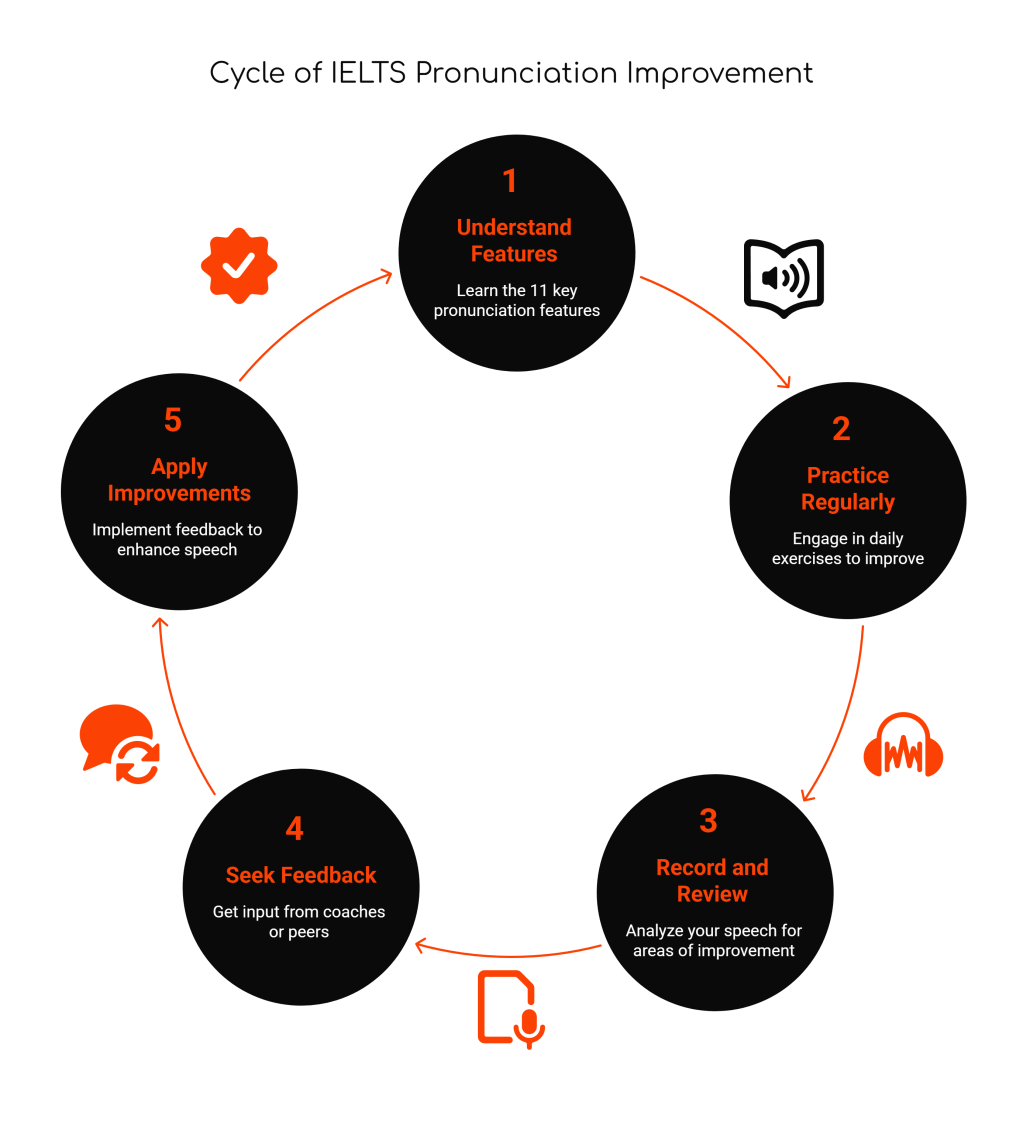
In the IELTS Speaking test, pronunciation accounts for 25% of your score. Yet, many learners focus only on grammar and vocabulary, overlooking the essential elements that make English speech sound natural, clear, and confident.
This guide covers all major pronunciation features, including:
- Word stress
- Sentence stress
- Intonation
- Rhythm
- Linking and connected speech
- Thought groups
- Sounds (segmentals)
- Weak forms
- Intrusion
- Elision
- Assimilation
Mastering these can help you achieve a more native-like delivery, avoid misunderstandings, and increase your IELTS band score.
Why Pronunciation Matters in IELTS
The IELTS Speaking Band Descriptors assess pronunciation based on:
- Clarity
- Naturalness
- Control over stress, intonation, and rhythm
- Ease of understanding
A strong accent isn’t a problem—but unclear or inconsistent pronunciation is. If the examiner struggles to follow you, your score will be affected.
1. Word Stress
Every multisyllabic English word has one syllable that is stressed more than the others.
Examples:
- RE-cord (noun) vs. re-CORD (verb)
- IN-sult (noun) vs. in-SULT (verb)
IELTS Tip: Misplacing stress can confuse meaning and affect intelligibility.
2. Sentence Stress
In a sentence, some words carry more stress (usually content words like nouns, verbs, adjectives).
Example:
“I WANT to PASS the IELTS EXAM.”
Use sentence stress to highlight key information.
3. Intonation
Intonation refers to the rise and fall of your voice. It conveys emotion, intent, and structure.
- Rising intonation: Yes/no questions “Are you ready?”
- Falling intonation: Statements or WH-questions “Where are you from?”
IELTS Tip: Good intonation helps listeners follow your thoughts.
4. Rhythm
English is a stress-timed language, meaning stressed syllables occur at regular intervals, and unstressed ones are shortened.
“I GO to the STORE on SUNDAYS.”
Practicing rhythm improves fluency and reduces robotic delivery.
5. Linking & Connected Speech
Words are often linked together in speech, with sounds blending across word boundaries.
Examples:
- Consonant + vowel: “go out” → “go-wout”
- Similar sounds: “want to” → “wanna”
- Consonant linking: “turn off” → “tur-noff”
IELTS Tip: Mastering linking makes your speech smoother and more natural.
6. Thought Groups (Chunking)
Divide your speech into logical groups of words—each expressing one complete idea.
“In my opinion / online learning / has both advantages / and challenges.”
This helps with fluency and avoids breathless delivery.
7. Sounds (Segmental Features)
These refer to individual sounds (consonants and vowels).
Common problem sounds:
- /θ/ → “th” in think
- /ð/ → “th” in this
- /v/ vs. /b/
- Long vs. short vowels: ship vs. sheep
IELTS Tip: Practice minimal pairs and phoneme discrimination exercises.
8. Weak Forms
Unstressed words (like function words) are often reduced in speech.
Examples:
- “to” → /tə/
- “and” → /ən/ or /n/
Proper use of weak forms improves rhythm and stress timing.
9. Intrusion
When we add a sound between two words to help them flow better.
Examples:
- “go on” → /goʊ wɒn/
- “he is” → /hi jɪz/
- “do it” → /du wɪt/
Intrusion helps you sound more fluent.
10. Elision
Omitting sounds for smoother speech.
Examples:
- “friendship” → /frɛnʃɪp/ (skip the /d/)
- “next day” → /nɛks deɪ/
Avoid sounding too stiff by learning common elision patterns.
11. Assimilation
When one sound changes to become more like a neighboring sound.
Examples:
- “good boy” → /gʊb bɔɪ/
- “in bed” → /ɪm bɛd/
Practicing these features helps you adapt to natural speech flow.
Common Pronunciation Mistakes in IELTS
| Mistake | Why It’s a Problem |
|---|---|
| Equal stress on all words | Makes speech sound unnatural |
| Ignoring intonation | Makes responses sound robotic or flat |
| Not linking words | Breaks fluency and rhythm |
| Mispronouncing key sounds | Leads to confusion and errors |
| Imitating accents poorly | Clarity is more important than accent |
Do’s and Don’ts
Do:
- Record and review your own speech
- Practice with native audio (TED Talks, IELTS samples)
- Focus on clarity, not accent imitation
- Use shadowing for rhythm and stress control
Don’t:
- Speak too fast or too slow
- Focus only on vocabulary and grammar
- Try to force a foreign accent
- Neglect pronunciation until test day
Frequently Asked Questions
Q: Will my accent lower my IELTS score?
A: No. As long as you’re clear and understandable, your accent doesn’t matter.
Q: What’s the fastest way to improve pronunciation?
A: Daily shadowing and repetition exercises using model speakers.
Q: Should I use British or American pronunciation?
A: Choose one and be consistent. Both are accepted in IELTS.
Top Strategies for IELTS Pronunciation Success
- Shadowing: Repeat speech after native speakers
- Record Yourself: Identify areas of improvement
- Use IPA Dictionaries: Learn correct pronunciation
- Practice Thought Groups: Break ideas into chunks
- Work with a Coach or Peer: Get real feedback
Final Thoughts
Pronunciation is not just about sounding “native”—it’s about being understood clearly, speaking with rhythm and stress, and showing you can communicate fluently. Even a Band 9 speaker doesn’t have to sound British or American—they just need to be clear, confident, and consistent.
Focus on the 11 key features of pronunciation, and your Speaking performance will rise to meet IELTS standards.
Learn More with IELTS Guide Phil
#IELTSPronunciation #EnglishPronunciation #IELTSSpeakingTips #PronunciationFeatures #IELTSGuidePhil #IELTSBand7Plus #IELTSRhythm #WordStress #ClearSpeechIELTS #IELTSPreparation #IELTS
 IELTS Guide Phil
Leave a comment