
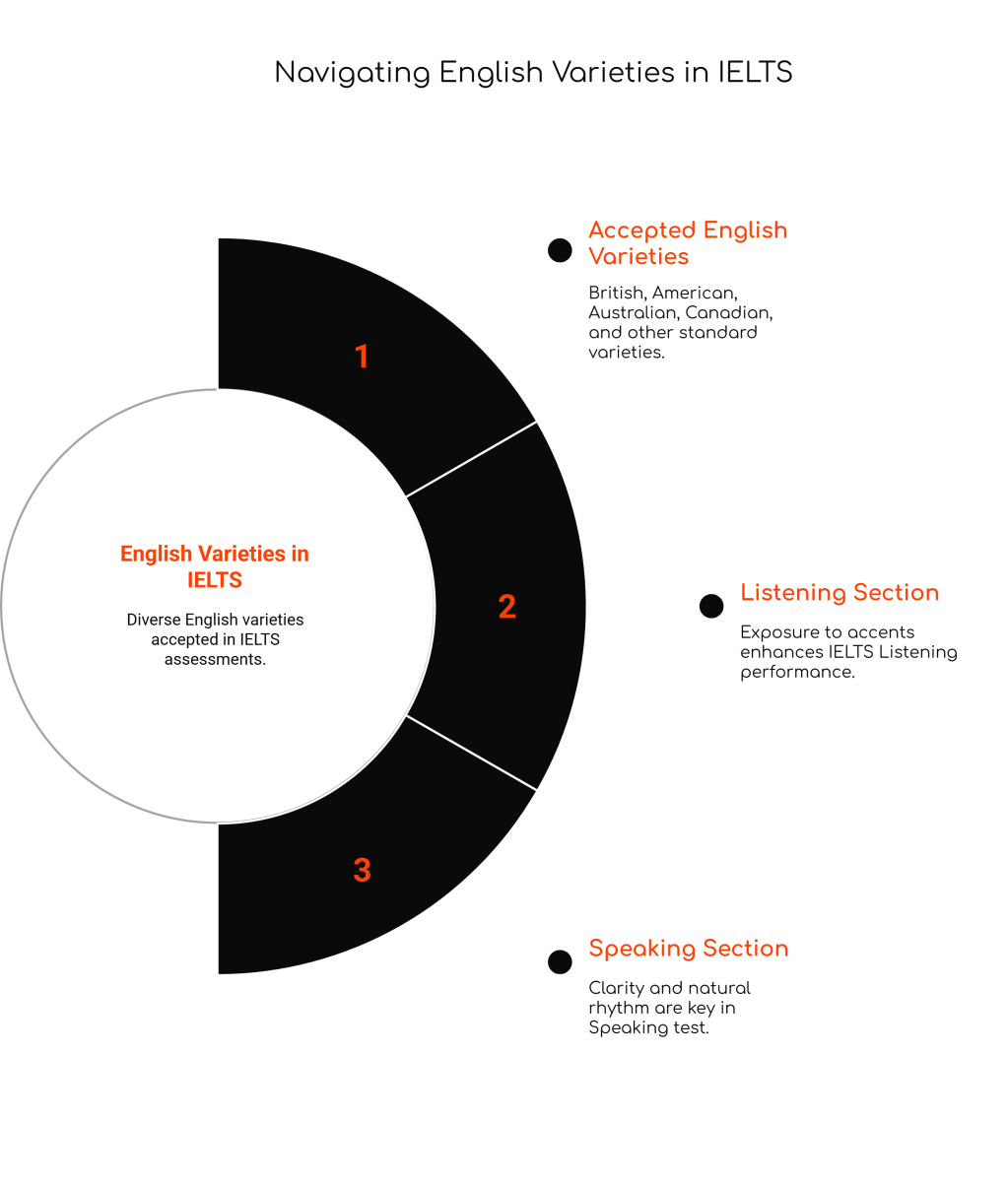
English is not a single, uniform language—it’s a global language with diverse varieties, from British and American to Australian, Canadian, and beyond. Fortunately, IELTS recognizes this reality and embraces international English standards in both Speaking and Listening assessments.
This post explores:
- What English varieties are accepted in IELTS
- How exposure to multiple accents can boost your Listening score
- How to adapt your Speaking style without losing your natural rhythm
What English Varieties Are Accepted in IELTS?
IELTS is jointly managed by Cambridge, the British Council, and IDP (Australia), and it’s designed for international test-takers. That means:
- You can speak in British, American, Australian, Canadian, or other standard English varieties.
- What matters is consistency, clarity, and accuracy—not which version you use.
You may:
- Spell words in either UK or US style (e.g., organize or organise)
- Use either pronunciation (e.g., schedule as /ˈskɛd.juːl/ or /ˈʃɛd.juːl/)
- Speak with your natural accent, as long as you’re understandable
How Different Accents Help in the IELTS Listening Section
IELTS Listening tests are designed to reflect the international nature of English. This means you will hear a variety of English accents, including:
- British (RP, regional)
- Australian
- New Zealand
- American
- Canadian
Why Exposure Matters:
- You’ll recognize pronunciation variations (e.g., water, data, schedule)
- You’ll be familiar with intonation and rhythm differences
- You’ll train your ears to pick up cues from different speakers
Preparation Tips:
- Watch shows from different regions (BBC, CNN, ABC Australia)
- Listen to diverse podcasts and YouTube channels
- Use IELTS practice tests with mixed accents
Adapting Your Speaking Style While Keeping Your Natural Rhythm
In the Speaking test, your goal is to:
- Be clear, confident, and coherent
- Use a consistent style (don’t mix too many varieties)
- Let your natural speaking rhythm shine—IELTS doesn’t penalize accents
You Don’t Need to Sound “British” or “American”
You just need to:
- Stress the right syllables
- Use appropriate intonation
- Speak at a comfortable pace
- Avoid unnatural “robotic” delivery or over-enunciating
Practical Speaking Tips:
- Record and review your speech: is it clear and natural?
- Use sentence stress and thought groups to sound fluent
- Avoid mixing British and American spelling in Writing (choose one and stick to it)
Common Mistakes and Misconceptions
| Myth | Reality |
|---|---|
| “I need a British accent to get Band 7+.” | Any clear accent is accepted |
| “Mixing accents improves my score.” | Mixing is confusing—be consistent |
| “They mark down non-native accents.” | Only clarity and pronunciation control matter |
| “I must use UK spelling.” | Use either British or American—just don’t mix them |
Do’s and Don’ts
Do:
- Listen to English from multiple regions during preparation
- Focus on clear enunciation, not mimicking accents
- Embrace your accent if it’s easy to understand
Don’t:
- Memorize scripts in an unfamiliar accent
- Overcorrect or change your natural rhythm
- Confuse accent with fluency or proficiency
Frequently Asked Questions
Q: Will I lose marks for having a Filipino/Indian/Arabic/Chinese accent?
A: No. IELTS examiners only care about clarity, pronunciation control, and fluency. Many Band 9 candidates speak with accents!
Q: Should I learn British pronunciation for IELTS?
A: Only if it feels natural to you. It’s better to be consistent and clear than forced and fake.
Q: Can I mix UK and US spelling in Writing?
A: No. Choose one standard and be consistent throughout your essay or letter.
Top Strategies for IELTS Success
- Expose Yourself to Global English
- Use streaming platforms, TED Talks, international news outlets
- Practice Active Listening
- Pause and repeat phrases from different accents
- Record Yourself Speaking
- Focus on clarity, stress, intonation—not accent mimicry
- Use Transcripts
- Compare what you hear to written text to recognize how accents affect pronunciation
- Build Accent Flexibility
- Understand different Englishes, even if you don’t adopt them
Final Thoughts
IELTS doesn’t expect you to speak like a news anchor—it expects you to speak clearly, confidently, and naturally. Whether you’re from Manila, Mumbai, Manchester, or Melbourne, your accent is accepted. What matters most is your ability to communicate ideas effectively and fluently.
Embrace your voice. Own your rhythm. Understand the Englishes around the world—and speak like someone who belongs on the global stage.
Learn More with IELTS Guide Phil
#IELTSAccents #GlobalEnglish #IELTSListeningTips #IELTSSpeakingSuccess #IELTSGuidePhil #EnglishVarieties #Band7Plus #IELTSWorldEnglishes #ClearSpeakingIELTS #IELTSAccentTips #IELTS
 IELTS Guide Phil
Leave a comment