
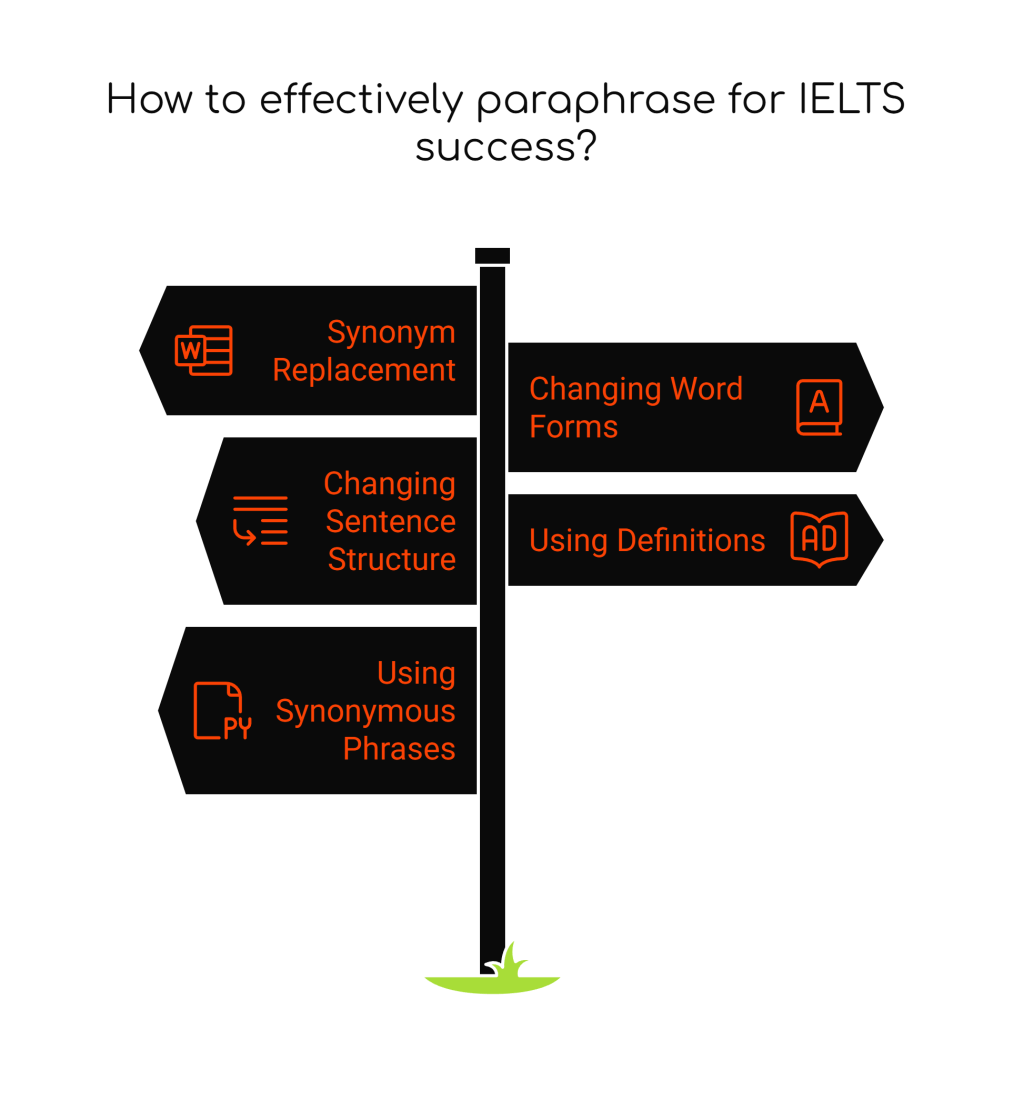
Paraphrasing is one of the most critical skills you need to master to achieve a high band score in the IELTS exam—especially in the Writing and Speaking sections. Whether you’re writing essays, describing graphs, or expressing yourself in an interview, your ability to rephrase ideas effectively shows your command of English vocabulary, grammar, and clarity.
In this blog post, we’ll explore paraphrasing in depth: what it is, why it matters, how to do it well, and how to avoid common mistakes.
What is Paraphrasing?
Paraphrasing means expressing the same idea using different words and sentence structures, while keeping the original meaning intact.
Example:
Original: Many people think that technology is making communication easier.
Paraphrased: A large number of individuals believe that technological advancements have simplified the way we communicate.
Why is Paraphrasing Important for IELTS?
Writing:
- Task 1: Rewriting the question prompt in your introduction.
- Task 2: Avoiding repetition, especially of keywords in the prompt.
- Demonstrating Lexical Resource and Grammatical Range: A key criterion in the IELTS Band Descriptors.
✔️peaking:
- Rephrasing questions before answering for clarity.
- Avoiding fillers by rewording the question while thinking.
- Showing fluency and vocabulary range without memorized phrases.
Types of Paraphrasing Techniques
1. Synonym Replacement
Use synonyms for key content words.
Original: The government should invest more in public transport.
Paraphrased: Authorities ought to allocate more funding to mass transit systems.
Be careful: Not all synonyms are interchangeable.
2. Changing Word Forms
Alter parts of speech (noun, verb, adjective, etc.).
Original: Pollution is increasing rapidly.
Paraphrased: The rapid increase in pollution is alarming.
3. Changing Sentence Structure
Use different grammatical structures or voices.
Original: Scientists are studying climate change.
Paraphrased: Climate change is being studied by scientists.
4. Using Definitions or Explanations
Define terms instead of repeating them.
Original: Globalization affects all industries.
Paraphrased: The process by which businesses and other organizations develop international influence impacts every sector.
5. Using Synonymous Phrases or Collocations
Replace fixed expressions with equivalent ones.
Original: The cost of living is rising.
Paraphrased: Living expenses are going up.
Common Paraphrasing Mistakes
- Changing the original meaning
- Incorrect: Most people hate technology.
- Original meaning: Most people think technology makes life easier.
- Using inappropriate synonyms
- Incorrect: The manager should fabricate a plan.
- Correct: The manager should devise a plan.
- Overcomplicating sentences
- Incorrect: A multitude of individuals are of the opinion that…
- Better: Many people believe that…
- Copying function words (e.g., prepositions, articles) and only changing a few content words
- This may be considered too close to the original in IELTS Writing Task 2 introductions.
Paraphrasing Dos and Don’ts
Dos:
- ✔ Practice paraphrasing daily using sample IELTS prompts.
- ✔ Use a thesaurus to learn new synonyms—but always check usage with a dictionary.
- ✔ Read academic texts and notice how ideas are expressed differently.
- ✔ Vary sentence length and structure to maintain natural flow.
Don’ts:
- ✘ Don’t use obscure or unnatural vocabulary.
- ✘ Don’t change essential meaning just to sound different.
- ✘ Don’t paraphrase for the sake of it—clarity is more important than complexity.
- ✘ Don’t rely solely on AI paraphrasers without understanding context.
Frequently Asked Questions (FAQs)
Q1: Do I have to paraphrase the entire IELTS Writing Task 2 question?
A: Yes, it’s a good practice to paraphrase the question prompt in your introduction to show lexical range, but do it naturally and accurately.
Q2: Is paraphrasing really necessary in the Speaking test?
A: It helps! Rephrasing or restating a question gives you thinking time and demonstrates fluency.
Q3: Can I repeat some keywords?
A: Yes—especially technical terms or when no synonym exists. Prioritize clarity.
Top Strategies for IELTS Success Using Paraphrasing
- Build a synonym bank for common IELTS topics: education, technology, environment, etc.
- Practice rewriting headlines, sentences, and questions every day.
- Record yourself paraphrasing aloud to improve fluency and confidence.
- Analyze high-scoring IELTS essays and pay attention to how ideas are paraphrased.
- Use IELTS-specific vocabulary (e.g., “individuals,” “authorities,” “infrastructure”) in your practice writing.
Paraphrasing Practice Challenge
Try paraphrasing the following sentence:
Original: Many people believe that online education is more convenient than traditional classroom learning.
Share your version in the comments or in our study group on Facebook:
IELTS Guide Phil – Official Study Group
Final Thoughts
Mastering paraphrasing is not about using fancy words—it’s about expressing ideas clearly, accurately, and in your own voice. The better you become at paraphrasing, the more naturally you will express yourself in both writing and speaking. It’s one of the surest paths to achieving a Band 7 or higher.
Learn More & Stay Connected
- IELTS Guide Phil Podcast on Spotify
- Visit the blog: ieltsguidephil.com
- Join our learning community on Facebook, X/Twitter, and BlueSky
#IELTSParaphrasing #IELTSWritingTips #IELTSSpeakingSuccess #Band7Plus #IELTSVocabulary #ParaphrasingSkills #IELTSPhilippines #IELTSGuidePhil #EnglishRephrasing #IELTSPreparation #IELTS
 IELTS Guide Phil
Leave a comment