
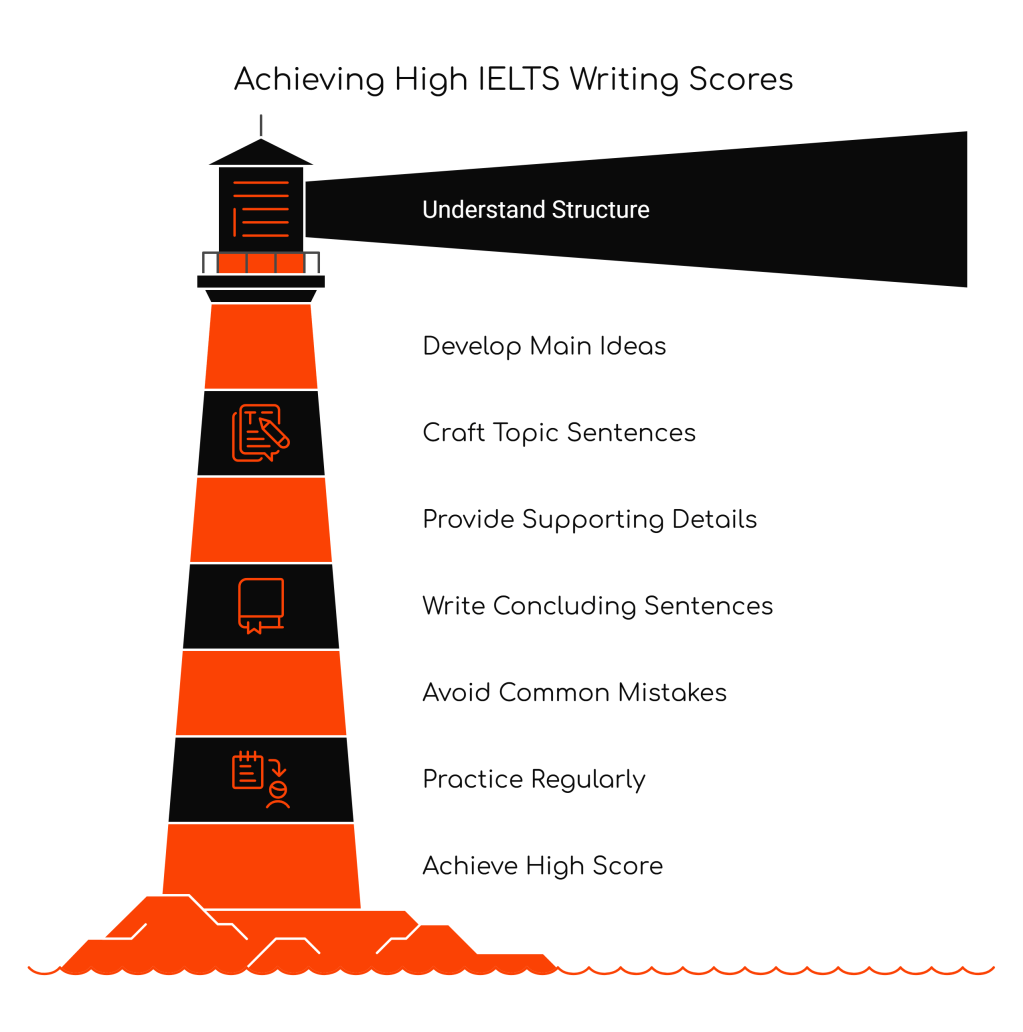
Mastering Essay Structure: Main Ideas, Sub-Ideas, Supporting Details, and Topic Sentences for High IELTS Band Scores
In IELTS Writing Task 2, it’s not enough to write grammatically correct sentences—you must also develop your ideas logically and clearly. High-scoring essays are built on strong main ideas, relevant sub-ideas, and specific supporting details.
In this guide, you’ll learn how to build well-structured body paragraphs using:
- Topic sentences
- One or two sub-ideas
- Clear explanations
- Specific examples
- Concluding/summarizing/linking sentences
Why Structure Matters in IELTS Writing
The IELTS Writing Task 2 Band Descriptors assess your:
- Task Response – Are your ideas fully developed and relevant?
- Coherence and Cohesion – Do your ideas flow logically?
- Lexical Resource – Do you use appropriate vocabulary?
- Grammatical Range and Accuracy – Do you demonstrate sentence variety and accuracy?
By using one or two well-explained sub-ideas per paragraph, you’ll show examiners that you can expand on your argument effectively without going off-topic.
Key Concepts and Definitions
1. Main Idea
The central argument or point of a paragraph.
Example: Governments should invest more in public transport.
2. Topic Sentence
Introduces the main idea at the beginning of the paragraph.
Example: One compelling reason for increasing investment in public transport is its impact on urban congestion and environmental sustainability.
3. Sub-Ideas
Specific points that develop or support the main idea. Each paragraph should have 1–2 sub-ideas that are explained and supported.
Sub-ideas for the topic above:
- Public transport reduces traffic volume.
- It also helps lower greenhouse gas emissions.
4. Explanation
Clarifies the sub-idea and shows why it matters.
Example: When more people rely on buses and trains, the number of private vehicles on the road decreases, which helps reduce congestion and fuel consumption.
5. Supporting Detail / Example
Provides specific evidence to support the explanation.
Example: A 2022 study in Singapore showed that train expansion reduced car use by 15% in urban centers.
6. Concluding/Summarizing Sentence
Summarizes or links the paragraph back to the thesis.
Example: Therefore, investing in public transport is a smart long-term strategy for reducing traffic and promoting sustainability.
Basic Essay Structure for IELTS Writing Task 2
Introduction
- Paraphrase the question
- State your thesis (position)
- Briefly outline the main ideas
Body Paragraph 1
- Topic sentence
- Sub-idea 1 → Explanation → Example
- Sub-idea 2 → Explanation → Example
- Summarizing sentence
Body Paragraph 2
- Topic sentence
- Sub-idea 1 → Explanation → Example
- Sub-idea 2 → Explanation → Example
- Summarizing sentence
Conclusion
- Summarize the key ideas
- Restate your position
- Optional: final recommendation or insight
Sample Paragraph Breakdown
Question: Some people think that university education should be free for everyone.
Topic Sentence: One strong argument in favor of free university education is that it creates equal opportunities and supports long-term national development.
Sub-Idea 1 – Equal access
Explanation: Students from low-income backgrounds often struggle to afford tuition fees, which leads to unequal chances in life.
Example: A UNESCO report in 2022 stated that 60% of qualified students in low-income countries abandon university due to financial barriers.
Sub-Idea 2 – Economic development
Explanation: Societies benefit when more citizens are educated and skilled, as this boosts productivity and innovation.
Example: Countries like Germany and Norway offer free university education and consistently rank high in economic performance and innovation indexes.
Summarizing Sentence: Thus, removing tuition fees can foster both individual empowerment and national progress.
Common Mistakes to Avoid
| Mistake | Why It’s a Problem | Fix |
|---|---|---|
| Listing too many ideas per paragraph | Makes the paragraph unfocused | Stick to 1–2 sub-ideas per paragraph |
| Weak topic sentences | Confuses the reader | Clearly introduce the main idea |
| No explanation of points | Reduces Task Response score | Always explain before giving an example |
| Generalizations without support | Weakens argument | Use specific, relevant examples |
| No conclusion | Essay feels unfinished | End with a strong final paragraph |
Dos and Don’ts
Do:
- Use 1–2 sub-ideas per body paragraph
- Explain your ideas clearly before using examples
- Start with a strong topic sentence
- Use transitions to link your thoughts
- Vary your vocabulary and sentence structures
Don’t:
- Write one paragraph with 4–5 undeveloped ideas
- Use examples without explanations
- Repeat the same point in every paragraph
- Write a conclusion that introduces new ideas
Frequently Asked Questions (FAQs)
Q1: How many sub-ideas should I write per paragraph?
A: Usually 1–2 well-developed sub-ideas per body paragraph are enough for clarity and depth.
Q2: What if I can’t think of examples?
A: Use logical or hypothetical examples—real data is helpful but not required.
Q3: Is it okay to have three body paragraphs?
A: Yes, but only if you can manage your time and develop all three fully. Two is usually safer.
Top Strategies for High IELTS Bands
- Plan your sub-ideas before writing
- Use the PEEL structure (Point, Explanation, Example, Link)
- Practice turning headlines or questions into full body paragraphs
- Analyze Band 8–9 model essays for idea development
- Use templates that allow flexibility, not memorization
Practice Task
Prompt: Some people believe that professional workers such as doctors and teachers should be paid more than sports and entertainment celebrities.
Write a body paragraph using this structure:
- Topic sentence
- Sub-idea 1 → Explanation → Example
- Sub-idea 2 → Explanation → Example
- Summarizing sentence
Share your response in our Facebook group for feedback:
IELTS Guide Phil Study Group
Stay Connected and Keep Learning
- Visit IELTS Guide Phil Blog
- Listen to the IELTS Guide Phil Podcast on Spotify
- Join our community on Facebook: IELTS Guide Phil
#IELTSWritingTips #IELTSParagraphStructure #IELTSEssayDevelopment #IELTSGuidePhil #Band7Plus #IELTSTopicSentences #IELTSSubIdeas #IELTSPreparation #AcademicWriting #IELTSPhilippines #IELTS
 IELTS Guide Phil
Leave a comment