
One of the most essential criteria for scoring Band 7 or higher in IELTS Writing and Speaking is Coherence and Cohesion. This doesn’t just mean that your ideas make sense — it means your message flows logically, clearly, and naturally.
At the heart of this is your use of cohesive devices—words and phrases that connect ideas, sentences, and paragraphs effectively.
This blog post expands on the core ideas found in the “Cohesive Devices” PDF and explains how to use them correctly for high-band IELTS performance.
What Are Cohesive Devices?
Cohesive devices, also called linking words or transition signals, are words or expressions that:
- Show the relationship between ideas
- Help organize your essay or speech
- Create a smooth flow in communication
These devices show contrast, add information, provide examples, indicate results, or mark time sequences.
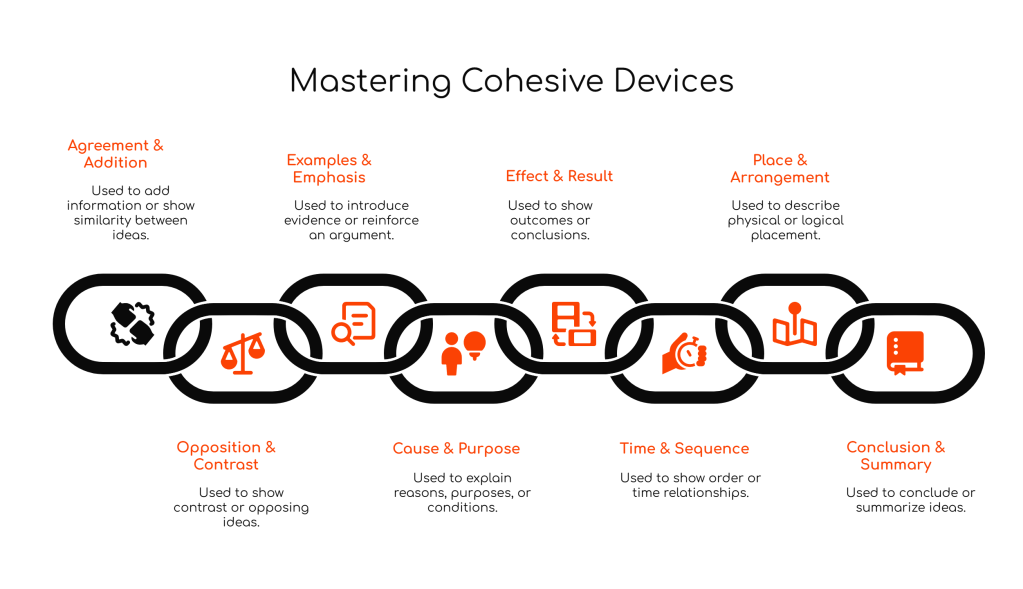
Categories of Cohesive Devices (with Examples and Usage)
1. Agreement, Addition & Similarity
Used to add information or show similarity between ideas.
Examples:
- In addition, moreover, furthermore, not only … but also, similarly, likewise, as well as, too
IELTS Use:
Writing Task 2: “Moreover, governments should invest in renewable energy to reduce dependence on fossil fuels.”
Speaking Part 3: “I enjoy reading fiction. Similarly, I’m interested in writing short stories.”
2. Opposition, Limitation & Contrast
Used to show contrast or opposing ideas.
Examples:
- However, although, even though, in contrast, on the other hand, nevertheless, despite, whereas, still, yet
IELTS Use:
“Many people prefer city life. However, it often comes with high living costs and noise pollution.”
“In contrast to traditional learning, online education allows greater flexibility.”
3. Examples, Support & Emphasis
Used to introduce evidence or reinforce an argument.
Examples:
- For example, for instance, to illustrate, namely, in particular, such as, especially, notably, in fact
IELTS Use:
“Developing countries face healthcare challenges. For instance, many rural areas lack qualified doctors.”
“In fact, studies show that people who exercise regularly have better mental health.”
4. Cause, Purpose & Condition
Used to explain reasons, purposes, or conditions.
Examples:
- Because, due to, since, so that, in order to, if, unless, provided that, as long as
IELTS Use:
“People are becoming obese because of poor dietary habits.”
“In order to achieve a high band score, candidates must practice regularly.”
“Unless governments take action, pollution will worsen.”
5. Effect, Result & Consequence
Used to show outcomes or conclusions.
Examples:
- Therefore, thus, consequently, as a result, hence, so, for this reason
IELTS Use:
“Many young people lack job opportunities. As a result, they migrate abroad.”
“Technology is advancing rapidly. Consequently, traditional jobs are disappearing.”
6. Time, Chronology & Sequence
Used to show order or time relationships.
Examples:
- First, second, finally, then, next, before, after, meanwhile, eventually, at the same time, subsequently
IELTS Use:
“First, students should understand the task. Then, they can brainstorm ideas.”
“Meanwhile, the government must ensure vaccine accessibility.”
7. Place & Spatial Arrangement
Used to describe physical or logical placement.
Examples:
- Beside, under, above, across, beyond, near, in front of, at the center, around, among
IELTS Use (especially Writing Task 1 – Diagrams or Maps):
“The cafeteria is located behind the main building, next to the library.”
“There is a parking area adjacent to the school.”
8. Conclusion, Summary & Restatement
Used to conclude or summarize ideas.
Examples:
- In conclusion, to summarize, in summary, overall, on the whole, in short, all in all
IELTS Use:
“In conclusion, while advertising can be persuasive, it should not manipulate consumers.”
“Overall, the bar chart indicates a steady increase in mobile phone use.”
Common Mistakes with Cohesive Devices
| Mistake | Why It’s a Problem | How to Fix |
|---|---|---|
| Overusing cohesive devices | Makes writing sound unnatural and robotic | Use them strategically, not excessively |
| Using inappropriate connectors | Confuses the reader or distorts logic | Learn the function of each device |
| Mixing formal with informal | Lowers tone consistency, especially in writing | Use formal connectors in essays |
| Repeating the same linker | Hurts lexical resource and variety | Use synonyms and a varied range |
Dos and Don’ts
Do:
- Use 1–2 linking phrases per paragraph
- Learn transition categories (contrast, result, example, etc.)
- Practice rewriting sample sentences with different cohesive devices
- Use cohesive devices naturally in Speaking Part 3
Don’t:
- Start every sentence with “However”
- Use casual linkers (e.g., “and then”) in academic writing
- Use cohesive devices as filler
- Ignore punctuation—most cohesive devices need commas!
Frequently Asked Questions
Q1: How many cohesive devices should I use in Writing Task 2?
A: Use them strategically and naturally—around 6–10 per essay is ideal, depending on length.
Q2: Can I use the same cohesive devices in Speaking?
A: Yes, but keep them natural and conversational. Use words like “also,” “but,” “so,” “for example” with fluency.
Q3: Will I lose marks if I don’t use cohesive devices?
A: Yes. They’re essential for Coherence and Cohesion, which is 25% of your writing and speaking score.
Top Strategies for Mastering Cohesive Devices
- Keep a Cohesive Device Journal
Group them by function and practice sentences with each. - Use IELTS Band 9 model essays
Highlight all linking words. Study how they’re used in context. - Paraphrase and Rewrite
Take one paragraph and rewrite it using different cohesive devices. - Practice Speaking Part 3 Answers
Add cohesive devices as you explain and elaborate.
Practice Activity
Rewrite the following paragraph using at least 3 different cohesive devices:
“Many people watch TV. They also spend a lot of time on social media. This can affect their productivity.”
Try replacing “also” and “this” with more formal or specific cohesive devices.
Final Thoughts
Cohesive devices are the glue that holds your ideas together in both IELTS Writing and Speaking. When used well, they make your arguments flow smoothly, your examples clear, and your tone professional. Use the list and categories from this post as part of your IELTS toolkit and review them regularly.
Bonus Download
Want a printable cheat sheet of all these cohesive devices organized by function?
Visit ieltsguidephil.com or contact us to receive your free PDF guide.
#IELTSCohesion #IELTSWritingTips #IELTSSpeakingSuccess #IELTSGuidePhil #Band7Plus #TransitionWords #CohesiveDevices #IELTSGrammar #IELTSBlog #IELTSVocabulary #IELTS
 IELTS Guide Phil
Leave a comment