
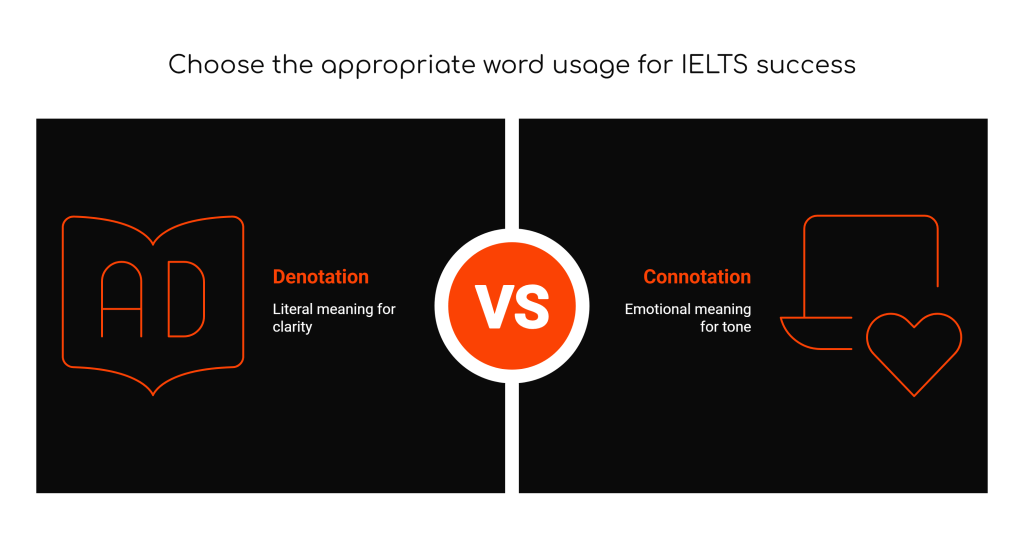
When preparing for the IELTS exam, most learners focus on grammar, vocabulary, and test strategies. But to truly excel—especially in Writing Task 2 and Speaking Part 3—you need to master the nuances of word meaning. Understanding the difference between denotation (literal meaning) and connotation (implied or emotional meaning) helps you express your ideas with precision, appropriateness, and sophistication—all qualities the IELTS exam rewards with higher bands.
What Are Denotation and Connotation?
Denotation
Definition: The literal, dictionary definition of a word.
Example:
- Snake → a legless reptile.
Connotation
Definition: The emotional, cultural, or personal association that a word carries beyond its literal meaning.
Example:
- Snake → danger, betrayal, untrustworthiness (negative connotation)
Both play a vital role in how your English is understood and assessed in IELTS tasks.
Why Connotation and Denotation Matter in IELTS
| IELTS Section | How It Matters |
|---|---|
| Writing Task 2 | Helps you choose formal, precise, and neutral words for academic tone |
| Speaking Part 1–3 | Enables appropriate word choice based on tone or context |
| Reading | Enhances your ability to infer tone or author’s attitude |
| Listening | Helps you detect implied meanings and speaker emotions |
Types of Connotation
| Type | Description | Example (vs. Neutral Word) |
|---|---|---|
| Positive | Implies a good or favorable meaning | Youthful vs. Childish |
| Negative | Implies an unpleasant or undesirable tone | Stingy vs. Thrifty |
| Neutral | Factual or non-emotional tone | House vs. Home (home is warmer) |
Examples in IELTS Contexts
Writing Task 2
Bad: Governments must control people.
Better: Governments must regulate public behavior.
→ Control has a negative connotation of domination, while regulate sounds neutral and appropriate.
Speaking Part 3
Bad: My manager is very bossy.
Better: My manager is quite assertive and direct.
→ Bossy has a negative tone, while assertive is more professional.
Reading
Passage says: “The politician manipulated public opinion.”
→ The connotation of manipulate suggests dishonesty or trickery, not neutral influence.
Common Mistakes IELTS Candidates Make
| Mistake | Explanation | Example |
|---|---|---|
| Using informal or negative connotations in Writing Task 2 | Makes tone inappropriate | “Kids” instead of “children” |
| Assuming two synonyms are interchangeable | Not always true | “Cheap” vs. “Affordable” |
| Overusing emotionally loaded words | Sounds biased or unbalanced | “Terrible traffic” vs. “Heavy traffic” |
| Translating idioms/connotations literally from L1 (e.g., Tagalog) | Can lead to confusion | “She has a wide face” (may sound insulting) |
Dos and Don’ts
Do:
- Learn the connotations of new vocabulary, not just the definitions.
- Replace informal or judgmental words with neutral, academic ones.
- Use a thesaurus with care—verify meanings and tone using a dictionary.
- Practice tone-matching exercises.
Don’t:
- Use overly emotional or biased terms in essays.
- Assume words with similar meanings are always interchangeable.
- Use words like “mad,” “crazy,” “huge,” in academic writing without qualifiers.
- Translate directly from your native language without checking tone.
Frequently Asked Questions (FAQs)
Q1: Why is connotation so important in IELTS Writing?
A: Because academic writing values neutrality and precision. Connotative errors can make your writing sound informal or biased, reducing your Task Achievement and Lexical Resource scores.
Q2: Can connotation affect my Speaking score?
A: Yes. Using emotionally inappropriate or extreme words (e.g., “disgusting” for food you merely disliked) can hurt your score under Lexical Resource and Fluency.
Q3: How do I learn the connotations of new words?
A: Use tools like Cambridge Dictionary, or vocabulary books like English Collocations in Use. Look up example sentences and synonyms, and note the tone.
Q4: Is it okay to use slang if the tone is casual?
A: In Speaking Part 1, a bit of informal language is acceptable. But in Writing, always avoid slang or strongly emotional expressions.
Top Strategies for IELTS Success
1. Build Word Banks with Tone Tags
Create lists of synonyms with their emotional tone:
- Positive: generous, modest, innovative
- Neutral: sufficient, adequate, legal
- Negative: lazy, nosy, selfish
2. Read Model Essays and Highlight Tone
Underline emotionally neutral language in high-scoring Writing Task 2 samples. Note how connotation shapes tone and objectivity.
3. Practice Replacing Loaded Words
Original: “The project was a disaster.”
Better: “The project faced significant challenges.”
4. Learn from Feedback
Have teachers or peers flag inappropriate word usage. Learn alternative expressions and practice rephrasing.
5. Use Context to Guess Connotation in Reading
When encountering a new word, consider the author’s overall tone. Is it sarcastic? Critical? Supportive?
Sample Exercise: Match the Connotation
Match the word with its tone:
| Word | Connotation |
|---|---|
| Frugal | Positive |
| Skinny | Negative |
| Affordable | Positive |
| Cheap | Negative |
| Inexpensive | Neutral |
Conclusion: Use the Power of Meaning
Mastering connotation and denotation helps you:
- Communicate ideas more accurately and appropriately
- Avoid awkward or offensive word choices
- Improve your Lexical Resource and Task Response scores
At IELTS Guide Phil, we encourage you not just to learn what words mean—but how they make your listener or reader feel. Understanding word tone is a hidden secret to achieving high IELTS band scores.
#IELTSGuidePhil #IELTSTips #IELTSWriting #IELTSSpeaking #Band7Plus #ConnotationVsDenotation #AcademicVocabulary #LexicalResource #IELTSGrammar #IELTSMindset #EnglishPrecision #IELTS
 IELTS Guide Phil
Leave a comment