
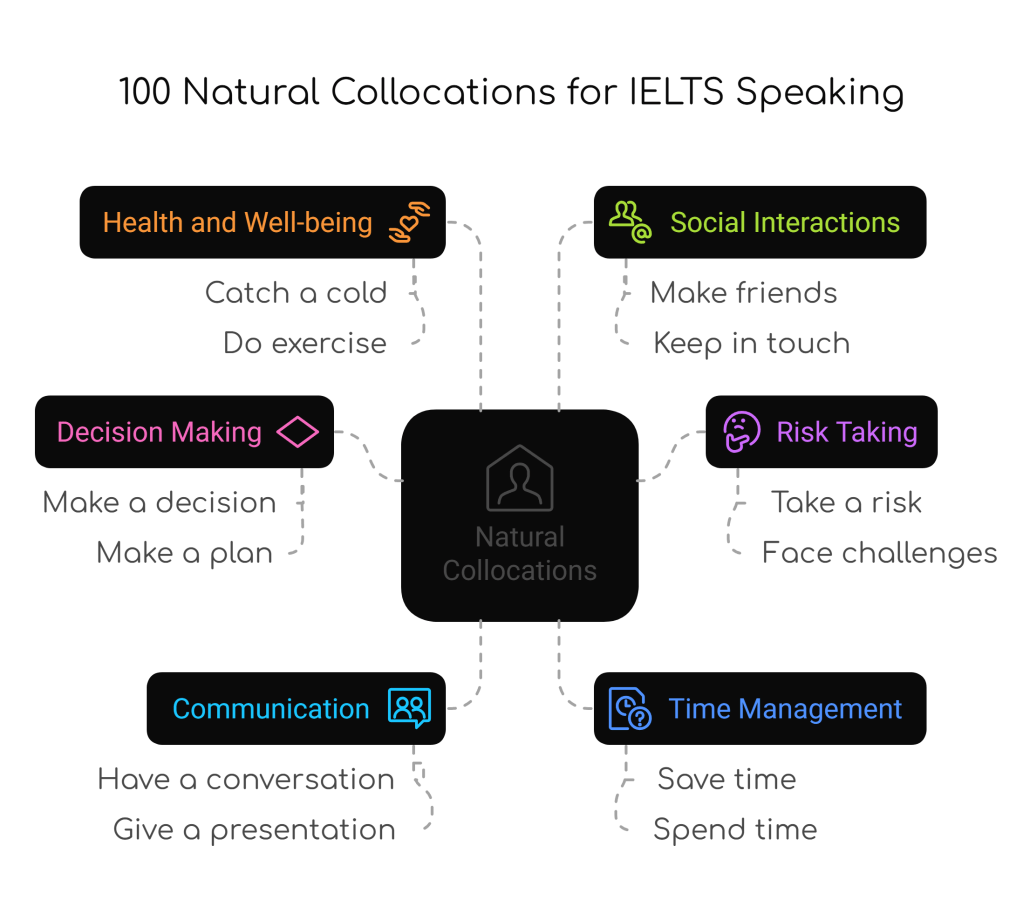
In the IELTS Speaking test, using natural and accurate collocations can significantly improve your fluency, coherence, and lexical resource scores. Collocations are natural word pairings that native speakers commonly use. Mastering them helps your speech sound more idiomatic, confident, and professional.
In this post, we’ll explore 100 essential collocations that can help you stand out in the IELTS Speaking test. Each one includes a brief definition and an example to show how you can use it naturally in conversation.
100 Natural Collocations with Definitions and Examples
- Make a decision – to decide
I had to make a decision quickly about my future. - Take a risk – to do something uncertain or dangerous
Sometimes you need to take a risk to succeed. - Do homework – to complete school assignments
I usually do my homework right after dinner. - Catch a cold – to get sick
I caught a cold because I didn’t wear a jacket. - Break the ice – to start a conversation
He told a joke to break the ice at the party. - Pay attention – to listen or watch carefully
You need to pay attention during lectures. - Save time – to use time efficiently
Using online banking really saves time. - Keep in touch – to stay in contact
We promised to keep in touch after graduation. - Have a conversation – to talk with someone
I had a great conversation with my tutor. - Lose interest – to stop being interested
I lost interest in the class after a few weeks. - Make an effort – to try
He made a real effort to improve his English. - Gain experience – to learn from doing something
I gained experience working part-time in retail. - Catch someone’s attention – to attract notice
The advertisement caught my attention instantly. - Run a business – to manage a company
My uncle runs a small café in town. - Take notes – to write information
I always take notes during my IELTS lessons. - Get a job – to find employment
I hope to get a job after I graduate. - Miss the point – to not understand
He completely missed the point of the discussion. - Do the dishes – to wash plates and utensils
I always do the dishes after dinner. - Have a break – to take a rest
We usually have a break after two hours of study. - Make progress – to improve
I’ve made a lot of progress in my pronunciation. - Come prepared – to be ready
I always come prepared for job interviews. - Find a solution – to solve a problem
We need to find a solution quickly. - Give advice – to help with suggestions
My parents often give me advice about life. - Do your best – to try hard
I always do my best during exams. - Speak fluently – to speak without pauses
I want to speak English fluently. - Feel nervous – to be anxious
I always feel nervous before public speaking. - Tell a lie – to not tell the truth
It’s better to admit your mistake than tell a lie. - Make a mistake – to do something wrong
Everyone makes mistakes when learning a language. - Keep a promise – to do what you said you would
She always keeps her promises. - Lose track – to forget or not follow
I lost track of time while studying. - Follow the rules – to obey guidelines
It’s important to follow the rules in school. - Take part in – to participate
I took part in a debate competition last week. - Go abroad – to travel to another country
I’d like to go abroad for further studies. - Have an impact – to influence
That speech had a big impact on me. - Raise awareness – to inform people
We need to raise awareness about climate change. - Make friends – to start relationships
It’s easy to make friends at university. - Come to a conclusion – to decide
We came to the conclusion that it was unfair. - Change your mind – to decide something else
I changed my mind about applying abroad. - Do exercise – to work out
I try to do exercise three times a week. - Take responsibility – to accept blame
He took responsibility for the mistake. - Meet expectations – to perform well
The product didn’t meet my expectations. - Face challenges – to deal with difficulties
We face many challenges in life. - Break the habit – to stop a routine
I’m trying to break the habit of staying up late. - Go online – to use the internet
I usually go online to study or shop. - Give a presentation – to speak formally
I gave a presentation on environmental issues. - Make a complaint – to say something is wrong
He made a complaint about the noisy room. - Build confidence – to become sure of yourself
Speaking regularly helps me build confidence. - Keep a secret – to not tell anyone
Can you keep a secret? - Lose your temper – to become angry
He lost his temper during the meeting. - Take advantage of – to benefit from
You should take advantage of this opportunity. - Spend time – to use time doing something
I love spending time with my family. - Give someone a hand – to help
Can you give me a hand with these boxes? - Make a living – to earn money
He makes a living as a freelance writer. - Get married – to become husband and wife
They got married last summer. - Stay calm – to remain peaceful
Try to stay calm during the interview. - Take care of – to look after
I take care of my younger brother every day. - Fall asleep – to start sleeping
I fell asleep while watching the movie. - Have fun – to enjoy oneself
We had so much fun at the beach. - Go out – to leave home for social reasons
I usually go out with friends on weekends. - Make a plan – to organize something
Let’s make a plan for the holidays. - Come late – to arrive after the expected time
He came late to the meeting again. - Have a look – to check or view something
Have a look at this interesting article. - Get dressed – to put on clothes
I got dressed quickly and left for work. - Lose weight – to become thinner
I’m trying to lose weight by exercising. - Get lost – to not know where you are
We got lost in the city centre. - Keep calm – to remain composed
During emergencies, it’s crucial to keep calm. - Go wrong – to fail or have problems
Something went wrong with my phone. - Make a promise – to commit to doing something
She made a promise to never lie again. - Ask a question – to inquire
Can I ask a question about the task? - Give an example – to illustrate something
Let me give you an example of that issue. - Get ready – to prepare
I got ready in 10 minutes this morning. - Have a meal – to eat
We had a delicious meal at the new restaurant. - Go shopping – to buy things
I usually go shopping on Saturdays. - Tell the truth – to be honest
Please tell the truth about what happened. - Run late – to be behind schedule
Sorry, I’m running late today. - Have a problem – to experience an issue
I had a problem with my laptop yesterday. - Take notes – to write down important information
I always take notes during lectures. - Catch up with – to update each other
Let’s catch up with each other this weekend. - Go jogging – to run for exercise
I go jogging every morning. - Break a record – to achieve something better than ever before
She broke the world record in swimming. - Keep fit – to stay in good shape
I go to the gym regularly to keep fit. - Make an impression – to influence someone’s opinion
First impressions really do matter. - Get stuck – to be unable to move or continue
I got stuck in traffic for an hour. - Give someone a call – to phone someone
I’ll give you a call later tonight. - Set goals – to plan objectives
I’ve set some academic goals for this year. - Take action – to do something
We need to take action on climate change. - Go on a trip – to travel
We’re going on a trip to the mountains. - Change the subject – to talk about something else
He quickly changed the subject after the question. - Get promoted – to receive a higher position
He got promoted after only six months. - Make a suggestion – to propose an idea
Can I make a suggestion about the project? - Come up with an idea – to think of something
She came up with a great idea for the presentation. - Give feedback – to offer opinions
The teacher gave me positive feedback. - Miss a chance – to lose an opportunity
I missed the chance to apply for the internship. - Keep learning – to continue studying
I believe in lifelong education and keeping on learning. - Get involved – to participate actively
Students should get involved in extracurricular activities. - Meet a deadline – to finish on time
I struggled to meet the deadline for my essay. - Take a break – to pause for rest
Let’s take a break before we continue. - Give a speech – to speak formally
He gave a moving speech at the ceremony. - Raise a question – to bring up a topic
She raised a question about exam results. - Develop skills – to improve abilities
I’m working hard to develop my writing skills.
Final Thoughts
Using natural collocations in IELTS Speaking is a powerful way to demonstrate fluency, accuracy, and range in your vocabulary. Instead of relying on basic phrases, these 100 collocations allow your speech to sound native-like and engaging. Practice using them in your answers, and try to incorporate them when describing your experiences, opinions, or plans in each part of the IELTS Speaking test.
#IELTS #IELTSSpeaking #IELTSVocabulary #IELTSTips #IELTSPreparation #HighBandIELTS #EnglishCollocations #SpeakFluently #IELTSGuide #IELTSLexicalResource #FluentEnglish #NaturalEnglish #IELTSBand7Plus #IELTSSpeakingTips #IELTS
 IELTS Guide Phil
Leave a comment