
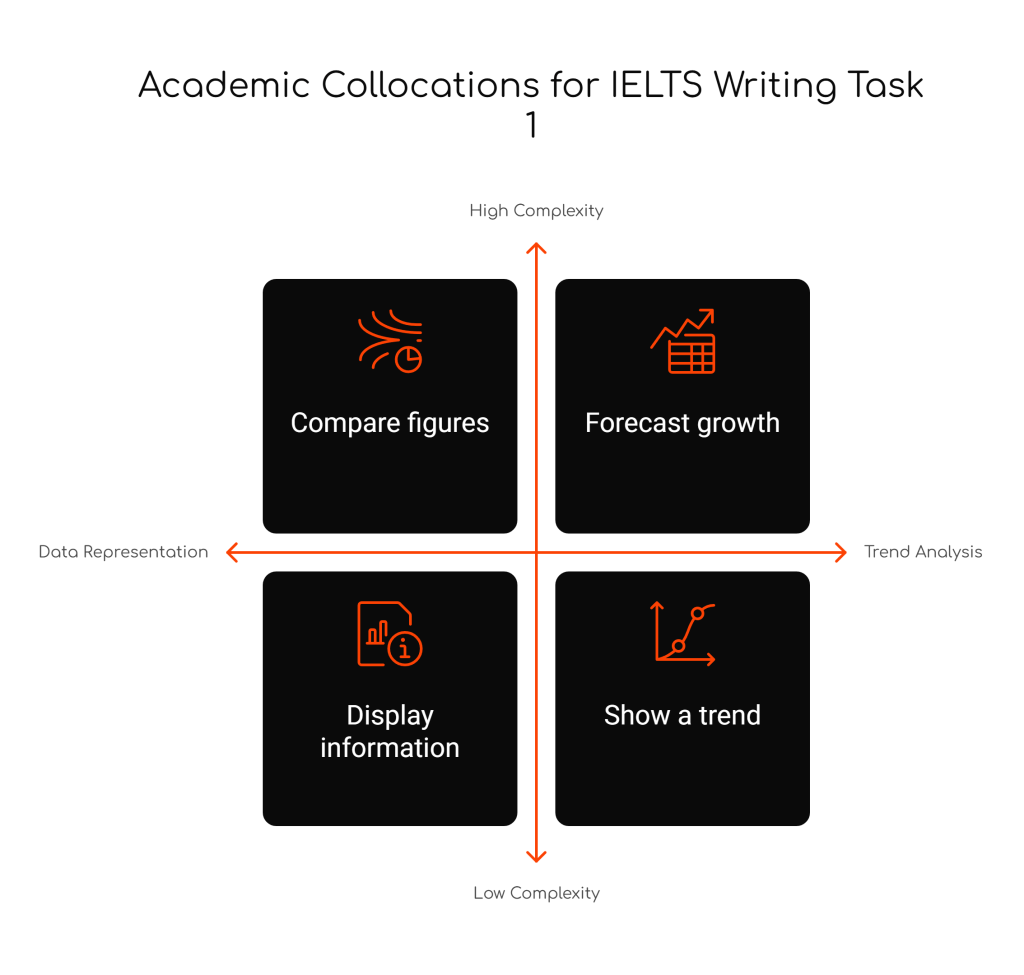
In IELTS Academic Writing Task 1, candidates must describe and analyze visual data such as graphs, charts, tables, and diagrams. One of the key criteria assessed is Lexical Resource, which refers to your range and accuracy of vocabulary. Using academic collocations—words that naturally go together—can help you write more fluently and appropriately.
This post presents 100 high-level academic collocations with definitions and example sentences to elevate your Writing Task 1 responses.
Academic Collocations with Definitions and Examples
- Show a trend
Definition: To display a direction in data
Example: The graph shows a trend of increasing unemployment. - Experience growth
Definition: To undergo an increase
Example: The company experienced rapid growth in profits. - Fluctuate significantly
Definition: To vary greatly
Example: Fuel prices fluctuated significantly over the period. - Reach a peak
Definition: To hit the highest point
Example: Tourism numbers reached a peak in July. - Decline steadily
Definition: To decrease gradually
Example: The population declined steadily from 2010 to 2020. - Remain stable
Definition: To stay unchanged
Example: The birth rate remained stable throughout the decade. - Drop sharply
Definition: To decrease quickly and steeply
Example: Car sales dropped sharply in December. - Increase gradually
Definition: To rise slowly over time
Example: The average income increased gradually over the five years. - Show a correlation
Definition: To display a relationship
Example: The data shows a correlation between education and income. - Rise dramatically
Definition: To increase a lot in a short time
Example: Internet usage rose dramatically after 2015. - Provide data
Definition: To offer numerical information
Example: The chart provides data on energy consumption. - Display information
Definition: To show details or figures
Example: The pie chart displays information about household expenditure. - Compare figures
Definition: To analyze numbers side by side
Example: The bar graph compares figures for different countries. - Represent values
Definition: To stand for numerical amounts
Example: Each bar represents the value for a specific year. - Illustrate changes
Definition: To show transformations
Example: The line graph illustrates changes in temperature. - Reveal patterns
Definition: To uncover trends
Example: The chart reveals patterns in consumer spending. - Present statistics
Definition: To show numerical data
Example: The table presents statistics on employment. - Summarize information
Definition: To give an overview
Example: The report summarizes information from various sources. - Indicate differences
Definition: To highlight contrasts
Example: The chart indicates differences in housing costs. - Show similarities
Definition: To highlight shared characteristics
Example: Both graphs show similarities in their upward trends. - Increase slightly
Definition: To grow a little
Example: Sales increased slightly in the final quarter. - Decline marginally
Definition: To drop by a small amount
Example: Profits declined marginally between 2018 and 2019. - Account for
Definition: To make up a portion
Example: Agriculture accounted for 30% of total GDP. - Remain constant
Definition: To not change
Example: The price of gas remained constant during the period. - Show fluctuations
Definition: To display ups and downs
Example: The graph shows fluctuations in interest rates. - Increase rapidly
Definition: To grow quickly
Example: Mobile phone usage increased rapidly after 2000. - Decline dramatically
Definition: To decrease steeply
Example: Industrial output declined dramatically in 2009. - Peak at
Definition: To reach the highest point
Example: Production peaked at 100,000 units. - Hit a low
Definition: To reach the lowest point
Example: Employment hit a low in March. - Grow consistently
Definition: To rise steadily over time
Example: The company grew consistently from 2010 to 2020. - Show stability
Definition: To reflect minimal change
Example: The figure shows stability across three decades. - Remain unchanged
Definition: To stay the same
Example: The unemployment rate remained unchanged throughout the year. - Drop suddenly
Definition: To fall quickly
Example: Sales dropped suddenly after the new regulation. - Increase modestly
Definition: To rise a small amount
Example: GDP increased modestly last quarter. - Display variation
Definition: To show differences
Example: The data displays variation across regions. - Provide a breakdown
Definition: To offer details
Example: The chart provides a breakdown of expenses. - Segment data
Definition: To divide information
Example: The graph segments data by age group. - Highlight changes
Definition: To emphasize differences
Example: The visual highlights changes in rainfall levels. - Observe a trend
Definition: To notice a pattern
Example: One can observe a trend of urbanization. - Show proportions
Definition: To display relative sizes
Example: The pie chart shows the proportions of income spent. - Demonstrate growth
Definition: To show an increase over time
Example: The chart demonstrates growth in student enrollment. - Reflect trends
Definition: To mirror ongoing developments
Example: The graph reflects trends in energy consumption. - Correlate with
Definition: To be connected or related
Example: Education level correlates with income level. - Represent data
Definition: To visually display statistics
Example: The diagram represents data collected in 2022. - Track changes
Definition: To follow developments over time
Example: The chart tracks changes in population density. - Measure growth
Definition: To quantify an increase
Example: The statistics measure growth in GDP. - Report figures
Definition: To state numerical data
Example: The table reports figures for each quarter. - Exhibit variation
Definition: To show differences
Example: The results exhibit variation among age groups. - Compare percentages
Definition: To analyze proportions
Example: The bar chart compares percentages of exports. - Convey information
Definition: To communicate facts or data
Example: The visual conveys information about housing trends. - Showcase patterns
Definition: To present recurring trends
Example: The graph showcases patterns in rainfall. - List statistics
Definition: To enumerate data
Example: The report lists statistics for all five regions. - Suggest a trend
Definition: To imply a direction of change
Example: The data suggests a trend toward digital media. - Depict changes
Definition: To show differences over time
Example: The line graph depicts changes in air quality. - Support analysis
Definition: To help with interpreting information
Example: These figures support analysis of income inequality. - Outline differences
Definition: To describe distinctions clearly
Example: The table outlines differences between two categories. - Categorize data
Definition: To arrange into groups
Example: The data is categorized by sector and region. - Differentiate categories
Definition: To distinguish between groups
Example: The chart differentiates categories by color. - Depict fluctuations
Definition: To show irregular variations
Example: The graph depicts fluctuations in demand. - Highlight proportions
Definition: To show relative sizes
Example: The pie chart highlights proportions of water usage. - Project growth
Definition: To estimate future increase
Example: The trend line projects growth for the next decade. - Identify changes
Definition: To point out differences
Example: The bar graph identifies changes in employment rates. - Distribute data
Definition: To spread across categories
Example: The chart distributes data across five sectors. - Visualize statistics
Definition: To make data visible
Example: The infographic visualizes statistics for clarity. - Chart progress
Definition: To track development
Example: The line graph charts progress in literacy rates. - Analyze data
Definition: To interpret numbers
Example: Researchers analyzed data on consumer behavior. - Quantify change
Definition: To measure the amount of variation
Example: The study quantifies change in average temperatures. - Represent percentages
Definition: To show proportions
Example: Each bar represents percentages of daily intake. - Illustrate growth
Definition: To visually show an increase
Example: The bar chart illustrates growth in exports. - Underline trends
Definition: To emphasize patterns
Example: These figures underline trends in the labor market. - Calculate averages
Definition: To determine the mean
Example: The table calculates averages for household spending. - Summarize trends
Definition: To give an overview of changes
Example: The graph summarizes trends in global warming. - Estimate values
Definition: To make an informed guess
Example: The model estimates values for future years. - Pinpoint peaks
Definition: To identify highest points
Example: The diagram pinpoints peaks in oil production. - Forecast growth
Definition: To predict an increase
Example: Analysts forecast growth in the technology sector. - Explain differences
Definition: To give reasons for variation
Example: The chart explains differences in life expectancy. - Denote changes
Definition: To indicate modifications
Example: The arrows denote changes in direction. - Indicate increases
Definition: To show rises
Example: The red line indicates increases in inflation. - Clarify distribution
Definition: To make the spread of data clear
Example: The pie chart clarifies the distribution of expenses. - Show tendencies
Definition: To indicate general directions
Example: The chart shows tendencies toward urban living. - Depict proportions
Definition: To represent parts of a whole
Example: The graphic depicts proportions of energy sources. - Record statistics
Definition: To document numerical data
Example: The report records statistics from multiple years. - List categories
Definition: To provide named groups
Example: The table lists categories of educational levels. - Signal variation
Definition: To show fluctuation
Example: The jagged line signals variation in temperature. - Report distribution
Definition: To show how something is spread
Example: The chart reports the distribution of voters by age. - Account for differences
Definition: To explain why distinctions exist
Example: The data accounts for differences in performance. - Provide comparisons
Definition: To show similarities and differences
Example: The chart provides comparisons between sectors. - Identify patterns
Definition: To find recurring trends
Example: The researcher identified patterns in rainfall. - Signify changes
Definition: To indicate variations
Example: The shift in color signifies changes in the dataset. - Detail findings
Definition: To provide in-depth results
Example: The report details findings on income inequality. - Show alignment
Definition: To indicate correspondence
Example: The trend lines show alignment between variables. - Highlight discrepancies
Definition: To point out inconsistencies
Example: The report highlights discrepancies in data sources. - Demonstrate consistency
Definition: To show stability over time
Example: The chart demonstrates consistency in revenue. - Support claims
Definition: To provide evidence
Example: The data supports claims made in the introduction. - Reveal contrasts
Definition: To show differences
Example: The chart reveals contrasts between male and female responses. - Track performance
Definition: To follow success metrics
Example: The graph tracks performance over the fiscal year. - Show alignment
Definition: To match up values or trends
Example: The figures show alignment with previous estimates. - Display consistency
Definition: To show lack of change
Example: The trend displays consistency across multiple years. - Summarize results
Definition: To give a brief overview
Example: The visual summarizes results of the survey. - Present findings
Definition: To display outcomes
Example: The bar graph presents findings from the latest census.
Final Thoughts
Mastering academic collocations is a key strategy for achieving a high band score in IELTS Academic Writing Task 1. These word combinations not only enhance your lexical resource but also improve the clarity and formality of your report. Practice using these collocations in your writing and try to incorporate a variety of them naturally and accurately to impress examiners and communicate data effectively.
#IELTS #IELTSWriting #WritingTask1 #IELTSAcademic #IELTSVocabulary #AcademicCollocations #Band7Plus #IELTSPreparation #IELTSTips #IELTSGuidePhil IELTS
 IELTS Guide Phil
Leave a comment