
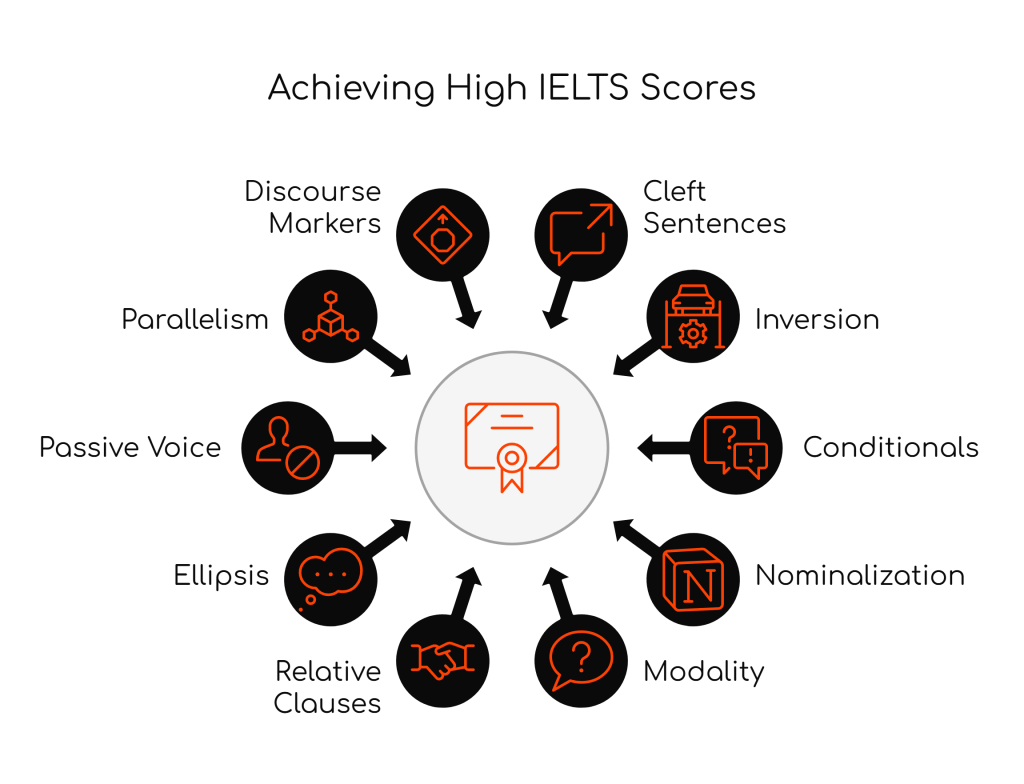
While correct grammar is essential for any IELTS taker, it’s the less common and more complex grammar structures that truly impress examiners and help you achieve Band 7.0 or higher. This post dives deep into advanced grammar features that enhance both accuracy and range — crucial descriptors in the IELTS Band Descriptors for Writing and Speaking.
What Are Less Common Grammar Skills?
These are advanced grammatical features that go beyond basic subject-verb agreement or sentence structure. They include a wide range of syntactic and stylistic devices used to communicate ideas clearly, precisely, and persuasively.
Types, Definitions, and Examples
1. Cleft Sentences
- Definition: A sentence structure that places emphasis on a specific part of the sentence.
- Example: It was the environment that the government failed to protect.
- Use: To emphasize a particular point in IELTS Writing Task 2.
2. Inversion
- Definition: Reversing the usual subject-verb order for emphasis or style.
- Example: Never have I seen such a poorly constructed argument.
- Use: High-level writing to show contrast or strong opinion.
3. Conditionals (Mixed & Inverted)
- Definition: Advanced conditional forms showing hypothetical or unlikely events.
- Example: Had I studied harder, I might have passed the exam.
- Use: Reflect on missed opportunities or alternate outcomes in Speaking.
4. Nominalization
- Definition: Turning verbs or adjectives into nouns for a more formal tone.
- Example: The government should focus on the reduction of pollution, not just control it.
- Use: Writing Task 2 essays to sound more academic.
5. Modality for Hedging
- Definition: Using modal verbs to express uncertainty or caution.
- Example: This could be due to a lack of educational resources.
- Use: IELTS Writing Task 2 to show balanced argumentation.
6. Relative Clauses (Defining & Non-defining)
- Definition: Clauses that provide additional information about a noun.
- Example: Students, who are often under pressure, may find exams overwhelming.
- Use: Enhance sentence complexity and fluency.
7. Ellipsis and Substitution
- Definition: Omitting or replacing elements to avoid repetition.
- Example: He enjoys football more than I do. (ellipsis: enjoy football)
- Use: In Speaking for natural fluency and in Writing for cohesion.
8. Passive Voice
- Definition: The subject receives the action of the verb.
- Example: The new law was introduced to reduce plastic waste.
- Use: In formal writing when the actor is unknown or unimportant.
9. Parallelism
- Definition: Keeping grammatical structures consistent in lists or series.
- Example: She enjoys reading, writing, and painting.
- Use: Writing Task 2 for stylistic clarity and cohesion.
10. Discourse Markers and Connectors
- Definition: Words and phrases that guide the reader/listener through your ideas.
- Examples: Nonetheless, in contrast, as a result, on the other hand
- Use: Writing and Speaking to improve coherence and cohesion.
Common Mistakes and Fixes
| Mistake | Why It’s Wrong | How to Fix It |
|---|---|---|
| It is reducing pollution that is important. | Awkward cleft structure | It is the reduction of pollution that is important. |
| Had I would known… | Incorrect use of inverted conditional | Had I known… |
| He is interested about science. | Wrong preposition | He is interested in science. |
| Despite of the rain… | Incorrect phrase | Despite the rain… |
| I want go university. | Missing preposition and article | I want to go to university. |
Dos and Don’ts
Dos:
- Use advanced grammar purposefully — don’t just show off.
- Vary sentence structures to demonstrate range.
- Practice both speaking and writing with complex forms.
- Review Band Descriptors and tailor grammar to match them.
Don’ts:
- Don’t overcomplicate your ideas with forced grammar.
- Don’t mix multiple structures in one sentence.
- Don’t forget punctuation — even complex grammar needs clarity.
- Don’t ignore context — use grammar naturally.
Frequently Asked Questions
Q: Should I use complex grammar in every sentence?
A: No. Mix simple, compound, and complex structures naturally. Range is important, but clarity comes first.
Q: Can advanced grammar make up for weak vocabulary?
A: Not entirely. High band scores require both grammatical range and lexical resource.
Q: Is passive voice always better?
A: Use it only when appropriate — when the actor is unknown or not important. Overusing it can make your writing impersonal.
Q: How do I practice these forms for IELTS Speaking?
A: Prepare model answers and consciously incorporate one or two advanced structures per answer.
Top Strategies for IELTS Success
- Grammar Journaling – Record advanced structures and try writing original sentences daily.
- Use Band 9 Model Essays and Speeches – Analyze the grammar used and imitate the patterns.
- Shadow Speaking Practice – Repeat after native speakers using complex grammar in context.
- Write and Rewrite – Reconstruct simple sentences using more complex grammar.
- Self-Recording – Record your speaking responses and evaluate grammar variety.
Sample IELTS Sentences Using Less Common Grammar
- What concerns many experts is the lack of infrastructure, not the funding.
- Rarely do governments act promptly during environmental crises.
- Had they implemented stricter laws earlier, pollution could have been minimized.
- There is a growing preference for online education among younger learners.
- Although it may seem ideal, this approach is not without drawbacks.
Final Thoughts
Less common grammar skills are the hallmark of advanced language use. They don’t just help you impress IELTS examiners — they help you communicate with precision and sophistication. By mastering these structures and using them strategically, you’ll stand out as a confident, capable, and high-level English user — ready for Band 7.0 and beyond.
Explore More
Full grammar guides at: IELTSGuidePhil.com
Expert tips on: IELTS Guide Phil Podcast on Spotify
Let’s connect: @IELTSGuidePhil on Facebook, X, and BlueSky
#IELTSGrammar #Band7Plus #IELTSWriting #IELTSSpeaking #LessCommonGrammar #EnglishFluency #GrammarForIELTS #IELTSGuidePhil #AcademicEnglish #IELTSPreparation #IELTS
 IELTS Guide Phil
Leave a comment