
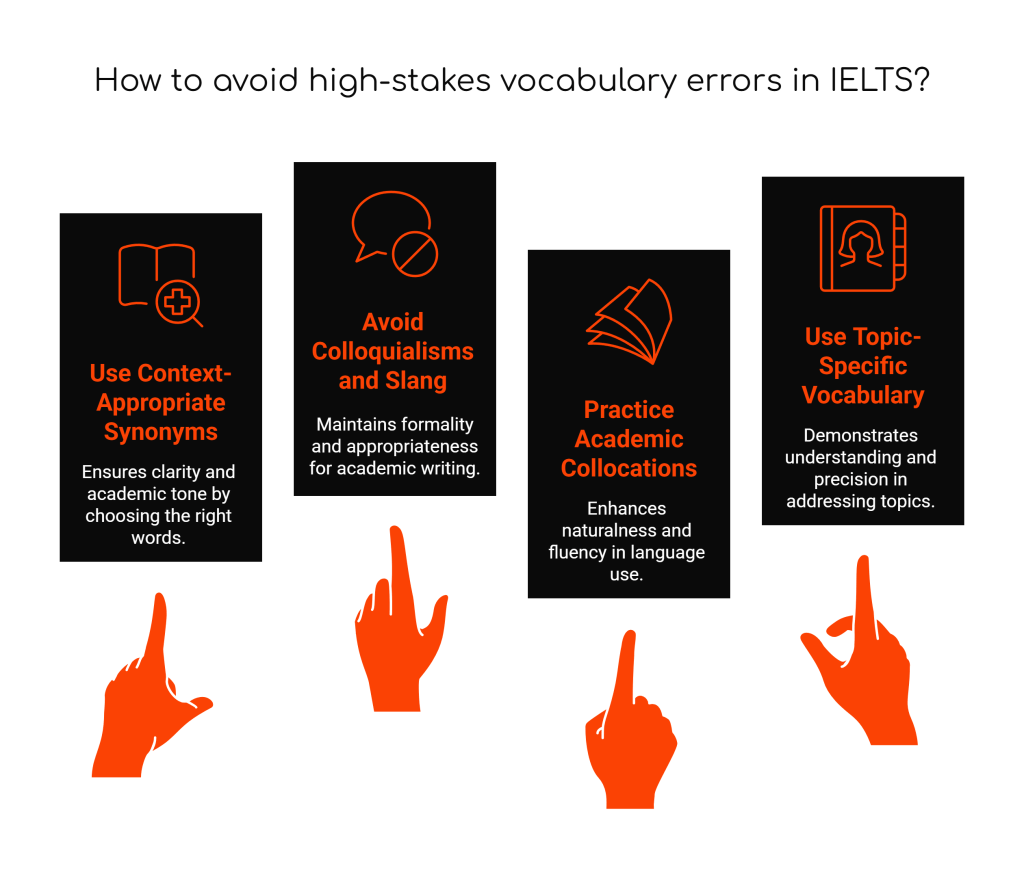
Your vocabulary is a crucial part of your IELTS performance. It doesn’t just affect your Lexical Resource score—it also impacts how natural, clear, and persuasive your writing and speaking are. However, certain vocabulary mistakes can be devastating to your score. This guide explores the most dangerous vocabulary errors, how to avoid them, and what to do instead to secure a Band 7 or above.
What Are High-Stakes Vocabulary Errors?
High-stakes vocabulary errors are major mistakes in word choice, usage, or tone that:
- Confuse your meaning,
- Make you sound unnatural or informal,
- Break the rules of academic English,
- Or show a lack of understanding of the topic.
These errors can ruin the coherence, tone, and impact of your answer—even if your grammar is perfect.
Types of Vocabulary Errors with Examples and Fixes
1. Misused Synonyms
- ❌ This problem is gigantic in our society.
- ✅ This problem is widespread in our society.
Explanation: Using “gigantic” instead of “widespread” shows a misunderstanding of academic tone. Choose context-appropriate synonyms.
2. Colloquialisms and Slang
- ❌ Lots of kids are getting into trouble these days.
- ✅ Many young people are engaging in problematic behavior.
Explanation: Slang and casual expressions lower your formality and are inappropriate for IELTS Writing Task 2.
3. Overused Words
- ❌ Very important, a lot of, thing, stuff
- ✅ Crucial, significant, factor, matter, issue
Explanation: These words are vague or repetitive. Variety and precision matter for high bands.
4. Inappropriate Register
- ❌ The guy was like really into science.
- ✅ The student was highly interested in science.
Explanation: Your vocabulary must suit an academic or semi-formal tone, especially in writing.
5. Made-Up or Incorrect Words
- ❌ Technologize, peoplize, educationality
- ✅ Use technology, increase population, educational quality
Explanation: Inventing words shows poor vocabulary knowledge and leads to confusion.
6. Repetition and Lack of Range
- ❌ Pollution is a big problem. Pollution affects the world. Pollution is caused by cars.
- ✅ Pollution is a major global issue, largely caused by vehicle emissions.
Explanation: Repetition lowers your lexical resource score. Use paraphrasing and variety.
7. Incorrect Collocations
- ❌ Make a decision on a crime
- ✅ Pass judgment on a crime
- ❌ Strong rain
- ✅ Heavy rain
Explanation: Wrong word combinations sound awkward and unnatural to native speakers.
8. Using Memorized Phrases Incorrectly
- ❌ It is universally acknowledged that pollution is bad.
- ✅ Pollution is widely considered a pressing environmental issue.
Explanation: Overused templates sound robotic and often don’t fit your specific argument.
Dos and Don’ts
DOs
- Use topic-specific vocabulary (e.g., urbanization, green energy, overpopulation).
- Learn and practice academic collocations.
- Use formal, precise language in Writing Task 2.
- Vary your vocabulary in Speaking to show lexical flexibility.
- Read and analyze Band 9 model answers.
DON’Ts
- Don’t use informal or slang words like “cool,” “guy,” “stuff.”
- Don’t repeat the same word or phrase excessively.
- Don’t translate directly from your native language.
- Don’t try to sound “fancy” with words you don’t understand well.
Frequently Asked Questions (FAQs)
Q1: Can I use idioms in IELTS?
A: Use idioms only in Speaking, and even then, only common, natural ones like “on the same page” or “a piece of cake.” Never use them in Writing Task 2.
Q2: How do I know if a word is academic?
A: Use resources like the Academic Word List (AWL) and Oxford Collocations Dictionary. Words common in essays, articles, and reports are typically academic.
Q3: Is it better to use rare words to impress the examiner?
A: No. Use accurate, appropriate vocabulary. Risky or obscure words can confuse the examiner and harm your score.
Top Strategies for Vocabulary Success
- Use a Collocation Notebook
– Note down phrases like “pose a threat,” “tackle a problem,” or “economic downturn.” - Learn by Topic
– Practice vocabulary for common IELTS themes (e.g., education, environment, crime). - Practice Contextual Use
– Don’t just memorize. Use new words in sentences, speaking, or writing. - Paraphrasing Practice
– Learn 2–3 ways to say common ideas. E.g., “important” = crucial, significant, essential. - Avoid Word Lists Without Context
– Memorizing disconnected words is less effective than learning them in context.
Sample Vocabulary Corrections
| Poor Vocabulary | Improved Version |
|---|---|
| Pollution is a big thing. | Pollution is a major concern. |
| The guy in charge is strict. | The supervisor is very strict. |
| Stuff like crime and pollution | Issues such as crime and pollution |
| There are a lot of problems. | There are numerous pressing issues. |
| The weather was bad. | The weather conditions were severe. |
Final Thoughts
In IELTS, word choice is power. It affects how credible, clear, and sophisticated you sound. Avoiding high-stakes vocabulary errors can make the difference between Band 6.5 and Band 7+. Focus on building a strong vocabulary through daily practice, topic-based learning, and precise usage. Remember: It’s not about using “big” words—it’s about using the right words in the right context.
#IELTSVocabulary #IELTSLexicalResource #IELTSWritingTips #IELTSSpeakingTips #AcademicEnglish #IELTSMistakes #Band7Plus #IELTSGuidePhil #VocabularyMatters #IELTSPreparation #IELTS
 IELTS Guide Phil
Leave a comment