
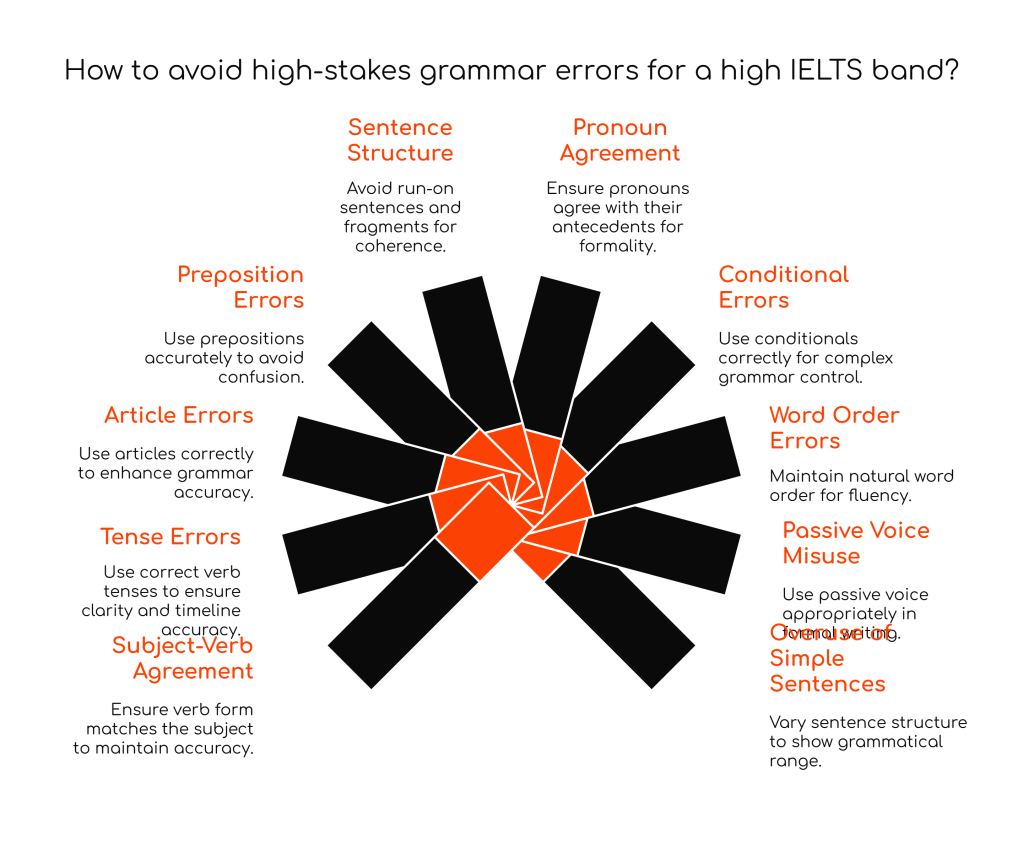
When it comes to the IELTS exam, grammar mistakes can significantly lower your score — especially if they occur repeatedly. The IELTS Band Descriptors clearly emphasize grammatical range and accuracy, which means you are expected to use a variety of structures correctly and appropriately. In this post, we’ll uncover the most critical grammar mistakes you must avoid and show you how to correct them for success in both Writing Task 1 and 2 and Speaking Parts 1–3.
What Are High-Stakes Grammar Errors?
High-stakes grammar errors are serious and frequent mistakes that interfere with clarity, reduce the formality of your writing, or make your speech sound unnatural. These include errors in verb tense, subject-verb agreement, sentence structure, articles, prepositions, and more. Eliminating these is essential for achieving Band 7 and above.
Types, Definitions, Examples, and Corrections
1. Subject-Verb Agreement Errors
- Definition: When the verb form doesn’t match the subject in number.
- ❌ She go to school every day.
- ✅ She goes to school every day.
- ✅ The number of students has increased.
Why it matters: Frequent subject-verb agreement errors lower your accuracy score and reflect weak grammatical control.
2. Tense Errors
- Definition: Incorrect use of verb tenses for time or context.
- ❌ Last year, I am taking the IELTS.
- ✅ Last year, I took the IELTS.
Why it matters: Misused tenses make it difficult for examiners to follow your timeline or argument progression.
3. Article Errors (a, an, the)
- ❌ I bought new phone.
- ✅ I bought a new phone.
- ❌ She is teacher.
- ✅ She is a teacher.
Why it matters: Article misuse is one of the most common errors that lower grammar accuracy, especially among intermediate learners.
4. Preposition Errors
- ❌ He is good in math.
- ✅ He is good at math.
- ❌ I depend in my friends.
- ✅ I depend on my friends.
Why it matters: Incorrect prepositions confuse meaning and reduce naturalness.
5. Run-On Sentences and Fragments
- ❌ He studied hard he passed the exam.
- ✅ He studied hard, so he passed the exam.
- ❌ Because he was late.
- ✅ Because he was late, he missed the meeting.
Why it matters: These damage coherence and sentence structure scores.
6. Pronoun Agreement Errors
- ❌ Everyone should do their best. (informal)
- ✅ Everyone should do his or her best. (formal IELTS writing)
Why it matters: In writing, formality matters. Ensure grammatical and logical consistency.
7. Conditionals Errors
- ❌ If I will study, I will pass.
- ✅ If I study, I will pass.
Why it matters: Conditionals are high-level structures. Errors here indicate a lack of control over complex grammar.
8. Word Order Errors
- ❌ He always is late.
- ✅ He is always late.
Why it matters: Mistakes in word order reduce naturalness and fluency in both speaking and writing.
9. Misuse of Passive Voice
- ❌ The manager was promoted the employee.
- ✅ The employee was promoted by the manager.
Why it matters: Passive voice is useful in formal writing, but must be used accurately.
10. Overuse of Simple Sentences
- ❌ I like food. I eat rice. I drink water.
- ✅ I enjoy eating rice, and I usually drink water with my meals.
Why it matters: You must show sentence variety to score above Band 6.
Dos and Don’ts
DOs
- Use a variety of tenses depending on the context.
- Learn and practice complex and compound sentence structures.
- Always check subject-verb agreement during editing.
- Use passive voice appropriately in Writing Task 1 (Academic).
- Practice paraphrasing and restructuring for grammatical flexibility.
DON’Ts
- Don’t memorize fixed templates with poor grammar.
- Don’t rely only on simple or short sentences.
- Don’t use spoken grammar in your formal writing (e.g. contractions like don’t, won’t).
- Don’t ignore punctuation — it affects sentence clarity.
Frequently Asked Questions (FAQs)
Q1: Can one or two grammar mistakes really lower my score?
A: Yes, especially if they affect clarity or occur repeatedly. Aim for minimal errors to score Band 7+ in grammar.
Q2: Is it okay to use simple grammar to avoid mistakes?
A: Only occasionally. Simplicity with accuracy is better than complexity with mistakes, but a lack of range will cap your score at Band 6.
Q3: What grammar is most important in Speaking?
A: Focus on tense accuracy, subject-verb agreement, and natural sentence structure. Fluency and clarity matter more than perfection.
Top Strategies for IELTS Grammar Success
- Daily Error Log
– Write down and review your common grammar errors to avoid repeating them. - Practice Paraphrasing with Different Structures
– Learn how to say the same thing in 2–3 different grammatical ways. - Master High-Value Grammar Patterns
– Conditionals, passive voice, modals, and noun clauses. - Use Grammar Correction Tools Wisely
– Grammarly, ChatGPT, and others can help you analyze writing patterns but always review them manually too. - Record and Transcribe Your Speaking
– Identify and fix recurring grammar errors in real-time speech. - Read Sample Band 9 Essays
– Notice how grammar is used flexibly and accurately.
Sample Fixes: Before and After
| Incorrect Sentence | Corrected Sentence |
|---|---|
| He go to work yesterday. | He went to work yesterday. |
| She enjoy to cook. | She enjoys cooking. |
| There is many advantages. | There are many advantages. |
| If I will be rich, I buy a car. | If I become rich, I will buy a car. |
| Because I was sick. | I missed class because I was sick. |
Final Thoughts
Grammar is not just about rules — it’s about clear and confident communication. The IELTS exam rewards accuracy, range, and control. By becoming aware of these high-stakes errors and learning how to fix them, you’ll not only avoid penalties but also boost your overall score significantly.
Even small corrections can push your Band 6.5 to a Band 7 or above when combined with good vocabulary and coherence.
#IELTSGrammar #GrammarForIELTS #Band7Plus #IELTSWriting #IELTSSpeaking #GrammarMistakes #IELTSPreparation #IELTSGuidePhil #AcademicEnglish #GrammarTips #IELTS
 IELTS Guide Phil
Leave a comment