
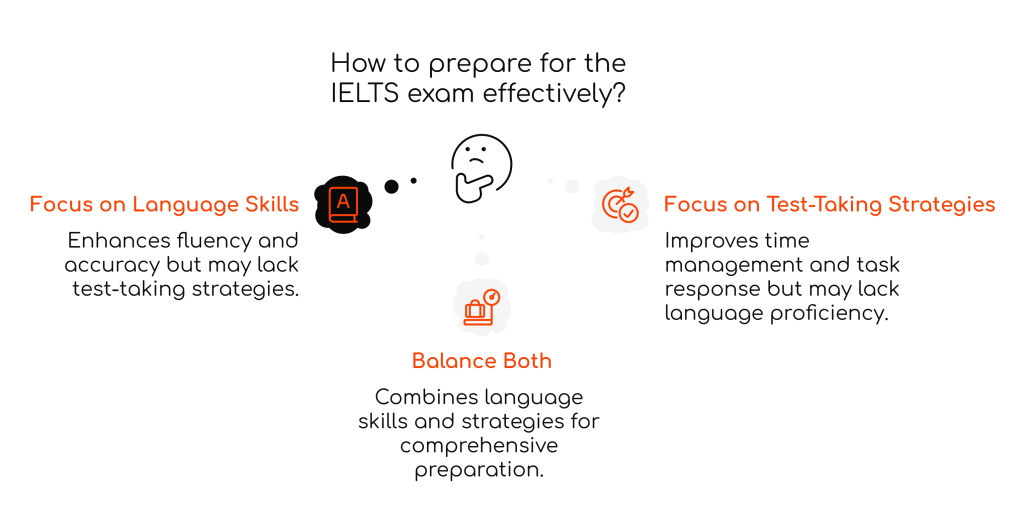
Preparing for the IELTS exam can feel overwhelming, especially if you’re juggling school, work, or personal challenges. Many test-takers focus too much on either test strategies or improving their English—when in fact, true success lies in balancing both. At IELTS Guide Phil, we believe in a holistic and strategic approach to IELTS preparation that develops your core English skills and equips you with smart exam techniques for each section of the test.
This guide walks you through everything you need to know to achieve Band 7.0 or higher by mastering both areas.
What Does a “Balanced IELTS Approach” Mean?
A balanced approach means preparing equally for:
- Language proficiency (grammar, vocabulary, pronunciation, coherence, fluency)
- Test-taking strategies (time management, task analysis, scoring criteria, question types)
Both are essential. You may be fluent in English but score poorly if you mismanage time. Conversely, test-taking skills are useless without strong language foundations.
Why You Need Both for IELTS Success
| Focus Area | Without the Other | Consequence |
|---|---|---|
| Strong English only | Weak test awareness | Low scores despite fluency |
| Strategy only | Poor grammar/vocab/coherence | Robotic, unnatural, or flawed English |
| Both combined | Real preparation | High band scores in all sections |
Key Language Skills to Develop
1. Grammar Mastery
- Definition: The rules that govern how sentences are structured.
- Examples: Tenses, sentence types, conditionals, articles, prepositions
- IELTS Use: Writing Task 2, Speaking coherence and accuracy
2. Vocabulary Range
- Definition: The ability to use a wide variety of precise and academic words.
- Examples: “implement” instead of “do”, “significant” instead of “big”
- IELTS Use: Writing Task 1 reports, Speaking Part 3, Reading
3. Pronunciation and Intonation
- Definition: Clear articulation, correct stress, and rhythm.
- IELTS Use: Speaking assessment criterion
4. Listening and Reading Comprehension
- Definition: Understanding spoken and written English
- IELTS Use: Listening and Reading sections (skimming, scanning, inference)
Key Test-Taking Skills to Develop
1. Time Management
- Writing: 20 mins for Task 1, 40 mins for Task 2
- Reading: ~20 mins per passage
- Speaking: Be concise and relevant
- Tip: Use a timer during practice.
2. Familiarity with Question Types
- Reading: True/False/Not Given, Matching Headings, etc.
- Listening: Form completion, multiple choice, maps
- Writing: Line graphs, discussion essays, etc.
- Tip: Learn the format and patterns.
3. Task Response and Structure
- Writing Task 2: Introduction, Body, Conclusion
- Speaking Part 2: Beginning, details, reflection
- Tip: Practice with structure templates (but don’t memorize blindly).
4. Knowing Scoring Criteria
- Writing: Task Achievement, Coherence, Lexical Resource, Grammar
- Speaking: Fluency, Vocabulary, Grammar, Pronunciation
- Tip: Use the public band descriptors to self-assess.
Common Mistakes When Preparation Is Unbalanced
| Mistake | Explanation |
|---|---|
| Memorizing full essays | Examiners can spot this—leads to low coherence scores. |
| Ignoring grammar issues | Even with good ideas, grammar affects clarity and score. |
| Doing only mock tests | Without language improvement, scores stagnate. |
| Practicing only one skill (e.g., Listening) | All sections are weighted equally—balance is key. |
Do’s and Don’ts
Do:
- Study English and IELTS test strategies regularly
- Review real sample answers and analyze them
- Get feedback from experienced teachers or partners
- Focus on accuracy first, then fluency
Don’t:
- Rely solely on TikTok or shortcut hacks
- Skip Reading or Writing because they’re “hard”
- Avoid Speaking practice due to fear or shyness
- Ignore grammar thinking it’s “basic”—it’s not
Frequently Asked Questions (FAQs)
Q1: How much time should I spend on grammar vs. practice tests?
A: Ideally, split your time 50/50. For example, 1 hour on grammar and vocabulary, 1 hour on task practice.
Q2: Can I pass IELTS just by watching YouTube videos?
A: Videos help with strategies but must be paired with real writing, speaking, and feedback sessions.
Q3: I’m already fluent—why do I still get Band 6?
A: Fluency doesn’t guarantee band scores. You may need to focus on coherence, structure, or exam format.
Q4: Should I study general English first before starting IELTS?
A: No need to separate them. You can improve both at the same time with IELTS-focused English study.
Top Strategies from IELTS Guide Phil
1. Weekly Rotations
Rotate your study focus:
Day 1–2: Grammar + Writing
Day 3–4: Listening + Speaking
Day 5: Vocabulary + Reading
Day 6: Full mock test
Day 7: Review + rest
2. Use IELTS Models, But Don’t Copy
Analyze sample answers to understand structure and vocabulary. Then create your own.
3. Record and Reflect
Record yourself speaking. Listen for fillers, grammar slips, and pronunciation issues.
4. Target Weaknesses
If Reading is your weakest skill, spend extra time understanding question logic and skimming techniques.
5. Engage in Real English
Watch TED Talks, read The Guardian, join English discussions online. Input improves output.
Final Thoughts
You don’t need to be a native speaker to succeed in IELTS—you need a balanced mindset. Mastering both the language and the test format gives you the confidence and competence to score high in all four sections.
At IELTS Guide Phil, we empower learners with resources that target both skills—whether it’s a grammar guide, a sample Speaking Part 2, or a strategy checklist. Remember, the key is balance: not just learning English, but learning how to show your English on test day.
#IELTSGuidePhil #IELTSBalancedPrep #IELTSGrammar #IELTSTips #Band7Plus #IELTSStrategy #IELTSWriting #IELTSSpeaking #IELTSReading #IELTSListening #EnglishForIELTS #IELTSMindset #IELTS
 IELTS Guide Phil
Leave a comment