
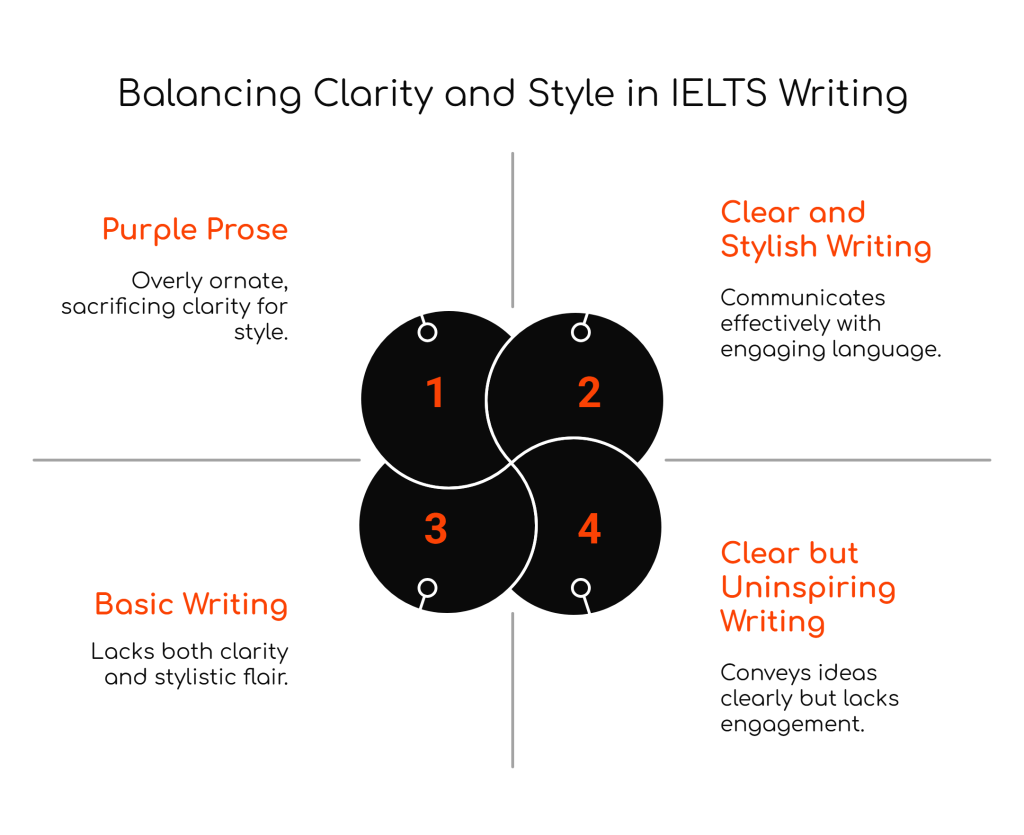
When preparing for the IELTS exam, especially the Writing section, many candidates try to impress examiners by using fancy words and overly complicated structures. However, style without clarity is dangerous—and often leads to lower scores.
In this guide, we explore purple prose and other writing errors that commonly hold IELTS candidates back. You’ll find definitions, examples, types, common mistakes, do’s and don’ts, FAQs, and top strategies for IELTS success.
What Is Purple Prose?
Purple prose refers to writing that is excessively ornate, flowery, or verbose, often sacrificing clarity for style. While it may sound “impressive,” it usually confuses the reader and fails to communicate ideas clearly and directly—a core requirement for high IELTS scores.
Definition:
Writing that uses too many adjectives, metaphors, or fancy words, creating unnecessary complexity and distracting from the main message.
Example of Purple Prose:
“In a realm where the golden tendrils of opportunity intertwine with the thorny vines of adversity, one must courageously venture forth into the labyrinthine tapestry of tertiary education.”
Clear Version:
“Pursuing higher education can be both rewarding and challenging.”
Why Purple Prose Hurts Your IELTS Score
The IELTS Writing Band Descriptors clearly prioritize:
- Clarity and coherence
- Task response
- Lexical resource (accurate and appropriate vocabulary)
- Grammatical range and accuracy
Purple prose often leads to:
- Overuse of uncommon or unnecessary vocabulary
- Long-winded sentences with little meaning
- Reduced coherence and cohesion
- Frequent grammatical mistakes
Other Writing Errors to Avoid
1. Overgeneralization
Saying things like “All people agree…” or “Everyone knows…” without evidence.
Better: “Many people believe…” or “It is often argued that…”
2. Clichés
Overused expressions make writing sound unoriginal.
Avoid: “Every coin has two sides.”
Use: “There are both advantages and disadvantages to…”
3. Redundancy and Wordiness
Repeating ideas unnecessarily.
Avoid: “In conclusion, to sum up, the final decision ultimately lies at the end.”
Use: “In conclusion, the final decision lies with the authorities.”
4. Ambiguous Vocabulary
Using words that don’t clearly fit the context.
Avoid: “The plan was a colossal situation.”
Use: “The plan led to a major issue.”
5. Misusing Advanced Vocabulary
Using rare or high-level words incorrectly.
Avoid: “He exacerbated his salary.”
Use: “He negotiated a higher salary.”
6. Lack of Structure
Disorganized paragraphs without topic sentences or logical progression.
Each paragraph should:
- Begin with a topic sentence
- Be focused on one main idea
- Include examples or explanations
Do’s and Don’ts
DO:
- Use academic vocabulary where appropriate.
- Prioritize clarity, coherence, and cohesion.
- Stick to one main idea per paragraph.
- Proofread your essay for repetition or awkward phrasing.
DON’T:
- Use complicated words just to impress.
- Overload your essay with adjectives or metaphors.
- Use vague or sweeping generalizations.
- Mix informal phrases with academic tone.
FAQs
Is using complex vocabulary bad for IELTS?
No—but only if used correctly and naturally. Forced or inaccurate use of “big words” lowers your score.
What’s the ideal sentence length?
Variety is key. Use a mix of short, medium, and long sentences. Avoid overly long sentences filled with commas and connectors.
Can I use metaphors or analogies in IELTS?
Use them sparingly and only if they clearly support your argument. Avoid figurative language that feels out of place in academic writing.
Top Strategies for IELTS Success
- Practice clarity over complexity. If a simpler word conveys your meaning, use it.
- Self-edit ruthlessly. Remove any redundant or confusing phrases.
- Use academic tone consistently. Avoid mixing casual or poetic language with formal writing.
- Study model essays. Learn how high-band essays use a precise and clear style.
- Avoid thesaurus traps. Make sure you understand any synonym you substitute.
Sample Sentences: Purple vs. Clear
| Purple Prose | Clear Alternative |
|---|---|
| The inexorable march of technological marvels renders human endeavor obsolete. | Technology is rapidly replacing many human jobs. |
| The omnipresent pollution contaminates our pristine azure skies. | Air pollution is becoming a serious global issue. |
| One cannot help but contemplate the cascading consequences of inadequate governance. | Poor governance can lead to serious consequences. |
Final Thoughts
Remember: clear writing is powerful writing. The IELTS exam is not a test of how many fancy words you know—it’s a test of how well you can express your ideas logically, coherently, and persuasively in English.
Avoid the temptation to overdecorate your writing. Instead, focus on substance, structure, and simplicity. These are the keys to a Band 7.0+.
Learn More from IELTS Guide Phil
IELTS Guide Phil Podcast – Listen on Spotify
In-depth grammar, vocabulary, and writing guides – Visit IELTSguidephil.com
Follow and connect:
- Facebook: IELTS Guide Phil
- X (Twitter): @ieltsguidephil
- BlueSky: @ieltsguidephil
#IELTSWriting #IELTSGrammar #IELTSMistakesToAvoid #PurpleProse #AcademicWriting #Band7Tips #IELTSPreparation #IELTSGuidePhil #IELTSVocabulary #ClearWriting #IELTS
 IELTS Guide Phil
Leave a comment