
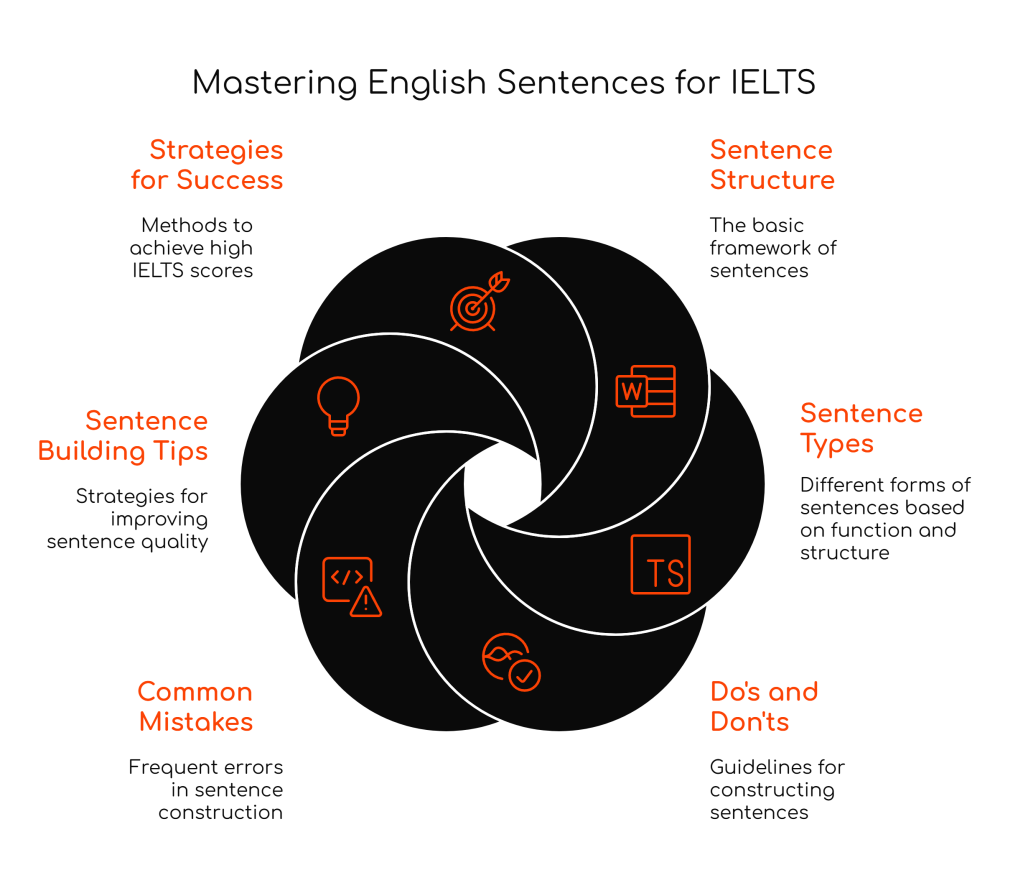
A well-constructed sentence is the foundation of effective communication, especially in the IELTS exam. Whether you’re trying to describe data in Writing Task 1, make an argument in Writing Task 2, or express your ideas clearly in Speaking Part 3, mastering sentence structure is essential for coherence, cohesion, and grammatical range—all of which are key criteria for a Band 7.0 or higher.
What Is a Sentence?
A sentence is a group of words that expresses a complete thought. It must contain a subject and a predicate and begin with a capital letter and end with appropriate punctuation.
Example: Students study hard for the IELTS exam.
Types of English Sentences (by Function)
1. Declarative Sentences
State facts or opinions.
I am preparing for the IELTS exam.
2. Interrogative Sentences
Ask questions.
Are you taking the IELTS next month?
3. Imperative Sentences
Give commands or instructions.
Read the instructions carefully.
4. Exclamatory Sentences
Express strong emotion.
What a challenging exam that was!
Types of Sentences (by Structure)
1. Simple Sentences
Contain one independent clause.
He studies every night.
2. Compound Sentences
Contain two independent clauses joined by a coordinating conjunction (FANBOYS: for, and, nor, but, or, yet, so).
He studies hard, and he attends every review session.
3. Complex Sentences
Contain one independent clause and at least one dependent clause.
Although he was tired, he completed his essay.
4. Compound-Complex Sentences
Contain at least two independent clauses and one or more dependent clauses.
Although it was late, she revised her essay, and she submitted it on time.
Do’s and Don’ts of IELTS Sentences
Do:
- Use a variety of sentence types to show grammatical range.
- Start with simple sentence structure before experimenting with complex ones.
- Ensure each sentence expresses a complete idea.
- Use linking devices and transitions for coherence.
Don’t:
- Write run-on sentences or comma splices.
Wrong: He studies hard, he wants a high score.
Right: He studies hard because he wants a high score. - Use fragments (incomplete sentences).
Wrong: Because of the exam.
Right: He was nervous because of the exam. - Overuse long or overly complex sentences that confuse the reader.
Common Sentence Errors and How to Fix Them
Understanding sentence errors is essential for boosting your Grammatical Range and Accuracy score in IELTS Writing and Speaking. Below is an expanded guide to common sentence-level issues, including run-ons, fragments, verb tense issues, and more.
| Error Type | Description | Why It’s Wrong | Correct Version | IELTS-Style Example |
|---|---|---|---|---|
| Sentence Fragment | Incomplete sentence missing a subject or verb or complete idea. | It lacks a full independent clause. | Add a subject and/or verb to complete the thought. | Because of the rising prices, many students find studying abroad difficult. |
| Run-on Sentence | Two or more independent clauses joined without proper punctuation. | Lacks proper conjunctions or punctuation. | Use a coordinating conjunction, semicolon, or separate into two sentences. | Many students study abroad, and they gain international experience. |
| Comma Splice | Two independent clauses joined only by a comma. | A comma alone is not strong enough. | Use a semicolon, conjunction, or period. | Many students take IELTS; they want to study overseas. |
| Subject-Verb Agreement Error | Subject and verb do not match in number (singular/plural). | Verb does not agree with the subject. | Match the verb form to the subject. | The number of candidates has increased dramatically. |
| Verb Tense Shift | Unnecessary shift from one tense to another. | Breaks time logic or confuses the timeline. | Keep consistent tense unless the timeline changes logically. | Last year, I enrolled in an IELTS course and improved my writing skills. |
| Misplaced Modifier | A descriptive word or phrase is placed too far from the word it modifies. | Causes confusion or ambiguity. | Place the modifier next to the word it describes. | To succeed in IELTS, students must practice regularly. |
| Dangling Modifier | The modifier lacks a clear subject in the sentence. | The subject being modified is missing or unclear. | Rewrite the sentence to include a clear subject. | After preparing for months, she finally took the IELTS exam. |
| Double Negatives | Using two negative words unnecessarily. | Creates confusion and contradicts meaning. | Use only one negative. | I didn’t say anything during the interview. |
| Wrong Verb Form | Using the incorrect base, past, or participle form. | Shows a lack of control over verb patterns. | Use correct tense and form. | He has written several essays to prepare. |
| Overuse of Passive Voice | Excessive use of passive can make writing unclear or wordy. | May obscure the subject or weaken clarity. | Use active voice where appropriate. | The teacher gave feedback on my essay. |
Quick Fix Tips
- Always check for a complete subject + verb + idea in every sentence.
- Use punctuation to separate ideas logically.
- Keep verbs consistent, especially in narrative and cause-effect structures.
- Use modifiers close to the words they describe.
- Vary sentence length to keep writing dynamic and readable.
IELTS-Specific Fix Example:
Poor Version (fragment, verb error, run-on):
Because the IELTS exam. I study every day I want to get a scholarship.
Improved Version:
Because the IELTS exam is competitive, I study every day. I want to get a scholarship.
Sentence Building Tips for IELTS Writing
Task 1 (Graphs, Charts, Maps):
- Use passive voice and complex sentences.
The number of users was increased significantly from 2010 to 2020.
Task 2 (Essays):
- Begin with a clear topic sentence.
One major advantage of studying abroad is exposure to new cultures. - Support ideas with complex and compound structures.
While some believe online education is effective, others argue that it lacks personal interaction.
Sentence Use in IELTS Speaking
Speaking Part 1:
- Use mostly simple and compound sentences.
I live in the city, and I enjoy its convenience.
Speaking Part 2:
- Use complex and narrative sentences to describe experiences.
When I visited Japan last year, I was amazed by its culture and technology.
Speaking Part 3:
- Use conditional, passive, and opinion-based structures.
If more people used public transport, the environment would benefit greatly.
Top Strategies for IELTS Success
- Vary sentence types in both Writing and Speaking to meet the “Grammatical Range and Accuracy” criterion.
- Practice combining short sentences into compound and complex ones.
- Edit your writing for sentence clarity and completeness.
- Read model IELTS essays and underline sentence patterns.
- Record yourself speaking and evaluate fluency and sentence accuracy.
Frequently Asked Questions (FAQs)
Q: How many sentence types should I use in IELTS Writing?
A: Use a mix—simple, compound, complex, and compound-complex. A variety shows grammatical range and can boost your score.
Q: Are longer sentences better for IELTS?
A: Not necessarily. Longer is not always better—clarity and accuracy are more important. One well-written complex sentence is better than a confusing one.
Q: Can I use incomplete sentences in Speaking?
A: Yes, occasionally, for natural conversation.
Not really.
But for Writing, avoid sentence fragments completely.
Practice Task
Convert the simple sentences below into complex or compound sentences:
- I prepared for the IELTS.
- She was tired. She continued studying.
Final Thoughts
Mastering sentence structure is not just a grammar task—it’s a communication skill that makes your ideas clearer, more persuasive, and easier to follow. The examiner is not looking for perfection, but for control, range, and clarity.
Don’t be afraid to experiment with structure, as long as you maintain accuracy. A sentence can make or break your IELTS score—make yours count.
Learn More from IELTS Guide Phil
Podcast: IELTS Guide Phil on Spotify
Blog: IELTSGuidePhil.com
Socials: Facebook | YouTube | X (Twitter) → @ieltsguidephil
#IELTSSentences #GrammarForIELTS #IELTSWritingTips #IELTSSpeakingSkills #SentenceStructure #IELTSBand7 #IELTSPreparation #IELTSGuidePhil #EnglishGrammar #AcademicWriting #IELTS
 IELTS Guide Phil
Leave a comment