
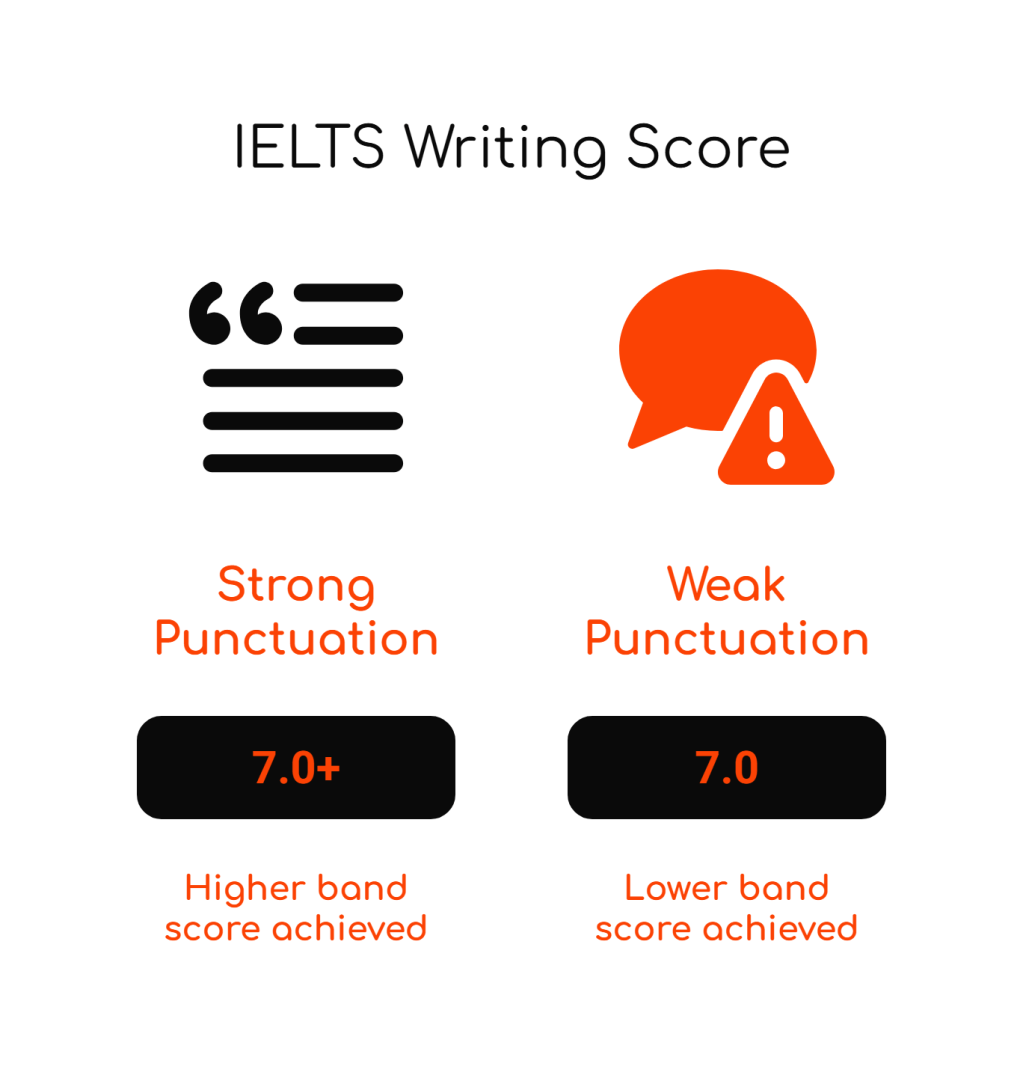
Clear punctuation is the backbone of effective academic writing. For IELTS candidates, especially those aiming for Band 7.0 and above, mastering punctuation can be the difference between a mediocre and a high-scoring essay. Punctuation helps organize your ideas, clarify your arguments, and avoid misunderstandings.
In this guide, you’ll learn the types of punctuation marks, their definitions, examples, common mistakes, do’s and don’ts, frequently asked questions, and top strategies for IELTS success.
What Is Punctuation?
Punctuation refers to the symbols used in writing to separate sentences and clarify meaning. These include marks like periods, commas, question marks, and more.
Why Punctuation Matters in IELTS
The IELTS Writing Band Descriptors assess:
- Grammatical range and accuracy
- Coherence and cohesion
- Task achievement
Poor punctuation disrupts all three. Misplaced or missing punctuation can confuse your meaning, fragment your ideas, or cause run-on sentences.
Types of Punctuation Marks with Definitions & Examples
1. Period (.)
Use: Ends declarative sentences.
Example: “The data was collected over a ten-year period.”
2. Comma (,)
Use: Separates items in a list, clauses, and introductory elements.
Example: “In conclusion, governments must address climate change.”
Common Mistake: Misusing commas in compound sentences.
Wrong: “The students studied hard, they passed the exam.”
Correct: “The students studied hard, so they passed the exam.”
3. Semicolon (;)
Use: Connects related independent clauses.
Example: “The economy is improving; however, inflation remains high.”
Common Mistake: Using it like a comma.
4. Colon (:)
Use: Introduces a list, example, or explanation.
Example: “There are three main causes: poverty, corruption, and inequality.”
5. Question Mark (?)
Use: Ends direct questions.
Example: “What are the long-term effects of globalization?”
6. Exclamation Mark (!)
Use: Expresses strong emotion. Rarely used in IELTS.
Avoid in academic writing unless quoting dialogue or for emphasis in informal letters (GT Task 1).
7. Quotation Marks (” “)
Use: Indicate direct speech or quotations.
Example: The article stated, “Climate change is a global emergency.”
8. Apostrophe (’)
Use: Shows possession or contractions.
Example (possession): “The government’s policy was effective.”
Example (contraction): “It’s essential to act now.” (Avoid contractions in formal writing.)
Common Mistake: Confusing “its” and “it’s”.
9. Dash (—)
Use: Adds emphasis, contrast, or explanation.
Example: “Education—when properly funded—can transform lives.”
Use sparingly in academic writing.
10. Parentheses ( )
Use: Adds additional or explanatory information.
Example: “The data (collected in 2023) reveals a clear trend.”
11. Ellipsis (…)
Use: Indicates omission or unfinished thought.
Avoid in IELTS academic writing.
Common Punctuation Mistakes in IELTS
| Mistake | Example | Correction |
|---|---|---|
| Run-on sentence | “The exam was hard many students failed.” | “The exam was hard. Many students failed.” |
| Comma splice | “Air pollution is rising, people are worried.” | “Air pollution is rising, and people are worried.” |
| Apostrophe misuse | “Its a major issue.” | “It’s a major issue.” |
| Unnecessary exclamation | “We must act now!” | “We must act now.” (More formal tone) |
| No punctuation | “If governments act now climate change can be stopped” | “If governments act now, climate change can be stopped.” |
Do’s and Don’ts
Do:
- Use punctuation to improve sentence clarity.
- Use commas to separate ideas and introductory phrases.
- Proofread for run-on or fragmented sentences.
- Understand the function of each punctuation mark.
Don’t:
- Overuse exclamation marks or ellipses.
- Use informal punctuation in formal writing tasks.
- Forget commas in compound and complex sentences.
- Mix up apostrophes (its vs. it’s; students vs. student’s).
FAQs
How important is punctuation in IELTS?
Very. Punctuation affects coherence, grammar, and meaning—especially for Writing Tasks.
Will I lose marks for small punctuation errors?
Occasional minor mistakes may not affect your score, but frequent errors will lower your Grammatical Range and Accuracy band.
Can I use contractions like “don’t” or “can’t”?
Avoid contractions in academic essays (Writing Task 2) but they are acceptable in informal letters (GT Task 1) or informal Speaking responses.
Top Strategies for IELTS Success
- Read sample essays aloud. Notice how punctuation contributes to flow and clarity.
- Practice editing. Rewrite your work to eliminate errors in punctuation.
- Use sentence variation. Mix simple, compound, and complex sentences—punctuated correctly.
- Use grammar check tools. Use tools like Grammarly to understand recurring punctuation issues (but don’t become dependent).
- Focus on clarity. If punctuation improves your reader’s understanding, use it. If it confuses, simplify.
Sample Sentence Transformations
| Weak Punctuation | Improved Version |
|---|---|
| The results were surprising, the government responded immediately. | The results were surprising. The government responded immediately. |
| Many students dislike exams they feel stressed. | Many students dislike exams because they feel stressed. |
| The solutions are: education awareness strict laws. | The solutions are: education, awareness, and strict laws. |
Final Thoughts
Strong punctuation is a silent score-booster in IELTS Writing. It clarifies your message, showcases your grammatical control, and helps you structure your arguments effectively. Even the best vocabulary can’t compensate for poorly punctuated sentences.
When in doubt, simplify your structure, aim for clarity, and proofread your work carefully. With focused practice, punctuation can become one of your strengths on test day.
Learn More with IELTS Guide Phil
Podcast: IELTS Guide Phil on Spotify
Blog: Visit IELTSGuidePhil.com
Follow on Socials:
- Facebook: IELTS Guide Phil
- X (Twitter): @ieltsguidephil
- BlueSky: @ieltsguidephil
#IELTSPunctuation #IELTSWriting #IELTSGrammar #Band7Tips #IELTS #IELTSPreparation #AcademicEnglish #EnglishPunctuation #GrammarMatters #IELTSGuidePhil
 IELTS Guide Phil
Leave a comment