
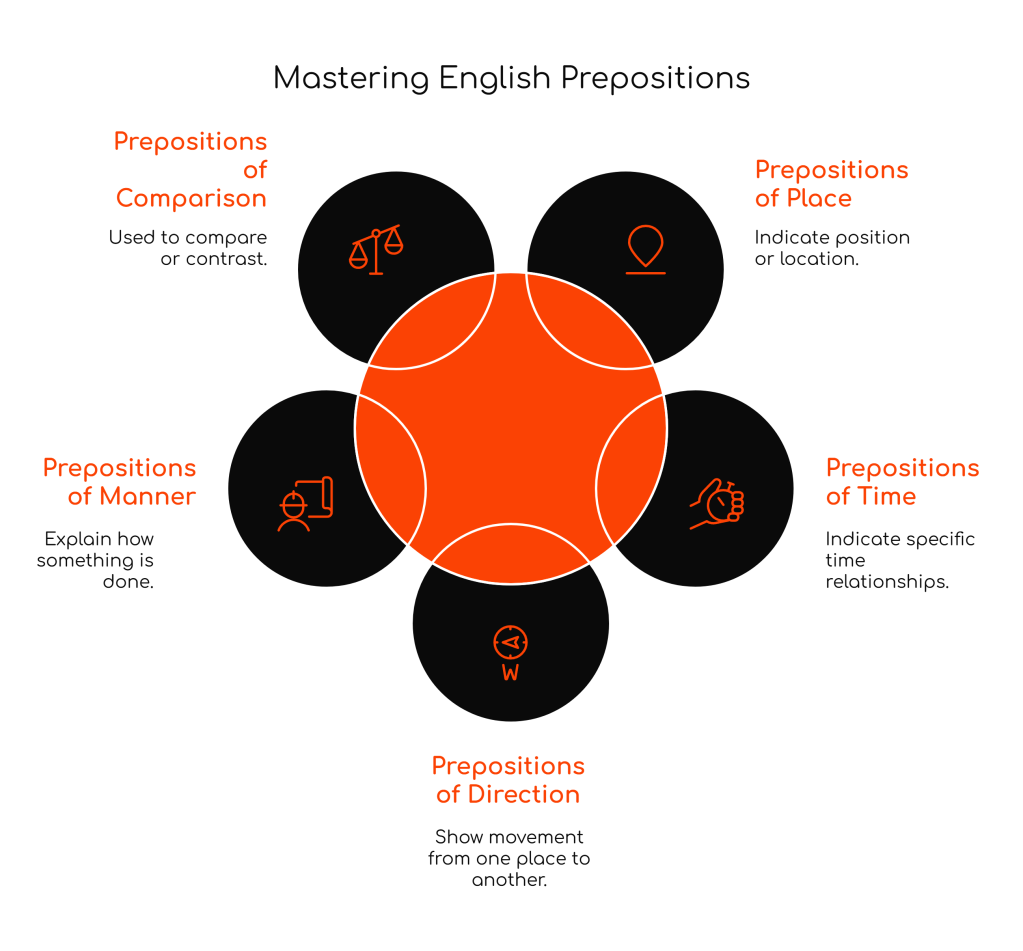
Prepositions may seem like small words, but they carry immense weight in IELTS Writing and Speaking. A preposition shows the relationship between a noun or pronoun and other elements in a sentence—and using them correctly is crucial for accuracy, fluency, and coherence.
Whether you struggle with in/on/at or get confused between by and with, this guide will help you understand, apply, and master prepositions for Band 7.0 and higher. You can watch this YouTube video explainer by IELTS Guide Phil.
What Are Prepositions?
A preposition is a word that links nouns, pronouns, or phrases to other words in a sentence. It often indicates direction, time, place, manner, cause, or possession.
Examples: in, on, at, by, with, under, before, after, about, to, from
Types of Prepositions with Definitions and Examples
1. Prepositions of Place
Indicate position or location.
| Preposition | Example |
|---|---|
| in | The book is in the bag. |
| on | The cup is on the table. |
| at | She is at the door. |
| under | The keys are under the sofa. |
| between | The shop is between the bank and the post office. |
2. Prepositions of Time
Indicate specific time relationships.
| Preposition | Example |
|---|---|
| at | The class starts at 8 a.m. |
| on | I was born on Monday. |
| in | He graduated in 2020. |
| before | Submit the form before Friday. |
| after | We’ll meet after lunch. |
3. Prepositions of Direction/Movement
Show direction or movement from one place to another.
| Preposition | Example |
|---|---|
| to | She went to the market. |
| into | He walked into the room. |
| onto | The cat jumped onto the bed. |
| from | He came from the library. |
| out of | She ran out of the building. |
4. Prepositions of Manner, Cause, Instrumentality
Explain how something is done or why.
| Preposition | Example |
|---|---|
| with | He cut the paper with scissors. |
| by | The book was written by Orwell. |
| because of | The event was cancelled because of the rain. |
| due to | The flight was delayed due to fog. |
5. Prepositions of Comparison or Concession
| Preposition | Example |
|---|---|
| like | He sings like a professional. |
| unlike | Unlike his brother, he is quiet. |
| as | She works as a consultant. |
Common Mistakes IELTS Candidates Make with Prepositions
| Mistake | Explanation | Correct Form |
|---|---|---|
| He arrived to the airport. | “Arrive” takes at or in, not “to” | He arrived at the airport. |
| I graduated on 2015. | “On” is for specific days, not years | I graduated in 2015. |
| She is married with a lawyer. | “Married” is followed by to | She is married to a lawyer. |
| I’m good in math. | The correct preposition is at | I’m good at math. |
Do’s and Don’ts
Do:
- Learn collocations (e.g., “interested in,” “good at”).
- Practice with gap-fill exercises to reinforce correct usage.
- Review your writing and speaking for unnecessary or missing prepositions.
- Read academic texts to observe natural use of prepositions.
Don’t:
- Translate prepositions literally from your native language.
- Overuse general prepositions like in or on.
- Forget that some verbs require specific prepositions (e.g., depend on, refer to).
IELTS-Specific Strategies
Writing Task 1 & 2:
Use prepositions to describe data and support arguments.
“The percentage increased from 10% to 25% between 2010 and 2020.”
“This solution is beneficial to society in the long term.”
Speaking:
Use them fluently to describe experiences, places, and reasons.
“I stayed at a friend’s house in London.”
“I’m passionate about environmental issues.”
Frequently Asked Questions (FAQs)
Q: Can I end a sentence with a preposition?
A: In Speaking, yes—it’s natural and common.
That’s the person I was talking about.
In formal Writing, try to avoid it unless rephrasing sounds awkward.
Q: Are prepositions different in British and American English?
A: Occasionally.
UK: at the weekend
US: on the weekend
Q: How many prepositions should I learn?
A: Focus on the most commonly used 50–70, especially those in prepositional phrases like “due to,” “in spite of,” “according to,” etc.
Sample IELTS Sentence Transformations
Basic:
“The car is the parking lot.”
With preposition:
“The car is in the parking lot.”
Academic version (Task 2):
“The availability of public transport reduces reliance on private vehicles.”
Practice Activity
- Complete the sentences:
- The chart shows an increase ___ 10% ___ 25%.
- I’m very interested ___ photography.
- He apologized ___ being late.
- Use these prepositions in IELTS-style responses:
- at, on, in, by, to, with, about, from, into, over
Top Strategies for IELTS Success
- Read and listen actively: Pay attention to prepositions in BBC articles, academic papers, and podcasts.
- Memorize prepositional phrases: e.g., “in addition to,” “as a result of,” “by contrast”.
- Practice speaking aloud: Describe a process, place, or trend using as many accurate prepositions as possible.
- Edit your essays carefully: Incorrect prepositions often lower scores in Grammatical Range and Accuracy.
Final Thoughts
Prepositions may be short, but they pack a grammatical punch. Mastering them will greatly enhance the accuracy and coherence of your IELTS writing and speaking, helping you stand out to the examiner.
Don’t ignore them—embrace them!
Learn More from IELTS Guide Phil
Podcast: IELTS Guide Phil on Spotify
Blog: IELTSGuidePhil.com
Socials: Facebook | X (Twitter) | YouTube → @ieltsguidephil
#IELTSGrammar #EnglishPrepositions #IELTSWriting #IELTSSpeaking #IELTSBand7 #GrammarForIELTS #IELTSVocabulary #IELTSGuidePhil #AcademicGrammar #IELTSPrep #IELTS
 IELTS Guide Phil
Leave a comment