
Conjunctions are essential tools in both IELTS Writing and Speaking. They connect your ideas, help you express relationships between thoughts, and improve the cohesion and coherence of your answers—key criteria for scoring Band 7.0 and above.
This blog post will walk you through everything you need to know about conjunctions: their types, uses, examples, and common errors, plus tips and strategies for mastering them in IELTS.
What Are Conjunctions?
A conjunction is a word that connects words, phrases, clauses, or sentences to show logical relationships such as addition, contrast, cause, or condition.
Examples: and, but, although, because, if, while
Using conjunctions appropriately can elevate the fluency and organization of your ideas, making your writing and speaking responses more academically sound.
Types of Conjunctions
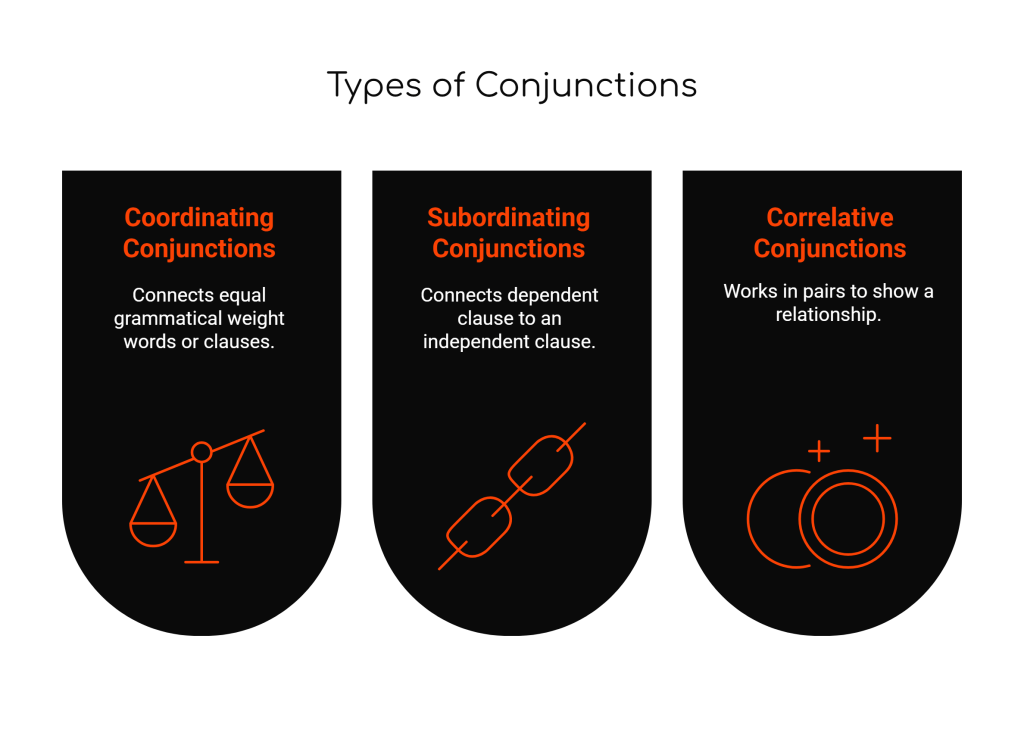
1. Coordinating Conjunctions
They connect words or clauses of equal grammatical weight.
Mnemonic: FANBOYS
- For – shows reason (I stayed, for it was raining.)
- And – adds information (She reads and writes well.)
- Nor – presents an alternative negative (He didn’t call, nor did he text.)
- But – shows contrast (I wanted to go, but I was sick.)
- Or – shows options (Would you prefer tea or coffee?)
- Yet – shows contrast (It was cold, yet she went swimming.)
- So – shows result (I was tired, so I slept early.)
IELTS Tip: Use coordinating conjunctions to combine simple sentences into compound structures.
2. Subordinating Conjunctions
They connect a dependent clause to an independent clause.
Examples: although, because, since, unless, if, while, whereas, before, after, even though
Although he studied hard, he failed the test.
I won’t attend the party unless she invites me.
IELTS Tip: These are ideal for showing cause and effect, contrast, or conditions—great for Task 2 essays.
3. Correlative Conjunctions
They work in pairs to show a relationship.
Examples:
- Either…or
- Neither…nor
- Not only…but also
- Both…and
- Whether…or
Not only did she pass, but she also topped the class.
Either you apologize or face the consequences.
IELTS Tip: These help you build complex, balanced structures in both Speaking and Writing.
Common Mistakes in Using Conjunctions
| Mistake | Explanation | Correction |
|---|---|---|
| Because I was tired. I slept early. | Fragmented sentence | I slept early because I was tired. |
| Although he was sick. He went to work. | Improper punctuation | Although he was sick, he went to work. |
| I like apples but I don’t like bananas. | Missing comma in compound sentence | I like apples, but I don’t like bananas. |
| She neither called or texted. | Incorrect pair | She neither called nor texted. |
Do’s and Don’ts
Do:
- Use a variety of conjunctions to improve cohesion.
- Understand the logical relationship you’re trying to express.
- Combine simple sentences into complex or compound ones.
- Review your writing to spot repetitive use of basic conjunctions like “and” or “but.”
Don’t:
- Overuse conjunctions—too many “ands” can clutter your sentences.
- Forget punctuation rules, especially commas with coordinating conjunctions.
- Use informal conjunctions like “’cause” in Writing Task 2.
- Mix up correlative conjunctions (e.g., either…nor ❌).
IELTS-Specific Strategies
For Writing Task 1 (Academic/GT)
Use subordinating conjunctions to express comparison, contrast, and cause:
“While the number of car users increased, bus users declined steadily.”
For Writing Task 2
Link arguments and reasons:
“Although some believe fast food is convenient, it poses significant health risks.”
For Speaking Part 3
Use conjunctions to expand or contrast opinions:
“I agree to some extent, but I also think personal effort plays a major role.”
Example Sentences by Conjunction Type
Coordinating:
“The economy is growing, and unemployment is decreasing.”
“He studied hard, but he didn’t pass.”
Subordinating:
“Because of the pandemic, many businesses shut down.”
“Although she’s young, she is very mature.”
Correlative:
“Both parents and teachers should be involved in education.”
“Not only is it affordable, but it’s also environmentally friendly.”
Frequently Asked Questions
Q: Can I start a sentence with a conjunction?
A: Yes, especially in Speaking or for stylistic emphasis in Writing. Just don’t overdo it.
But that doesn’t mean we should ignore the issue.
Q: Are there specific conjunctions I should avoid in IELTS?
A: Avoid overly casual ones like “so” or “and then” in Writing Task 2. Instead, use “therefore”, “thus”, or “as a result.”
Q: Will repeating “and” or “but” lower my score?
A: Yes. Repetitive use without variety affects coherence and lexical range.
Sample IELTS Sentence Transformations
Basic:
“The city is crowded. It is noisy.”
Improved with a conjunction:
“The city is crowded, and it is noisy.”
Advanced:
“Although the city is crowded, it offers numerous cultural experiences.”
Practice Challenge
Write 3 sentences for each type of conjunction:
- One using and, but, or
- One using although, because, unless
- One using either…or / not only…but also
Then revise them into IELTS Task 2-level statements.
Final Thoughts
Mastering conjunctions will:
- Strengthen coherence and cohesion
- Help you construct compound and complex sentences
- Demonstrate a higher range of grammar
- Boost your Writing and Speaking band scores
Don’t underestimate the power of a well-placed “although” or “not only.” With conscious practice, you can use conjunctions to link your ideas seamlessly and logically—just what the IELTS examiner wants.
Learn More from IELTS Guide Phil
Podcast: IELTS Guide Phil on Spotify
Blog: IELTSGuidePhil.com
Follow on Socials:
Facebook | X (Twitter) | BlueSky → @ieltsguidephil
#IELTSGrammar #IELTSWriting #IELTSSpeakingTips #EnglishConjunctions #IELTSGrammarGuide #AcademicGrammar #Band7IELTS #IELTSGuidePhil #GrammarTips #IELTSPreparation #IELTS
 IELTS Guide Phil
Leave a comment