
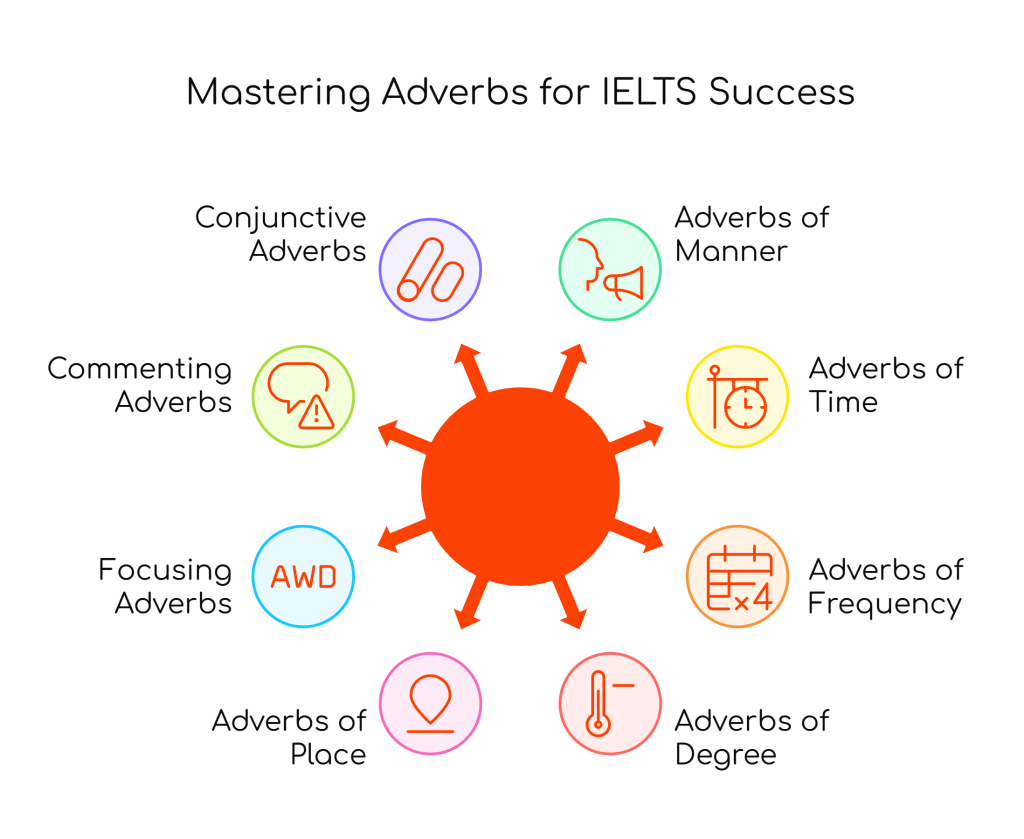
Adverbs are the unsung heroes of English grammar. They add depth, precision, and clarity to your speech and writing. For IELTS candidates, effective use of adverbs can enhance your fluency, accuracy, and lexical resource—all key criteria for scoring Band 7 and above. In this guide, we’ll explore everything you need to know about adverbs to confidently use them in the IELTS exam. You can watch this YouTube video explainer by IELTS Guide Phil.
What Are Adverbs?
An adverb is a word that modifies a verb, adjective, or another adverb. It answers questions like how, when, where, why, to what extent, and how often.
Examples:
- She speaks fluently. (modifies the verb “speaks”)
- It is incredibly difficult. (modifies the adjective “difficult”)
- He ran very quickly. (modifies another adverb)
Types of Adverbs
Understanding the different types of adverbs can help you choose the right ones for academic, formal, or conversational contexts.
1. Adverbs of Manner (How?)
Describes how something is done.
Examples: carefully, fluently, confidently
IELTS Use:
“She answered the questions confidently during the interview.”
2. Adverbs of Time (When?)
Indicates when something happens.
Examples: recently, now, soon, always
IELTS Use:
“The situation has recently improved.”
3. Adverbs of Frequency (How often?)
Shows how frequently something occurs.
Examples: often, rarely, usually, sometimes
IELTS Use:
“Public transport is usually reliable in developed cities.”
4. Adverbs of Degree (To what extent?)
Modifies adjectives, verbs, or other adverbs to show intensity or degree.
Examples: very, quite, almost, extremely
IELTS Use:
“The solution was extremely effective.”
5. Adverbs of Place (Where?)
Tells where the action happens.
Examples: here, there, nearby, everywhere
IELTS Use:
“Pollution can be found everywhere in urban areas.”
6. Focusing Adverbs
Draw attention to a specific part of a sentence.
Examples: even, only, just, especially
IELTS Use:
“Only the wealthy can afford private healthcare.”
7. Commenting Adverbs
Express the speaker’s attitude or opinion.
Examples: fortunately, sadly, undoubtedly, arguably
IELTS Use:
“Undoubtedly, technology has transformed education.”
8. Conjunctive Adverbs
Used to link clauses and show relationships between ideas.
Examples: however, therefore, moreover, consequently
IELTS Use:
“The project failed; however, it provided valuable lessons.”
Adverb Placement Rules
Adverb placement depends on its type and what it’s modifying:
- Before the main verb: “She usually walks to school.”
- After the verb: “He speaks clearly.”
- At the beginning of the sentence (especially for linking adverbs): “Therefore, stricter regulations are necessary.”
Common Mistakes with Adverbs
| Mistake | Explanation | Correction |
|---|---|---|
| “He drives careful.” | Use adverb, not adjective | “He drives carefully.” |
| “She completely understand the topic.” | Wrong verb tense/agreement | “She completely understands the topic.” |
| “I did my homework quick.” | “Quick” is an adjective | “I did my homework quickly.” |
| “He speaks English very good.” | “Good” is an adjective | “He speaks English very well.” |
Do’s and Don’ts
DO:
- Use a range of adverbs to improve your lexical resource.
- Learn academic adverbs for formal writing (e.g., consequently, significantly).
- Place adverbs accurately based on what they modify.
DON’T:
- Overuse adverbs—especially in Writing Task 2.
- Use informal adverbs in academic writing (e.g., really, super, kinda).
- Forget that adverbs modifying adjectives or other adverbs usually come before them.
Frequently Asked Questions (FAQs)
Can I use adverbs like “very” or “really” in IELTS Writing?
Use sparingly and opt for stronger, more academic options like “highly,” “significantly,” or “considerably.”
What are high-scoring adverbs for IELTS?
Adverbs such as “notably,” “effectively,” “significantly,” “consequently,” and “increasingly” show academic tone and precision.
Should I use adverbs in IELTS Speaking?
Yes! In Speaking, natural and well-placed adverbs (e.g., “honestly,” “clearly,” “definitely”) improve fluency and coherence.
Top Strategies for IELTS Success with Adverbs
- Expand your adverb vocabulary by category (e.g., frequency, manner, degree).
- Read model essays and speeches to observe effective adverb use.
- Practice rephrasing – turn “He is a quick writer” into “He writes quickly.”
- Be specific – avoid vague adverbs like “really” and “nice” in Writing.
- Combine adverbs and collocations to enrich your expression.
Sample Sentences for IELTS Practice
- “Tourism has significantly boosted the local economy.”
- “She responded to the examiner’s questions confidently and clearly.”
- “Consequently, governments must reconsider their energy policies.”
- “Education has become increasingly important in the digital era.”
Final Thoughts
Adverbs bring accuracy, tone, and style to your English. Mastering them helps you express ideas more precisely, which is vital for achieving high scores in IELTS Writing and Speaking. With the right balance and context, adverbs can give your answers a professional polish that examiners value.
Learn More and Stay Connected
IELTS Guide Phil Podcast – Listen on Spotify
Free IELTS Resources and Articles – Visit the Blog
Join the Facebook Community – IELTS Guide Phil
X (Twitter): @ieltsguidephil
BlueSky: @ieltsguidephil
#IELTSAdverbs #IELTSGrammar #IELTSWritingTips #IELTSSpeakingTips #IELTSVocabulary #Band7Plus #FluentEnglish #StudyWithPhil #IELTSGuidePhil #AcademicEnglish #IELTS
 IELTS Guide Phil
Leave a comment