
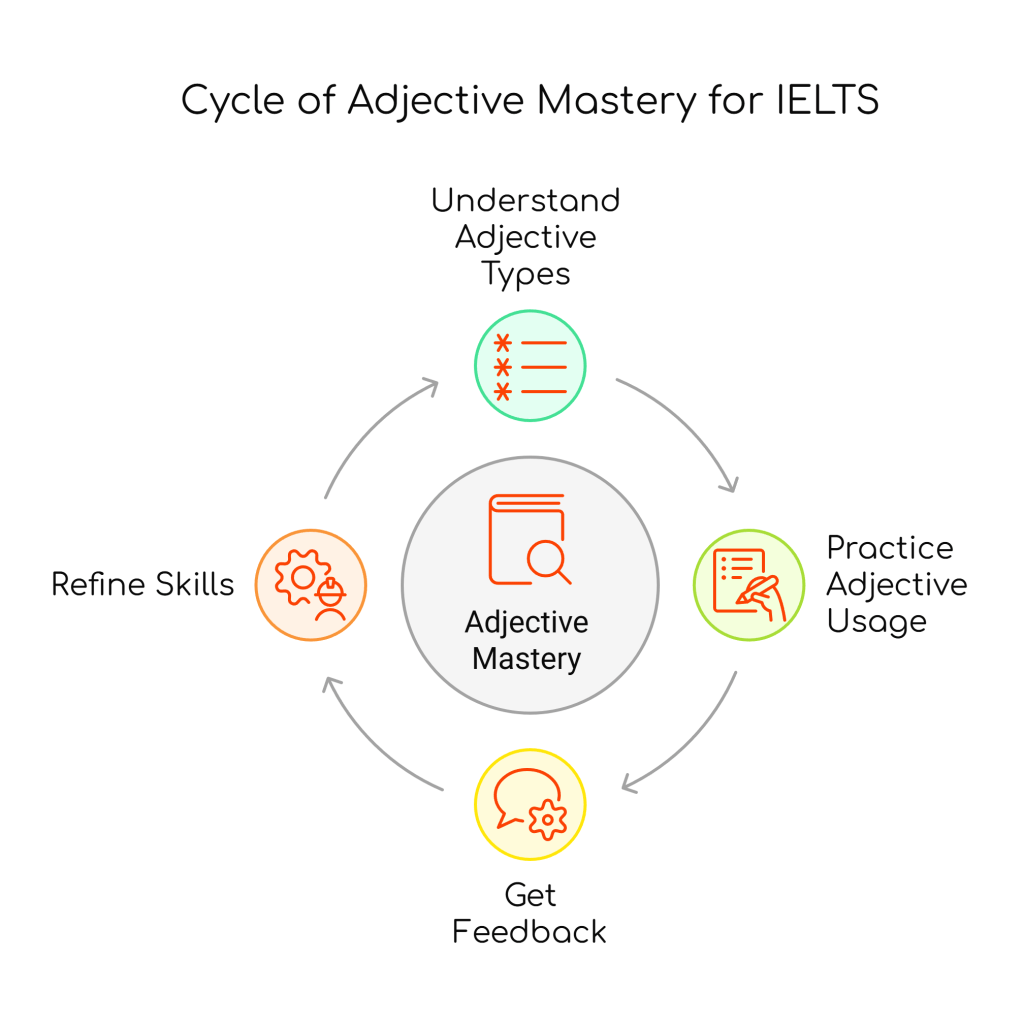
Adjectives are powerful tools in the English language. For IELTS candidates, using a wide range of precise, appropriate, and academic adjectives can dramatically improve your performance in Writing and Speaking. This guide will help you understand how to effectively use adjectives to boost your band score and express ideas more clearly and fluently. You can watch this YouTube video explainer by IELTS Guide Phil.
What Are Adjectives?
An adjective is a word that describes or modifies a noun or pronoun. It tells us what kind, how many, or which one.
Examples:
- A challenging task (describes the noun “task”)
- The second attempt (specifies “which one”)
- An honest answer (tells “what kind”)
Types of Adjectives
Understanding the various types of adjectives will help you use them more accurately in your IELTS responses.
1. Descriptive Adjectives
These describe the qualities of a noun.
Examples: intelligent, enormous, fragile
IELTS Use:
“The lecture provided an insightful overview of climate change.”
2. Quantitative Adjectives
These express the quantity of something.
Examples: many, few, several, much, little
IELTS Use:
“Only a few countries have implemented effective policies.”
3. Demonstrative Adjectives
Used to indicate specific items.
Examples: this, that, these, those
IELTS Use:
“These measures could reduce pollution significantly.”
4. Possessive Adjectives
Show ownership or possession.
Examples: my, your, his, her, its, our, their
IELTS Use:
“Their research supports this theory.”
5. Interrogative Adjectives
Used in questions.
Examples: which, what, whose
IELTS Use:
“Which factors influence consumer behavior?”
6. Comparative and Superlative Adjectives
Used for comparison.
Examples: better, worse, more efficient, most effective
IELTS Use:
“Solar energy is more sustainable than fossil fuels.”
7. Compound Adjectives
Formed by combining two or more words.
Examples: well-known, long-term, high-tech
IELTS Use:
“The government introduced a long-term solution.”
Adjective Placement and Order
In English, adjectives usually come before the noun and follow a specific order:
Quantity > Opinion > Size > Age > Shape > Color > Origin > Material > Purpose
Example:
“Three beautiful large old round blue Italian wooden dining tables”
Common Mistakes with Adjectives
| Mistake | Explanation | Correction |
|---|---|---|
| “More better” | Redundant comparative | Just say “better” |
| “Informations are important” | “Information” is uncountable | “Information is important” |
| “She is more prettier” | Double comparative | “She is prettier” |
| “An university” | Incorrect article before a vowel sound | “A university” (because of the ‘yoo’ sound) |
Do’s and Don’ts
DO:
- Use a variety of adjectives to avoid repetition.
- Choose adjectives appropriate for formal and academic tone in Writing Task 2.
- Practice precision — choose words that best describe the idea.
DON’T:
- Overuse adjectives unnecessarily — it can make writing cluttered.
- Use overly emotional or vague adjectives in academic writing (e.g., “awesome”, “nice”).
- Forget about adjective-noun agreement.
Frequently Asked Questions (FAQs)
How many adjectives should I use in an IELTS essay?
Use them sparingly and strategically — enough to add detail, but not so many that your writing becomes wordy or informal.
Can I use adjectives like “awesome” or “cool” in IELTS Speaking?
Only in informal contexts like Part 1 — avoid them in Part 3 or in Writing tasks. Use more descriptive terms like “impressive” or “innovative.”
Should I use advanced adjectives to get Band 7+?
Yes — precise academic vocabulary, including adjectives, helps demonstrate a wide range of lexis, which is essential for higher bands.
Top Strategies for IELTS Success with Adjectives
- Build your adjective bank – Create lists based on topics like environment, education, health, etc.
- Practice collocations – Know which nouns typically go with which adjectives.
- Use adjectives in context – Practice full sentences, not just isolated words.
- Listen and learn – Pay attention to how adjectives are used in high-scoring Speaking samples or academic texts.
- Get feedback – Use platforms or communities (like IELTS Guide Phil) to check if your adjective usage sounds natural and appropriate.
Sample Sentences for IELTS Practice
- “The widening income gap is a major issue in many societies today.”
- “A comprehensive understanding of the topic is essential for academic success.”
- “Pollution is a growing concern, especially in densely-populated urban areas.”
Final Thoughts
Mastering adjectives is about precision, appropriateness, and range. In IELTS Writing and Speaking, they help you convey nuance, demonstrate lexical flexibility, and express complex ideas. Whether you’re describing a problem, comparing data, or expressing your opinion, well-chosen adjectives elevate your language and help you reach the higher band scores you’re aiming for.
Learn More and Stay Connected
IELTS Guide Phil Podcast – Listen on Spotify
Free Resources and Articles – Visit the Blog
Join the Facebook Community – IELTS Guide Phil
X (formerly Twitter): @ieltsguidephil
BlueSky: @ieltsguidephil
#IELTSAdjectives #IELTSGrammar #IELTSVocabulary #HighBandIELTS #IELTSWritingSuccess #IELTSSpeakingSkills #AcademicAdjectives #StudyWithPhil #IELTSGuidePhil #LearnEnglishBetter #IELTS
 IELTS Guide Phil
Leave a comment