
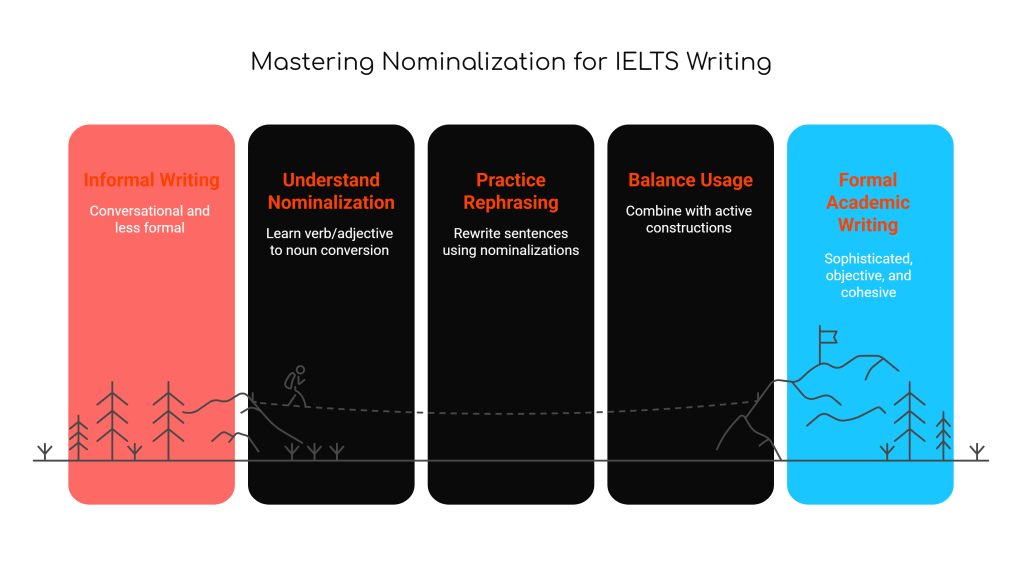
Nominalization is one of the most effective techniques used in academic writing to increase formality, improve objectivity, and showcase a higher level of grammatical control. If you’re aiming for Band 7 or above in IELTS Writing, understanding and applying nominalization can significantly elevate the sophistication of your essays.
What Is Nominalization?
Nominalization is the process of turning verbs, adjectives, or even clauses into nouns. This technique is a hallmark of formal and academic writing, helping writers to express ideas in a more abstract and impersonal way.
Example:
The government implemented the policy immediately.
The implementation of the policy was immediate.
Why Is Nominalization Important in IELTS?
Improves Formality
Nominalized structures are common in academic texts and are expected in IELTS Writing Task 2 and Academic Task 1.
Increases Objectivity
By focusing on actions or concepts rather than agents (people), your writing becomes less personal and more academic.
Enhances Cohesion
Nominalization allows the use of linking words and more structured sentence connectors.
Demonstrates Lexical Resource
The ability to convert verbs/adjectives to nouns shows a high level of vocabulary knowledge and grammatical control.
Types of Nominalization
1. Verb → Noun
| Verb | Nominalized Form |
|---|---|
| analyze | analysis |
| decide | decision |
| develop | development |
| improve | improvement |
Example:
We analyzed the data. → Our analysis of the data was thorough.
2. Adjective → Noun
| Adjective | Nominalized Form |
|---|---|
| strong | strength |
| efficient | efficiency |
| responsible | responsibility |
| effective | effectiveness |
Example:
The solution was effective. → The effectiveness of the solution was evident.
3. Clause → Noun Phrase
Example:
That the company was dishonest shocked us. → The dishonesty of the company shocked us.
Examples in IELTS Contexts
Task 1 (Academic):
The graph shows that the number of users increased significantly.
→ There was a significant increase in the number of users.
Task 2 (Essay):
People waste a lot of food.
→ Food wastage is a growing concern.
Common Mistakes
- Overusing nominalization so that your writing becomes dense or unclear.
- Forcing nominalization when a simple verb would be more effective.
- Using incorrect noun forms (e.g., developation instead of development).
- Dropping articles/prepositions around nominalized phrases.
Dos and Don’ts
| Do | Don’t |
|---|---|
| Use nominalization to express formality and abstraction | Use it in every sentence |
| Learn common noun forms of verbs and adjectives | Invent incorrect forms |
| Combine nominalization with clear grammar | Create vague or wordy sentences |
| Practice with academic topics | Avoid practice assuming it’s only for “complex” topics |
Frequently Asked Questions
Q1: Is nominalization required in IELTS Writing?
Not required, but it’s highly recommended for higher bands in Task 2 and Academic Task 1. It shows command of academic style.
Q2: Should I nominalize everything?
No. Balance is key. Overuse may harm clarity and readability. Use it strategically for abstract ideas or formal expressions.
Q3: Is it useful in Speaking?
Not typically. IELTS Speaking is conversational, so natural verbs and personal structures are preferred.
Top Strategies for IELTS Success
- Make a conversion list: Start with the most common verbs/adjectives in IELTS (e.g., increase → increase, improve → improvement).
- Rephrase your writing: Take a paragraph and rewrite it using nominalizations to add variety and formality.
- Use models: Study Band 8–9 essays to identify where nominalization is applied.
- Check balance: Use nominalizations alongside active constructions to maintain flow.
- Practice in feedback loops: Write essays and ask tutors to comment on overuse or misuse.
Nominalization in Action (Before & After)
Before:
Many people think that the government should build more hospitals.
After:
There is a growing belief in the need for increased hospital construction by the government.
Common Nominalizations in IELTS
| Verb/Adjective | Nominalization | IELTS Topic Example |
|---|---|---|
| increase | increase | population increase |
| solve | solution | solution to pollution |
| educate | education | access to education |
| pollute | pollution | air pollution |
| develop | development | infrastructure development |
| responsible | responsibility | government responsibility |
Final Thoughts
Nominalization is a game changer for IELTS Writing, especially if you want to hit Band 7.0 or above. It reflects formality, objectivity, and academic tone—key elements in high-scoring responses. Use it thoughtfully, balance it with active structures, and watch your writing evolve into a more sophisticated and cohesive style.
Explore More with IELTS Guide Phil
🎧 Listen to the IELTS Guide Phil Podcast on Spotify:
IELTS Guide Phil on Spotify
Visit the IELTS blog for writing techniques and vocabulary mastery:
ieltsguidephil.com
Follow IELTS Guide Phil:
- Facebook: IELTS Guide Phil
- X (formerly Twitter): @ieltsguidephil
- BlueSky: @ieltsguidephil
#IELTSWriting #Nominalization #IELTSVocabulary #AcademicWriting #IELTSBand7 #IELTSGrammar #IELTSWithPhil #LearnEnglish #WritingTips #IELTS2025 #IELTS
 IELTS Guide Phil
Leave a comment