
In the world of IELTS, achieving a high band score in Writing and Speaking is often about more than just using big words—it’s about how well you connect ideas, maintain coherence, and demonstrate vocabulary range. One powerful but often underutilized technique that can significantly boost your band score is the use of lexical chains.
What Are Lexical Chains?
A lexical chain is a sequence of related words that contribute to cohesion and semantic unity in a text. These words are connected through topic-related vocabulary, synonyms, antonyms, hyponyms, or other types of lexical relationships.
Example:
Climate change is a growing concern. Rising temperatures, extreme weather patterns, and global warming are just a few symptoms of this environmental crisis.
(All the bolded terms form a lexical chain around the topic of climate change.)
Why Are Lexical Chains Important in IELTS?
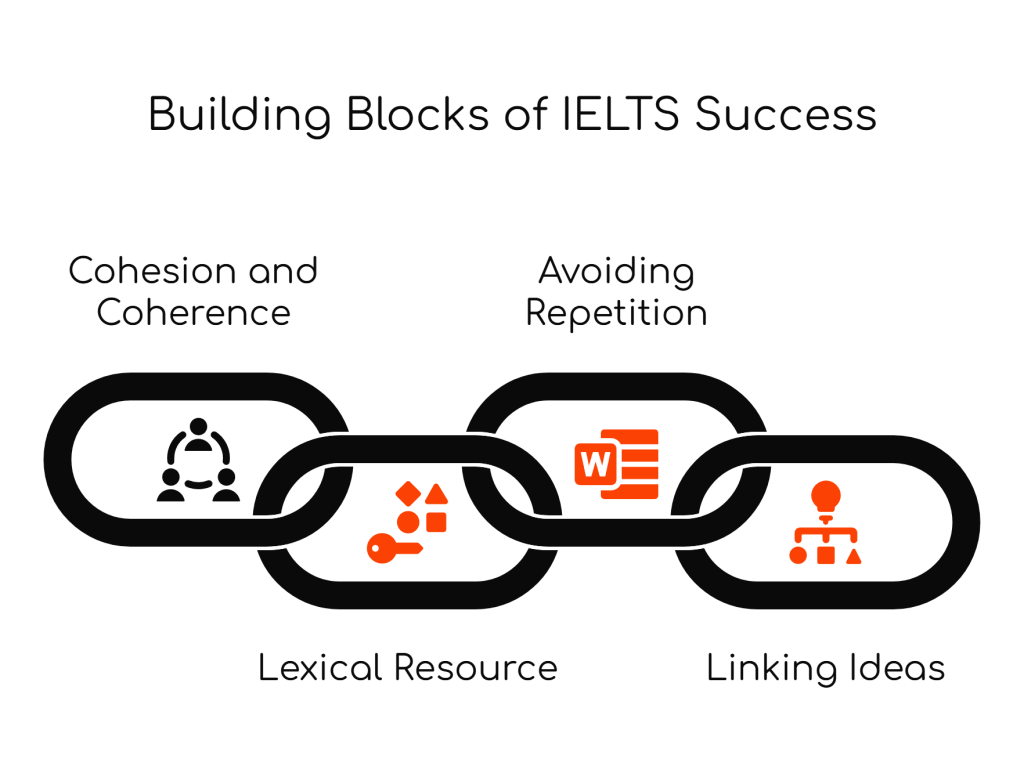
Lexical chains are crucial for:
- Cohesion and coherence in writing and speaking.
- Demonstrating lexical resource, especially for Band 7 and above.
- Avoiding repetition while maintaining clarity.
- Linking ideas smoothly across sentences and paragraphs.
IELTS Band Descriptors & Lexical Chains
- Band 7+: “Uses a sufficient range of vocabulary to allow some flexibility and precision.”
- Band 8+: “Uses a wide range of vocabulary fluently and flexibly to convey precise meaning.”
- Band 9: “Uses a wide range of vocabulary with very natural and sophisticated control.”
Lexical chains help meet all of these descriptors.
Types of Lexical Chains
Here are the main types of lexical chains you can use in IELTS Writing and Speaking:
1. Repetition
Repeating key terms strategically to emphasize continuity.
The government should act. The government must also fund public health.
2. Synonyms
Using equivalent terms to maintain clarity while avoiding repetition.
The issue is serious. This problem must be addressed immediately.
3. Antonyms
Using contrast to build nuanced arguments.
While some believe in freedom, others prioritize control.
4. Superordinate–Subordinate (Hypernym–Hyponym)
Using general and specific terms within the same semantic field.
Fruit is healthy. Apples, bananas, and oranges provide essential vitamins.
5. Meronyms and Holonyms (Part–Whole Relationships)
Describing parts of a whole for descriptive or explanatory purposes.
The car was old. Its engine, tires, and dashboard were all worn out.
6. Thematic Chains (Topic-Specific Vocabulary)
Using vocabulary connected to a central theme.
Education lexical chain: school, teacher, curriculum, exam, assessment, student, pedagogy
Common Mistakes to Avoid
- Overusing synonyms incorrectly (e.g., using “problem” and “challenge” interchangeably when they don’t quite match the tone).
- Breaking coherence by switching topics too abruptly.
- Forcing vocabulary into sentences without natural flow.
- Using unrelated words that confuse the lexical chain.
Dos and Don’ts
| Do | Don’t |
|---|---|
| Use lexical chains to maintain topic unity | Change vocabulary without regard to meaning |
| Mix synonyms, hyponyms, and theme-specific terms | Overuse one type of word (e.g., only synonyms) |
| Use topic-related chains for each paragraph | Repeat the same word excessively |
| Practice identifying chains in model essays | Neglect vocabulary cohesion in writing |
Frequently Asked Questions
Q1: Are lexical chains only important in IELTS Writing?
No. Lexical chains also boost coherence and vocabulary score in IELTS Speaking, especially in Parts 2 and 3.
Q2: Do lexical chains help with Task Achievement?
Yes, they help maintain focus and make your arguments clearer, which contributes to higher scores in Task Achievement and Coherence and Cohesion.
Q3: How can I practice building lexical chains?
- Read high-scoring IELTS sample essays and highlight chains.
- Use mind maps to connect related vocabulary.
- Practice paraphrasing and extending topic-specific vocabulary.
Top Strategies for IELTS Success Using Lexical Chains
- Create topic vocabulary banks for common IELTS topics (education, environment, health, etc.).
- Practice rewriting essays using lexical chains for each main idea.
- Review synonyms and theme-based vocabulary regularly.
- Speak aloud with lexical variation, especially when describing processes or giving opinions.
- Analyze band 8–9 sample essays to observe lexical cohesion in action.
Sample Lexical Chains by Topic
Environment
climate change – global warming – carbon emissions – sustainability – green energy – conservation
Health
illness – disease – symptoms – treatment – healthcare – recovery – prevention
Education
student – teacher – learning – curriculum – instruction – exam – academic
Employment
job – profession – career – workforce – employment – recruitment – occupation
Conclusion: Lexical Chains = Higher Bands
Lexical chains are more than just a vocabulary trick—they’re a cohesive strategy that demonstrates maturity and range in language use. Mastering them can push your score from Band 6.5 to 7.5 or beyond by showing examiners that you are not only fluent but also strategic and precise in your communication.
If you’re serious about reaching Band 7.0+, start building and practicing lexical chains today.
Explore More with IELTS Guide Phil
Listen to the IELTS Guide Phil Podcast on Spotify for vocabulary tips and real practice:
IELTS Guide Phil on Spotify
Read more IELTS vocabulary tips on the blog:
ieltsguidephil.com
Join the IELTS community:
IELTS Guide Phil on Facebook
Also on X (Twitter) and BlueSky – @ieltsguidephil
#IELTSVocabulary #LexicalChains #IELTSWriting #IELTSBand7 #IELTSPreparation #AcademicEnglish #IELTSWithPhil #IELTSGrammar #LearnEnglish #IELTS2025 #IELTS
 IELTS Guide Phil
Leave a comment