
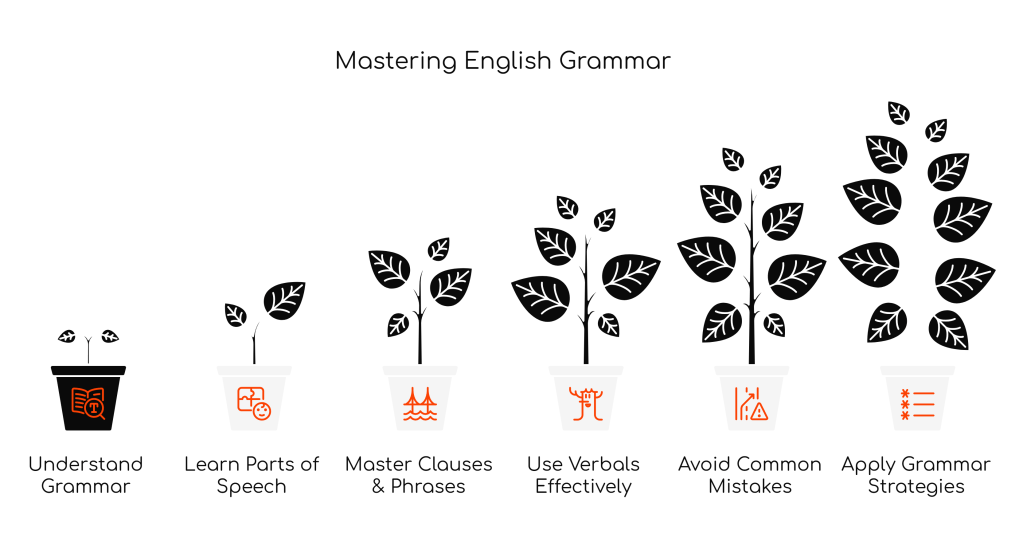
Understanding grammar is key to mastering English for exams like IELTS, academic success, and clear communication. This in-depth guide breaks down essential grammar terms, provides clear examples, explains common mistakes, and offers practical tips for learners at all levels.
What Is Grammar?
Grammar is the system and structure of a language. It includes everything from parts of speech and sentence structure to punctuation and syntax. Knowing grammar allows you to form correct sentences, understand others, and express complex ideas effectively.
PARTS OF SPEECH (The 8 Core Categories)
1. Noun
- Definition: A word that names a person, place, thing, or idea.
- Types: Common, proper, abstract, collective, concrete.
- Examples: teacher, Paris, democracy, team, book
- Do use articles before singular countable nouns.
- Don’t confuse countable and uncountable nouns in IELTS Writing.
- Common Mistake: Saying “advices” instead of “pieces of advice.”
2. Verb
- Definition: A word that expresses action or a state of being.
- Types: Action, linking, auxiliary, transitive, intransitive.
- Examples: run, is, have been, become, jump
- Do use the correct tense form for the situation.
- Don’t mix past and present without reason.
- Common Mistake: “She go to school every day” → should be “She goes…”
3. Adjective
- Definition: Describes or modifies a noun or pronoun.
- Examples: beautiful, intelligent, five, blue
- Do use adjectives before nouns: a tall man.
- Don’t double-stack comparative forms (“more better”).
- Common Mistake: Saying “more better” instead of “better.”
4. Adverb
- Definition: Modifies a verb, adjective, or another adverb.
- Types: Manner, time, frequency, degree.
- Examples: quickly, very, often, well
- Do place adverbs correctly in the sentence: He quickly ran home.
- Don’t confuse adjectives and adverbs: “He speaks good” → “He speaks well.”
5. Pronoun
- Definition: A word that replaces a noun.
- Types: Personal, possessive, demonstrative, reflexive, relative, interrogative.
- Examples: he, they, which, himself
- Do ensure pronouns agree with the noun in number and gender.
- Don’t use vague or ambiguous pronoun references.
- Common Mistake: “When Sarah saw Emily, she was crying.” (Who is “she”?)
6. Preposition
- Definition: Shows the relationship between a noun or pronoun and another element.
- Examples: in, at, on, over, between
- Do memorize collocations (e.g., interested in, good at).
- Don’t say “discuss about” — it’s just “discuss.”
7. Conjunction
- Definition: Joins words, phrases, or clauses.
- Types: Coordinating (FANBOYS), subordinating, correlative.
- Examples: and, but, because, either…or
- Do use subordinating conjunctions for complex sentences.
- Don’t overuse “and” in academic writing.
8. Interjection
- Definition: A word or phrase that expresses emotion.
- Examples: Wow! Oh no! Yikes!
- Do use sparingly in informal contexts.
- Don’t use interjections in formal IELTS essays.
CLAUSES & PHRASES
Clause
- A clause contains a subject and a verb.
- Independent Clause: Can stand alone (She smiled.)
- Dependent Clause: Cannot stand alone (Because she smiled…)
Phrase
- A phrase lacks a subject-verb pair.
- Examples: in the morning, having finished dinner, to succeed
SPECIAL VERB FORMS: VERBALS
1. Gerund
- A verb ending in –ing that functions as a noun.
- Example: Swimming is fun.
2. Infinitive
- “To” + base verb; can act as a noun, adjective, or adverb.
- Example: To learn is important.
3. Participle
- Verb form used as an adjective.
- Example: The broken glass…
COMMON GRAMMAR MISTAKES
- Sentence Fragment: Because I was tired.
- Comma Splice: She writes, she teaches.
- Run-on Sentence: I like grammar it’s fun.
- Subject-Verb Agreement Errors: The students is…
- Dangling Modifier: Running to school, the backpack fell off.
DOS AND DON’TS
DO | DON’T
Use varied sentence structures | Overuse simple sentences
Edit and proofread your work | Submit first drafts
Review grammar regularly | Assume automatic correctness
Read and listen to native material | Ignore your grammar weaknesses
Frequently Asked Questions (FAQs)
Q1: Do I need to know all grammar terms to pass IELTS?
No, but knowing key grammar terms helps you improve writing and speaking accuracy.
Q2: How do I know if my sentence is grammatically correct?
Practice writing, get feedback, and use grammar-checking tools like Grammarly or Quillbot.
Q3: What’s the most common IELTS grammar mistake?
Subject-verb agreement and incorrect verb tenses are common errors.
Top Grammar Strategies for IELTS Success
- Master Verb Tenses: Use past, present, and future forms correctly.
- Improve Sentence Variety: Combine simple, compound, and complex structures.
- Focus on Subject-Verb Agreement: Always match the subject and verb correctly.
- Avoid Slang and Contractions: Use formal structures in Writing Task 2.
- Edit Carefully: Always proofread for small but costly errors.
Additional Resources
- Check out the IELTS Guide Phil Blog for grammar posts, guides, and tips.
- Listen to the IELTS Guide Phil Podcast on Spotify.
- Follow IELTS Guide Phil on Facebook, X (Twitter), and BlueSky for daily grammar posts and IELTS tips.
Final Thoughts
Grammar is the foundation of effective communication. Whether you’re studying for IELTS or improving your general English, mastering these terms will elevate your confidence, clarity, and correctness. Practice consistently, learn from your mistakes, and use this guide as a reliable reference.
#EnglishGrammar #GrammarGuide #LearnEnglish #EnglishLearning #GrammarMatters #EnglishLanguage #GrammarCheck #IELTSPreparation #IELTSGrammar #IELTSWriting #IELTSTips #IELTSSuccess #IELTSVocabulary #IELTS2025 #Band7Plus #AceTheIELTS #IELTSWithPhil #IELTS
 IELTS Guide Phil
Leave a comment