
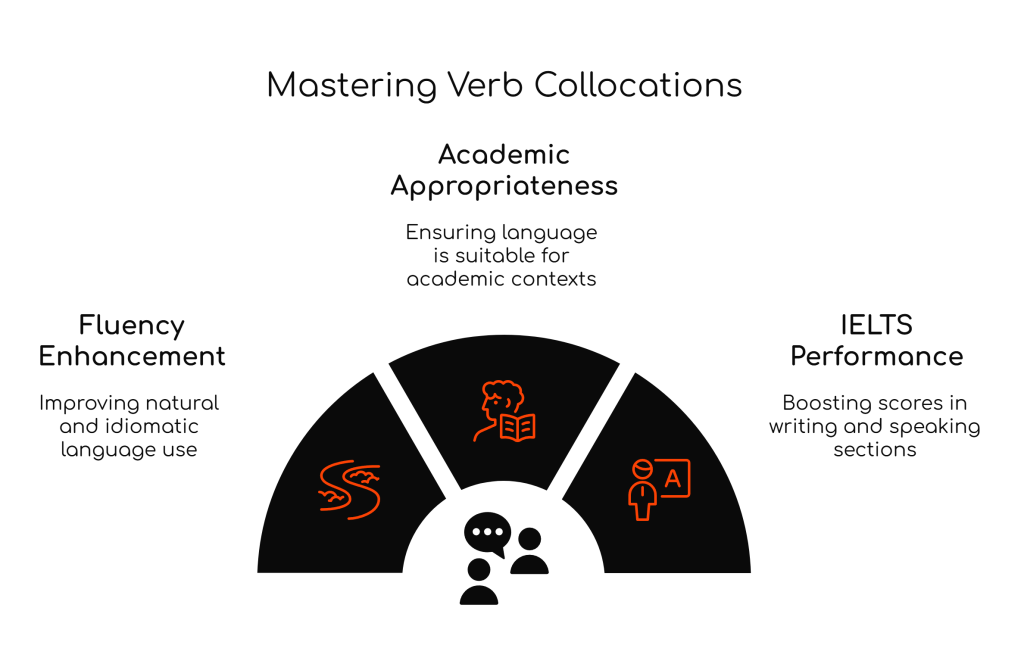
When preparing for the IELTS exam—especially the Writing and Speaking sections—using precise and natural verb collocations can significantly enhance your performance. Verb collocations are word combinations where a specific verb naturally pairs with a specific noun, adverb, or preposition. Mastery of these can make your language more fluent, idiomatic, and academically appropriate.
In this blog post, we explore 100 verb collocations that are particularly useful for IELTS candidates aiming for Band 7 and above.
100 Common and High-Level Verb Collocations (with Definitions and Examples)
- Address an issue – To deal with a problem or topic.
The government must address the issue of unemployment. - Affect outcomes – To influence the results of something.
Lack of preparation may affect outcomes in the exam. - Allocate resources – To assign resources for a specific purpose.
The school allocated resources to improve science education. - Analyze data – To examine data methodically.
Researchers analyzed data collected over a decade. - Apply knowledge – To use what you know in a practical situation.
Students must apply knowledge in real-world scenarios. - Avoid conflict – To steer clear of disagreements.
Effective communication helps avoid conflict. - Boost productivity – To increase the efficiency of production.
Flexible schedules can boost productivity at work. - Break a habit – To stop doing something habitual.
It’s difficult to break a smoking habit. - Cause concern – To make someone worried.
The rise in pollution levels is causing concern. - Cater to needs – To serve or fulfill requirements.
Hospitals must cater to the needs of elderly patients. - Commit a crime – To break the law.
He was arrested for committing a serious crime. - Conserve energy – To use energy wisely.
We should conserve energy to protect the planet. - Consider alternatives – To think about other options.
Always consider alternatives before making a decision. - Contribute to development – To help in growth or progress.
Education contributes to economic development. - Cope with stress – To manage difficult emotions.
Meditation helps me cope with stress. - Create opportunities – To make chances for progress.
Innovation can create job opportunities. - Damage reputation – To harm one’s public image.
The scandal damaged the politician’s reputation. - Deliver results – To achieve expected outcomes.
The new system delivered better results. - Demand attention – To require focus or notice.
This issue demands immediate attention. - Develop skills – To improve abilities.
You need time to develop communication skills. - Discuss ideas – To talk about concepts or suggestions.
The team met to discuss new marketing ideas. - Display behavior – To show certain actions or attitudes.
The child displayed aggressive behavior. - Earn a living – To make money for daily life.
She earns a living by teaching. - Embrace change – To accept transformation.
Successful people embrace change rather than fear it. - Enhance performance – To improve how something works.
Good sleep enhances cognitive performance. - Establish a relationship – To create a bond.
Teachers must establish a positive relationship with students. - Evaluate effectiveness – To assess how well something works.
We evaluated the effectiveness of the training program. - Exercise control – To show power or restraint.
He failed to exercise control over his temper. - Expand knowledge – To increase understanding.
Travel helps expand your cultural knowledge. - Facilitate learning – To make learning easier.
Technology can facilitate interactive learning. - File a complaint – To report a problem officially.
She filed a complaint against the rude staff. - Foster creativity – To encourage creative thinking.
The course is designed to foster creativity. - Gain experience – To acquire practical knowledge.
Internships help students gain experience. - Generate income – To earn money.
Freelancing can generate additional income. - Give feedback – To offer opinions or evaluations.
Teachers gave constructive feedback. - Grant permission – To allow something officially.
The manager granted permission to leave early. - Handle pressure – To manage stressful situations.
He can handle pressure well in emergencies. - Hold a meeting – To organize a discussion.
They held a meeting to address the budget cuts. - Identify problems – To recognize issues.
Engineers identified several design problems. - Impose restrictions – To enforce rules or limits.
Governments imposed travel restrictions during the pandemic. - Improve quality – To make something better.
New materials improved the quality of the product. - Influence decisions – To affect choices.
Parental advice can influence career decisions. - Inspire confidence – To make others trust or believe.
A calm speaker inspires audience confidence. - Invest time – To spend time for a future benefit.
It’s wise to invest time in self-development. - Join forces – To collaborate.
The two companies joined forces to launch a new product. - Keep records – To maintain written data.
Hospitals must keep accurate records. - Launch a campaign – To start an organized activity.
The NGO launched a campaign against plastic use. - Lead a team – To guide a group.
She led the research team effectively. - Maintain standards – To keep quality consistent.
The school maintains high educational standards. - Manage expectations – To handle people’s hopes.
It’s crucial to manage client expectations. - Meet deadlines – To complete work on time.
Employees are expected to meet strict deadlines. - Negotiate terms – To discuss and agree on conditions.
They negotiated the terms of the contract carefully. - Offer support – To provide help or encouragement.
Volunteers offered support to flood victims. - Organize events – To plan and coordinate activities.
The university organizes cultural events annually. - Overcome obstacles – To successfully deal with difficulties.
She overcame many obstacles to finish her degree. - Perform tasks – To carry out duties.
The software helps users perform tasks efficiently. - Pose a threat – To present a danger.
Climate change poses a serious threat to biodiversity. - Predict outcomes – To forecast results.
It is difficult to predict election outcomes. - Preserve traditions – To maintain cultural customs.
Festivals help preserve traditional values. - Present findings – To share research results.
The scientist presented her findings at the conference. - Promote awareness – To increase knowledge or understanding.
The campaign aims to promote environmental awareness. - Propose solutions – To suggest ways to fix problems.
Experts proposed multiple solutions to the housing crisis. - Provide insights – To give useful perspectives.
His speech provided deep insights into the topic. - Raise funds – To collect money for a cause.
The charity raised funds for cancer research. - Reach an agreement – To settle a negotiation.
Both sides reached an agreement after hours of discussion. - Reduce costs – To lower expenses.
The company reduced costs by outsourcing production. - Reflect values – To show what is important to someone or something.
The brand reflects core environmental values. - Refuse offers – To decline proposals or invitations.
She politely refused several job offers. - Reinforce beliefs – To strengthen convictions.
The speech reinforced the audience’s beliefs. - Reject claims – To deny accusations or statements.
The company rejected the fraud claims. - Report findings – To communicate research results.
The journalist reported the findings accurately. - Resolve conflicts – To settle disagreements.
The mediator helped resolve the family conflict. - Respect differences – To acknowledge and honor diversity.
Students are taught to respect cultural differences. - Retain control – To keep authority or influence.
The manager retained control of the project. - Reveal results – To make results known.
The survey revealed surprising results. - Risk failure – To be exposed to potential defeat.
Entrepreneurs must risk failure to innovate. - Safeguard rights – To protect legal or human entitlements.
Laws exist to safeguard individual rights. - Secure funding – To obtain money for a project.
The team secured funding for the new research center. - Seek advice – To ask for guidance.
Students are encouraged to seek academic advice. - Set goals – To establish targets.
It’s important to set realistic goals. - Shape opinion – To influence what people think.
Media can shape public opinion significantly. - Show appreciation – To express gratitude.
The teacher showed appreciation for her students’ efforts. - Solve problems – To find solutions.
The software helps solve technical problems. - Strengthen ties – To improve relationships.
Cultural exchanges strengthen international ties. - Submit assignments – To hand in school work.
All students must submit their assignments by Friday. - Support arguments – To back up claims or points.
Use examples to support your arguments in essays. - Take initiative – To act without being told.
Employers value staff who take initiative. - Target improvements – To aim for progress.
The reforms targeted improvements in healthcare. - Trigger reactions – To cause responses.
The announcement triggered strong public reactions. - Undermine credibility – To weaken trust or believability.
Plagiarism undermines academic credibility. - Update records – To keep information current.
All customer records must be updated regularly. - Utilize resources – To use assets effectively.
We must utilize natural resources efficiently. - Validate claims – To prove something is true.
The scientist validated her claims with evidence. - Value diversity – To appreciate variety.
Modern societies increasingly value cultural diversity. - Voice concerns – To express worries.
Citizens voiced concerns over rising crime rates. - Widen access – To make something more available.
The government plans to widen access to higher education. - Win support – To gain approval or backing.
The proposal won widespread community support. - Work remotely – To do your job from outside the office.
Many employees now work remotely. - Write reports – To prepare written documents.
Engineers must write technical reports clearly. - Yield results – To produce outcomes.
Hard work eventually yields positive results.
Final Thoughts
Using accurate and advanced verb collocations is crucial for achieving fluency and coherence in IELTS Writing and Speaking. These combinations not only help you sound more natural and idiomatic but also demonstrate a higher level of lexical resource—a key criterion in IELTS assessment. Incorporate these collocations in your practice essays, speaking tasks, and vocabulary journals to boost your performance and confidence on test day.
#IELTSVocabulary #IELTSTips #VerbCollocations #IELTSWriting #IELTSSpeaking #LexicalResource #IELTSPreparation #HighBandIELTS #AcademicEnglish #IELTSGuidePhil #IELTS
 IELTS Guide Phil
Leave a comment