
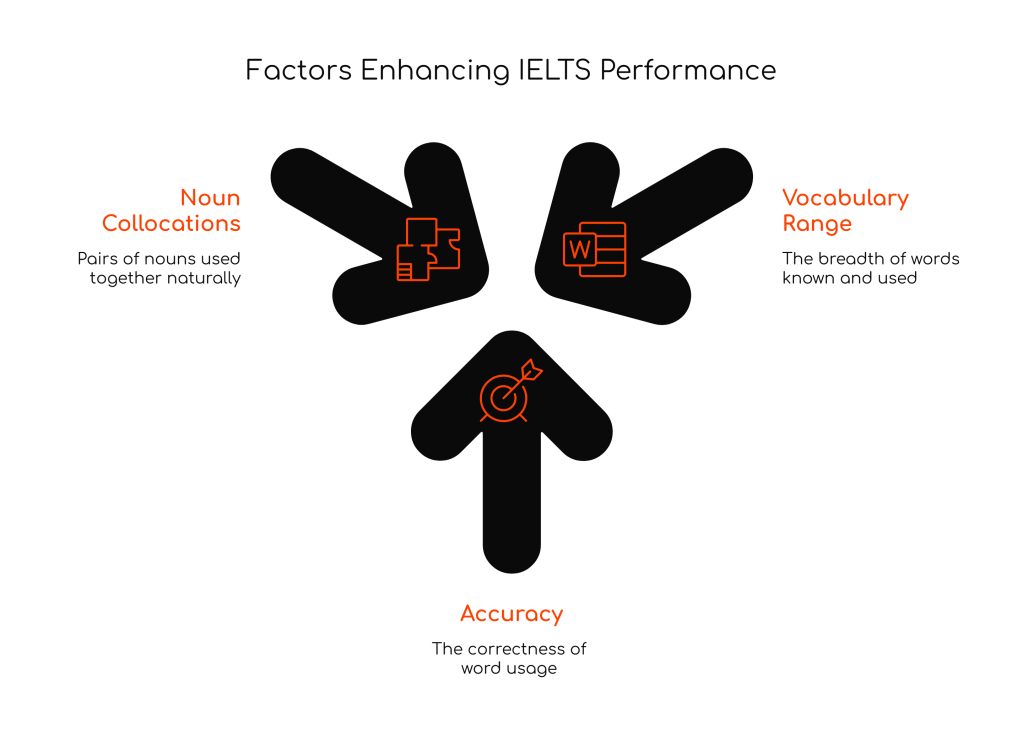
In IELTS Writing and Speaking, vocabulary range and accuracy play a crucial role in achieving higher band scores. One effective way to showcase lexical resource is through precise and natural noun collocations—pairs or groups of words that are often used together in English. While many candidates rely on basic expressions like “strong opinion” or “big problem,” high-scoring test takers stand out by using less common and more academic collocations.
This post provides 100 carefully selected noun collocations that can significantly enhance your IELTS performance. Each entry includes the full collocation, a short definition, and an example sentence to help you use them accurately.
100 Less Common Noun Collocations
- Adverse consequences
Negative results or effects
The policy led to adverse consequences for small businesses. - Public outcry
Strong public opposition or protest
The decision to close the library caused a public outcry. - Economic downturn
A decline in economic activity
The country is struggling with a severe economic downturn. - Unprecedented growth
Growth that has never been seen before
The tech industry has experienced unprecedented growth in the last decade. - Societal norm
A generally accepted behavior in society
Wearing formal clothes to interviews is a societal norm. - Environmental degradation
Damage to the environment
Deforestation contributes to environmental degradation. - Parental involvement
Participation of parents in their children’s education
Parental involvement is key to student success. - Job satisfaction
The feeling of fulfillment from one’s job
High job satisfaction often leads to increased productivity. - Moral obligation
A duty based on moral principles
There is a moral obligation to help the less fortunate. - Technological advancement
The development of new technologies
Technological advancement has changed how we communicate. - Cultural heritage
Traditions and values passed down through generations
Museums play a role in preserving cultural heritage. - Social disparity
Inequality among social groups
Social disparity is widening in urban areas. - Traffic congestion
Overcrowded roads and traffic jams
Traffic congestion is a major issue in big cities. - Educational reform
Changes aimed at improving education
The government proposed an educational reform last year. - Consumer behavior
The buying habits of people
Marketing strategies are influenced by consumer behavior. - Financial literacy
Understanding how to manage money
Schools should teach students financial literacy. - Healthcare access
Availability of medical services
Rural communities struggle with limited healthcare access. - Judicial system
The legal system of a country
The judicial system must be fair and impartial. - Political instability
Frequent changes or uncertainty in government
Political instability can deter foreign investment. - Nutritional value
The health benefits of food
Fruits have high nutritional value. - Population density
The number of people living in a given area
High population density can strain public resources. - Climate crisis
A critical situation due to climate change
The climate crisis demands immediate global action. - Income inequality
A large gap between rich and poor
Income inequality is a serious economic challenge. - Research funding
Money allocated for scientific studies
Lack of research funding hinders innovation. - Urban expansion
The growth of cities
Urban expansion often leads to deforestation. - Communication barrier
Difficulty in understanding or exchanging ideas
Language can be a communication barrier in multinational teams. - Legal framework
The structure of laws and regulations
A solid legal framework is essential for governance. - Carbon footprint
The amount of carbon emissions produced
Reducing our carbon footprint helps combat climate change. - Mental resilience
Ability to cope with stress and adversity
Mental resilience is crucial for academic success. - Wage disparity
Difference in income between groups
Wage disparity exists between genders in many industries. - Public perception
How the public views something
Media shapes public perception. - Language proficiency
Skill in using a language
IELTS measures language proficiency in English. - Media coverage
Reporting of news and events
The accident received widespread media coverage. - Public policy
Government action plans and regulations
Public policy should address environmental issues. - Energy consumption
The use of energy resources
Modern appliances help reduce energy consumption. - Youth unemployment
Young people without jobs
Youth unemployment is a growing concern in many countries. - Data breach
Unauthorized access to confidential data
The company suffered a massive data breach. - Academic integrity
Honesty in academic work
Plagiarism is a violation of academic integrity. - Public transport infrastructure
Facilities for buses, trains, etc.
Improved public transport infrastructure eases urban traffic. - Cybersecurity threat
Risks to digital systems
Cybersecurity threats are becoming more sophisticated. - Gender bias
Prejudice based on gender
The recruitment process must be free from gender bias. - Crisis management
Dealing with emergencies or difficult situations
Effective crisis management prevented further damage during the flood. - Technological dependency
Over-reliance on technology
Technological dependency can reduce human interaction. - Resource allocation
Distribution of resources
Proper resource allocation is crucial in disaster relief. - Job redundancy
Loss of employment due to a position being unnecessary
Automation has increased job redundancy in manufacturing. - Social cohesion
Unity and cooperation within society
Volunteering promotes social cohesion in communities. - Healthcare expenditure
Spending on medical services
Rising healthcare expenditure is a burden on the government. - Workplace diversity
Variety of backgrounds among employees
Workplace diversity enhances innovation and creativity. - Global trade
International buying and selling of goods
Global trade boosts economic development. - Internet accessibility
Ability to use the internet
Rural areas suffer from poor internet accessibility. - Immigration policy
Rules for people entering a country
The new immigration policy has sparked debate. - Information overload
Too much information to process
Students often struggle with information overload during research. - Peer influence
Effect of peers on behavior
Peer influence can shape adolescent decisions. - Market volatility
Unpredictable changes in financial markets
Investors are wary of market volatility. - Water scarcity
Shortage of clean water
Water scarcity threatens agriculture in arid regions. - Digital divide
Gap between those with and without access to technology
Bridging the digital divide is a global challenge. - Job mobility
Ability to change jobs or locations easily
Job mobility increases career opportunities. - Energy efficiency
Using less energy to perform the same task
LED bulbs promote energy efficiency in homes. - Budget deficit
Spending more than income
The government is working to reduce its budget deficit. - Retirement planning
Preparing financially for retirement
Retirement planning is essential for long-term stability. - Cultural diversity
Presence of different cultures in a group or society
Cultural diversity enriches the learning environment. - Digital transformation
Use of digital technology in all areas
Digital transformation is reshaping education. - Waste management
Handling and disposal of waste
Effective waste management reduces environmental pollution. - Productivity rate
Measure of output per unit of input
Higher education levels can improve a country’s productivity rate. - Inflation rate
Rate at which prices increase over time
A high inflation rate erodes purchasing power. - Public awareness
General knowledge or understanding by the public
Campaigns aim to raise public awareness about recycling. - Knowledge gap
Difference in knowledge between individuals or groups
Addressing the knowledge gap improves equality in education. - Social inequality
Unequal distribution of resources and opportunities
Social inequality can lead to unrest. - Life expectancy
Average lifespan of a population
Healthcare improvements have increased life expectancy. - Crime rate
Frequency of criminal activity
The city has seen a drop in the crime rate. - Healthcare disparity
Difference in medical services among populations
Healthcare disparity affects marginalized communities. - Information flow
Movement of information within or between organizations
Efficient information flow is key to effective communication. - Consumer rights
Legal entitlements of buyers
Laws protect consumer rights in online shopping. - Poverty cycle
Repetitive pattern of poverty passed through generations
Education is essential to break the poverty cycle. - Risk assessment
Evaluation of potential risks
Companies conduct risk assessments before launching products. - Digital footprint
Data left behind from online activity
Young people must be aware of their digital footprint. - Language acquisition
Process of learning a language
Children typically have a faster language acquisition rate. - Career progression
Advancement in one’s career
Skills training supports career progression. - Voting turnout
Percentage of eligible voters who cast ballots
Low voting turnout reflects political disengagement. - Air pollution
Contamination of the atmosphere
Air pollution is linked to respiratory diseases. - Family dynamic
Patterns of interactions within a family
Modern lifestyles have altered traditional family dynamics. - Medical breakthrough
Important discovery in medicine
The new vaccine was a major medical breakthrough. - Global warming
Rise in Earth’s average temperature
Global warming affects sea levels and weather patterns. - Technological gap
Difference in access to technology
Closing the technological gap is essential for development. - Job insecurity
Lack of job stability
Temporary contracts contribute to job insecurity. - Social stigma
Negative label associated with something
Mental illness still carries a social stigma. - Nutritional deficiency
Lack of essential nutrients
Vitamin D nutritional deficiency is common in winter. - Work ethic
Attitude towards hard work
Employers value a strong work ethic. - Healthcare infrastructure
Facilities and systems for medical care
Developing nations often lack proper healthcare infrastructure. - Resource depletion
Exhaustion of natural resources
Resource depletion is a serious environmental issue. - Financial burden
Heavy cost or expense
University tuition can be a financial burden for families. - Public trust
Confidence people have in institutions
Scandals can erode public trust in government. - Policy implementation
Execution of government policies
Effective policy implementation ensures desired outcomes. - Job retention
Keeping employees in a company
Training programs support job retention. - Innovation capacity
Ability to develop new ideas
Countries invest in education to boost innovation capacity. - Youth engagement
Involvement of young people in activities
Youth engagement is critical for sustainable development. - Global interconnectedness
Linkage between countries and cultures
Global interconnectedness affects economies and societies alike. - Judicial reform
Changes in the justice system
Judicial reform aims to improve fairness and efficiency. - Personal fulfillment
Feeling of satisfaction from personal achievements
Volunteering brings a sense of personal fulfillment. - Social mobility
Ability to move up in social class
Education enhances opportunities for social mobility.
Final Thoughts
Using less common noun collocations in IELTS Writing and Speaking can significantly improve your lexical resource score. These 100 examples not only sound more sophisticated but also demonstrate your ability to use English naturally and precisely. Regularly practicing these collocations in context will prepare you to impress IELTS examiners and reach a higher band score.
#IELTSVocabulary #IELTSWriting #IELTSSpeaking #Band9Vocabulary #IELTSPreparation #AcademicEnglish #IELTSGuidePhil #LexicalResource #NounCollocations #IELTSTips #HighLevelVocabulary #IELTS
 IELTS Guide Phil
Leave a comment